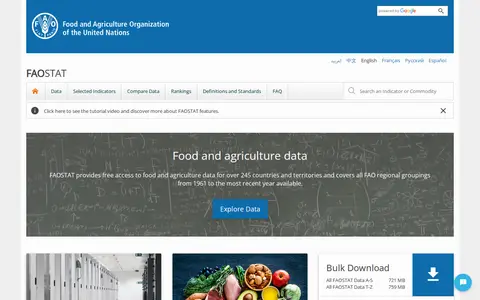
FAOSTAT is a database that provides free access to food and agriculture data for over 245 countries and territories. It covers all FAO regional groupings and includes data from 1961 up to the most recent year available. The service enables users to explore and analyze agricultural statistics globally.
Directory
Search results
Published directory entries matching your search.
Analyzes structured data and helps produce queries, insights or visualizations.
Documentation - Financial Data API.
A stock screener for investors and traders offering financial visualizations, with sections for stock and ETF screening, maps, charts, news, insider trading, futures, forex, crypto, watchlists and portfolios. An Elite tier is described as providing real-time data, technical charting, alerts and no ads.
Firecrawl is a web data API designed for AI agents. It allows searching and scraping web content, returning data in formats such as JSON and Markdown. The service also provides access to Alexandria’s providers and specialized indexes. Firecrawl is open source, used by over 150,000 companies, and announced a $75 million Series B funding round.
Apache Flink is a distributed data processing engine for stateful computations over data streams. It offers exactly-once state consistency, event-time processing, layered APIs including SQL on stream and batch data, and flexible deployment with savepoints. Its stated use cases include event-driven applications, stream and batch analytics, and data pipelines and ETL.
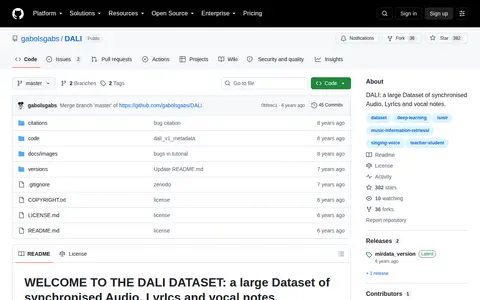
DALI is a dataset of synchronised audio, lyrics and vocal notes, presented as a collection of gz files. A Python package, dali_code, is stored in the repository for reading and working with the data; release versions are installable via pip. The dataset was created automatically using a teacher-student machine learning paradigm, described in an ISMIR 2018 paper.
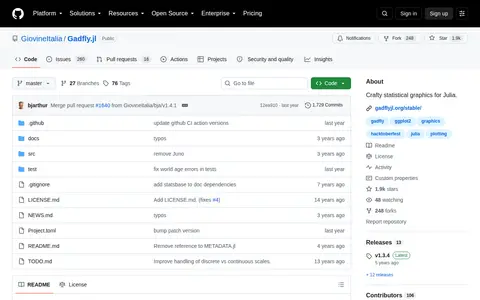
Gadfly is a Julia package for creating statistical graphics. Developed by GiovineItalia, it provides a grammar of graphics for generating visualizations in Julia. The repository includes documentation, examples, and installation instructions, and is open source.
Efficient pure-Matlab implementations of graph algorithms to complement MatlabBGL's mex functions.
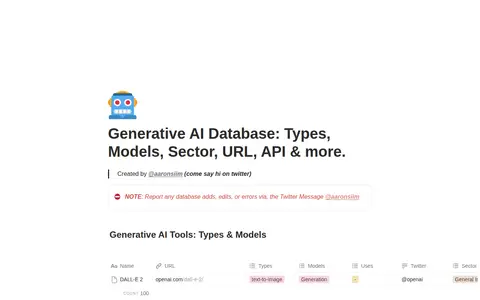
Generative AI Database is a Notion-based collaborative AI workspace built to align with an organization's existing context. It enables users to build and orchestrate AI agents directly alongside team projects, meetings, and connected applications.
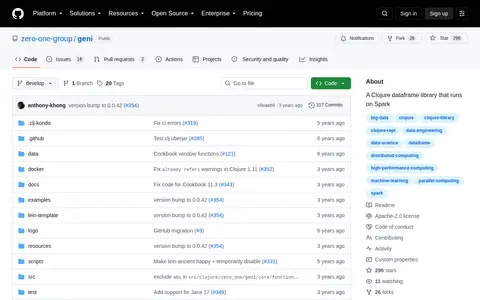
A Clojure dataframe library that runs on Apache Spark.
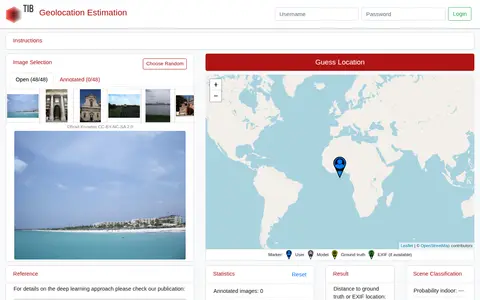
GeoEstimation is a tool for estimating the geolocation of photos. Users select an image from a predefined benchmark test set and click a world map to make a guess. Results are shown as a heat map of likely locations and a visualization of contributing photo parts, alongside scene classification probabilities for indoor, nature and urban settings.
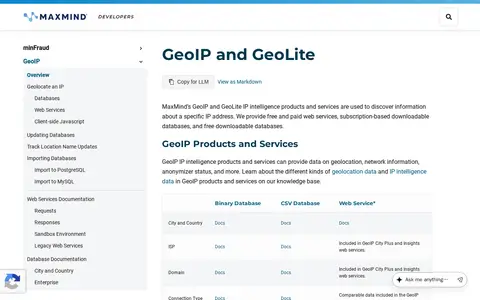
GeoLite databases and web services from MaxMind provide free geolocation and limited network data for IP addresses. The data is less accurate than MaxMind's paid GeoIP products. A free GeoLite account is required to download databases or query the web services, which use the same integration methods and documentation as GeoIP with minor modifications.
Right now, ChatGPT, Perplexity, Claude, and Gemini are answering questions about your industry. They.
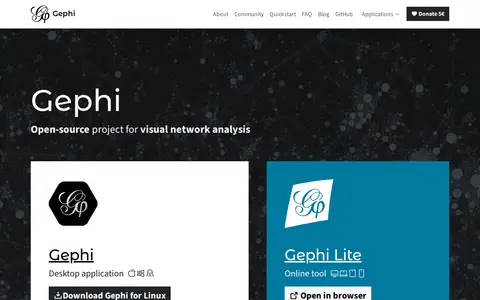
Gephi is free, open-source software for network visualization and analysis. It is available as a desktop application and as Gephi Lite in the browser. It includes algorithms for community detection, centrality measures and clustering, multiple layout algorithms, appearance customization and image exports. The source code is released under the GPL license.
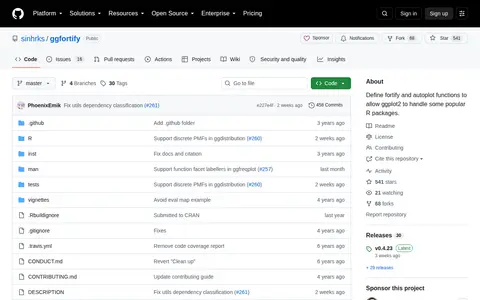
Unified interface to ggplot2 popular R packages.
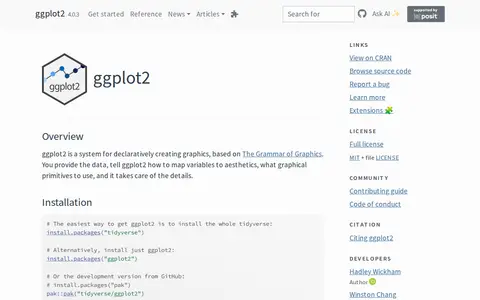
ggplot2 is a system for declaratively creating graphics, based on The Grammar of Graphics. Users provide the data and specify how variables map to aesthetics and which graphical primitives to use, and the system handles the details. It is described as over 10 years old, and installation is available through the tidyverse or as a standalone package.
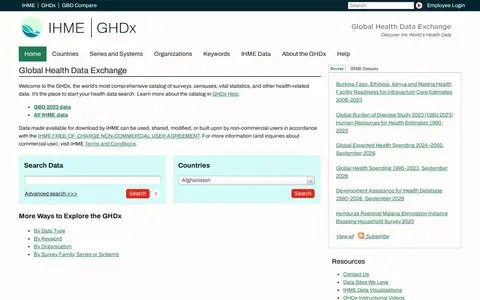
The Global Health Data Exchange (GHDx) is a catalog of global health and demographic data. It records information about data topics, links to data providers, and offers direct downloads where permission exists. The catalog covers surveys, censuses, vital statistics, registries, indicators, estimates, administrative health data, and health-related financial data. IHME-published data downloads may be used by non-commercial users under a free non-commercial user agreement.
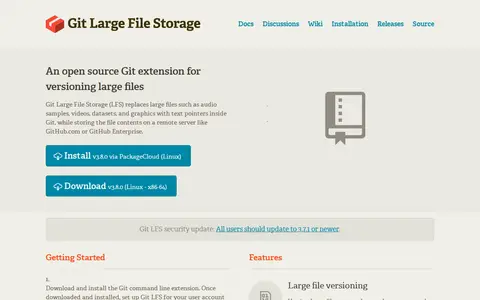
Git Large File Storage (Git LFS) is an open source Git extension for versioning large files. It replaces large files such as audio samples, videos, datasets, and graphics with text pointers inside Git while storing the file contents on a remote server like GitHub.com or GitHub Enterprise. Installation is available for Windows, Mac, and Linux. Tracking file types does not convert pre-existing files, which requires the git lfs migrate command.
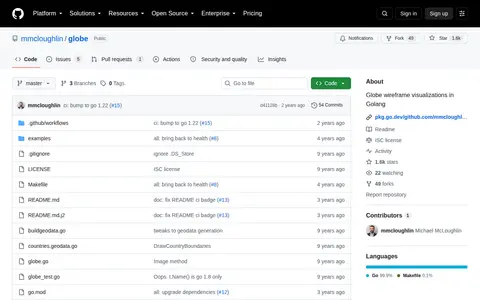
Globe is a Go library for wireframe globe visualizations, backed by pinhole. It can draw graticules, land and country boundaries, dots, lines along great circles, and rectangles, and save output as PNG. Users install it with go get, and the project is available under the ISC License.
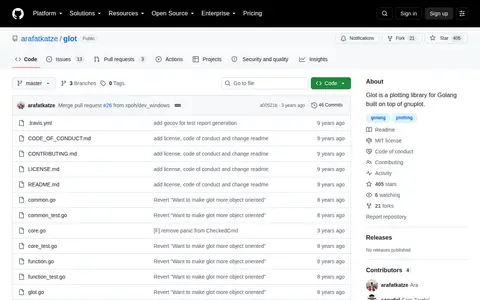
Glot is a plotting library for Golang built on top of gnuplot.
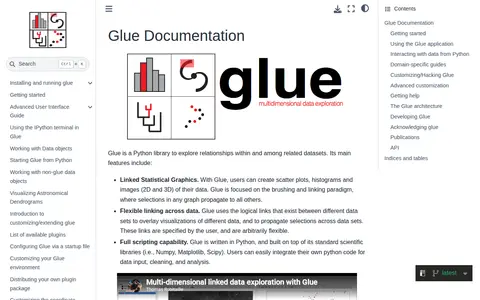
Glue is a Python library for exploring relationships within and among related datasets. It provides linked statistical graphics such as scatter plots, histograms and 2D and 3D images, with selections in one graph propagating to others. It supports user-specified links across datasets and scripting through Python's scientific libraries.
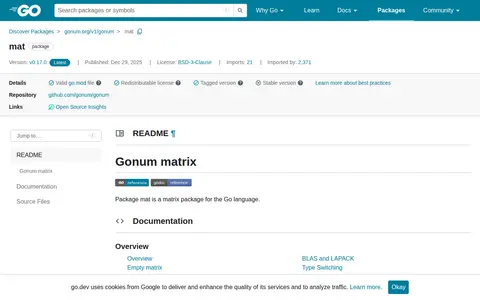
The mat package from Gonum provides implementations of float64 and complex128 matrix structures and linear algebra operations on them in Go. It offers interfaces for matrix classes, concrete implementations such as Dense and SymDense, methods for using matrix data, and types for matrix factorizations such as QR and LU.
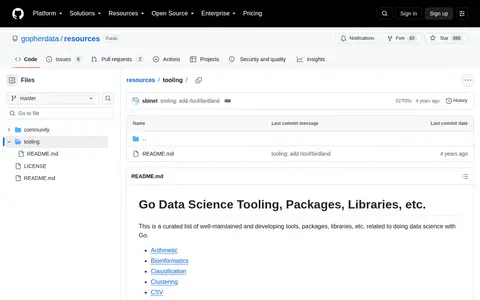
Gopherdata's tooling directory is a curated list of tools, packages, and libraries for doing data science with Go. It organizes resources across categories such as classification, clustering, CSV handling, distributed data analysis, geospatial work, machine learning, and plotting, and also lists proposed packages meant to fill gaps in the ecosystem.