worldwidescience.org
Federated search portal querying science databases and repositories across many countries.
Recently added
Browse dated community launches and imported or editorial directory additions.
Federated search portal querying science databases and repositories across many countries.
Explains federated searching across government science databases often described as the deep web.
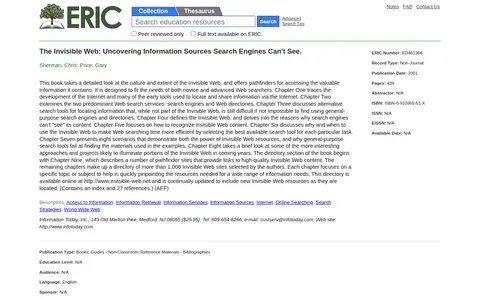
A 2001 book by Chris Sherman and Gary Price examining the nature and extent of the Invisible Web and offering pathfinders for accessing its content, aimed at novice and advanced web searchers. Chapters cover the development of the Internet, search engines and web directories, why search engines cannot see invisible web content, how to recognize it, and when to use it. A directory section lists more than 1,000 Invisible Web sites by topic.

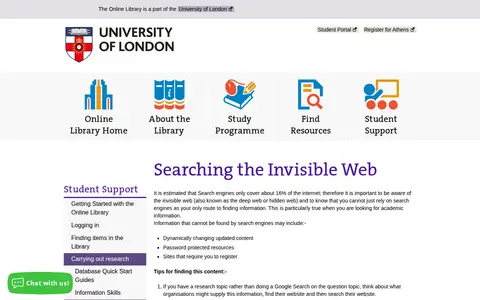
A library support page explaining the invisible web, also called the deep web or hidden web. It states that search engines cover about 16% of the internet and advises against relying on them alone, especially for academic information. It lists content search engines cannot find, such as dynamically changing content, password protected resources and sites requiring registration, and suggests web directories and asking a librarian.

Guide to search tools and databases that surface information outside conventional web indexes.

National Academies chapter explaining deep-web content, discovery limits and information retrieval.

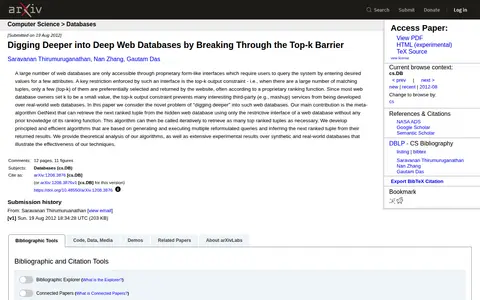
An arXiv paper on digging deeper into hidden web databases limited by the top-k output constraint. It presents the GetNext meta-algorithm, which retrieves the next ranked tuple through a restrictive interface without prior knowledge of the ranking function, and algorithms that generate and execute multiple reformulated queries. Theoretical analysis and experiments over synthetic and real-world databases are reported.

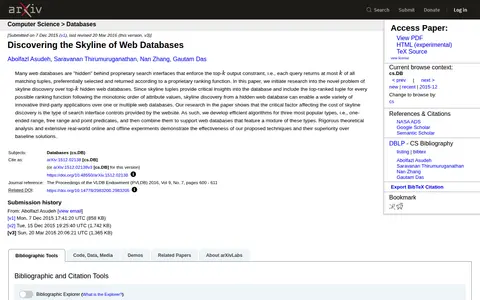
An arXiv paper on discovering skylines over hidden web databases whose search interfaces enforce a top-k output constraint. It examines how search interface controls affect discovery cost and develops algorithms for one-ended range, free range and point predicates, combined for mixed interfaces. Experiments over real-world online and offline databases are reported.

Explains how metadata and structured access affect discovery of database-backed and deep-web content.
National Transportation Library record for research on discovering and cataloging hidden-web resources.

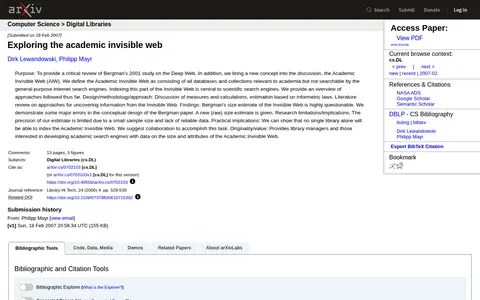
This arXiv paper by Dirk Lewandowski and Philipp Mayr provides a critical review of Bergman's 2001 study on the Deep Web. It introduces the concept of the Academic Invisible Web, defined as databases and collections relevant to academia but not searchable by general-purpose internet search engines, and reviews approaches for indexing it. The authors question Bergman's size estimate and suggest collaboration.

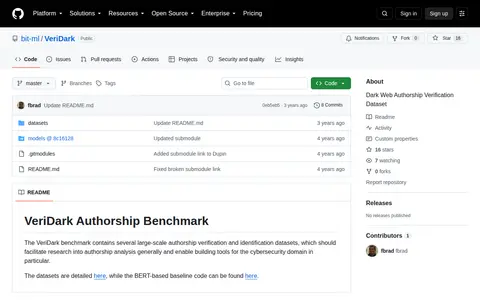
Research archive containing dark-web authorship verification datasets and baseline models.
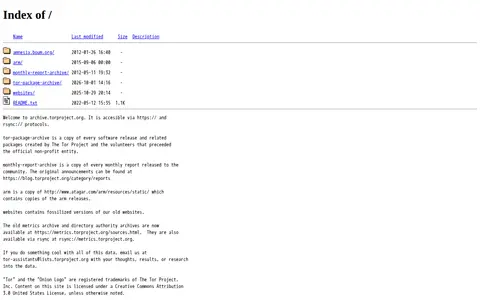
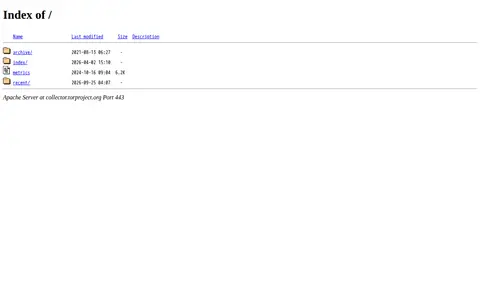
Official archive of older Tor software, websites, mailing lists, reports and project material.
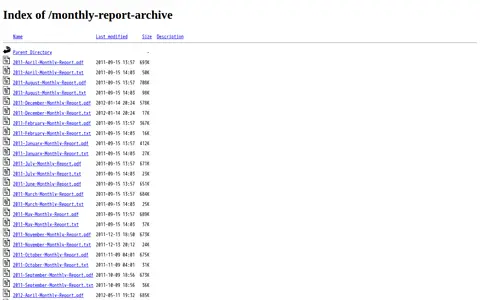
Archive of Tor Project monthly reports documenting development, research and community activity.
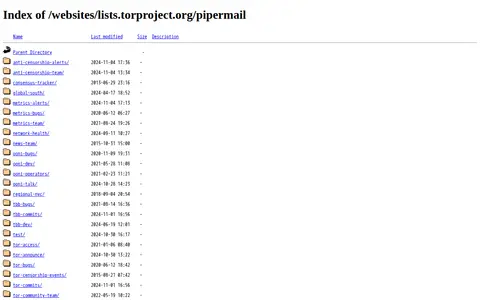
Historical public mailing-list messages documenting Tor development, research and relay operations.

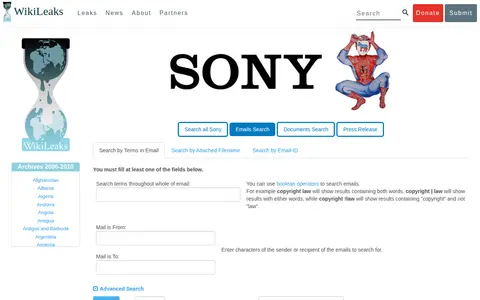
WikiLeaks archive for searching the Sony email release and related historical documents.

Historical visualization and research record mapping a sample of linked Tor onion services.
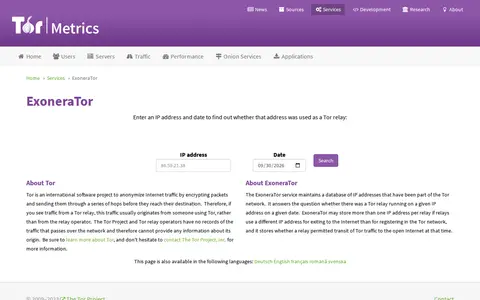
ExoneraTor is a Tor Metrics service that maintains a database of IP addresses that have been part of the Tor network. It answers whether a Tor relay was running on a given IP address on a given date. It may store more than one IP address per relay and records whether a relay permitted transit of Tor traffic to the open Internet at that time.
Public-interest archive preserving leaked and released datasets for journalism and historical research.
Official Tor archive providing recent and historical network descriptors for reproducible research.

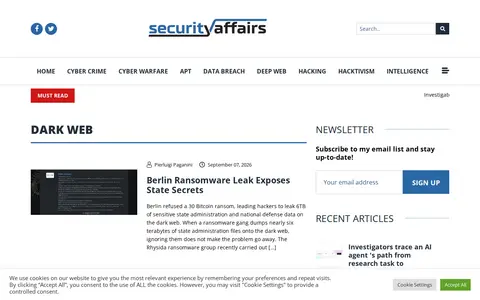
Reporting archive on dark-web crime, underground forums, data leaks and law-enforcement actions.

Research and explainers on dark-web investigations, criminal forums and threat-intelligence methods.

Insikt Group is the research unit of Recorded Future. It conducts research on cybercrime, state-sponsored threats and global issues, and supplies analyst-validated data, analytics and cyber and geopolitical intelligence to the Recorded Future Platform. Its resources include intelligence reports, threat briefings and information on threat actors.
Research article cataloging ransomware leak sites and explaining how their status is tracked.