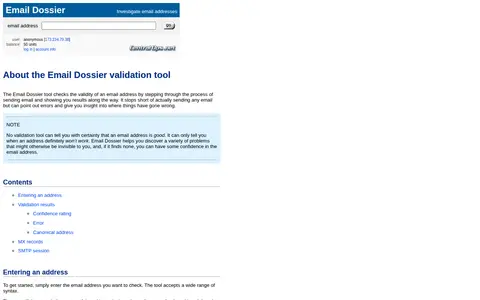
Email Dossier is a validation tool that checks an email address by walking through the process of sending email without actually sending any. It checks address syntax, looks up the domain's mail servers and tries contacting them. It reports a confidence rating from 0 to 3, error codes, a canonical address and MX records.
Directory
Search results
Published directory entries matching your search.
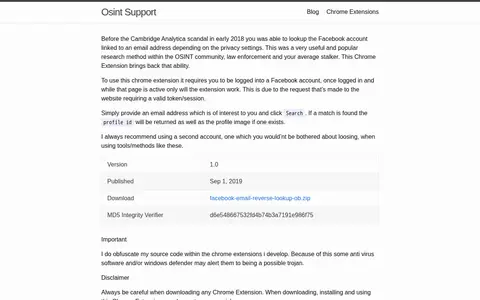
A Chrome extension that restores the pre-2018 ability to look up the Facebook account linked to an email address, subject to privacy settings. It requires the user to be logged in to a Facebook account while the page is active, and returns the profile ID and profile image when a match is found.

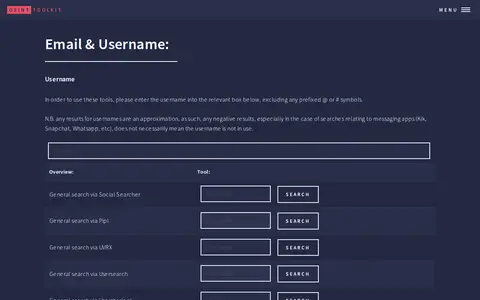
OSINT Toolkit provides email and username lookup tools. Users enter a username or email to run general searches, social media searches and messaging app searches. The site notes that username and email results are an approximation, so negative results do not necessarily mean an account is not in use.
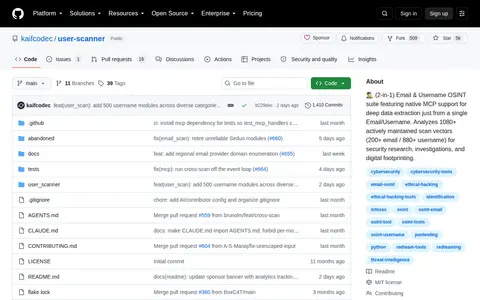
User Scanner is a two-in-one email and username OSINT suite with native MCP support. It performs deep data extraction from a single email or username, analyzing over 1080 maintained scan vectors, including more than 200 email and 880 username sources. It is intended for security research, investigations, and digital footprinting.
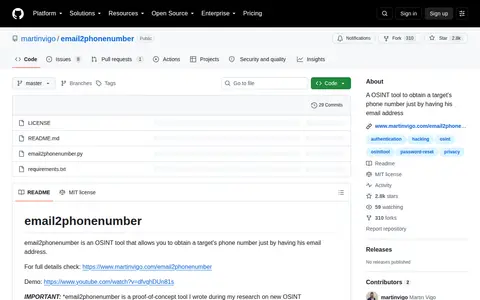
OSINT tool that helps derive possible phone numbers connected to an email using partial number clues.
Python tool for collecting email addresses from search engines and public web sources during authorized research.
DNSai is a collection of DNS and email security tools on one page. It covers DNS record lookups, WHOIS, blacklist checks, SPF, DKIM and DMARC builders and validators, email header analysis and bulk domain scanning. The tools return plain-English AI summaries, and each is available through an API and MCP connectors.
Reverse WHOIS lookup for finding domains connected to the same registrant, email, or ownership details.
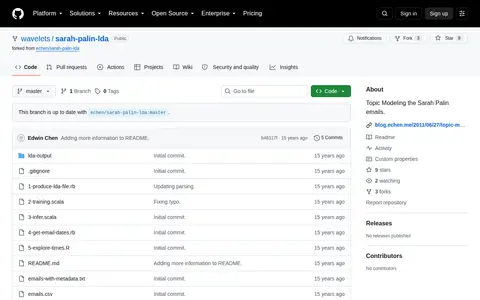
A GitHub repository for topic modeling the released Sarah Palin emails using latent Dirichlet allocation. It includes scripts to prepare the emails, train an LDA model with Stanford's TMT, infer topics, extract email dates, and explore topics over time. The repository also describes a demo email browser for viewing the organized documents.
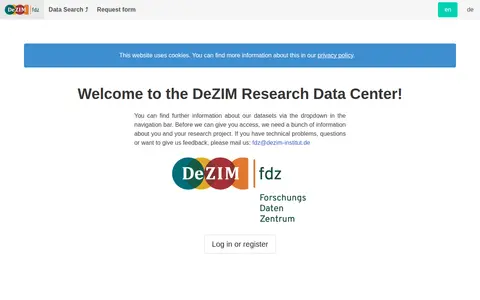
The DeZIM Research Data Center provides information about its datasets through a navigation dropdown. Access requires submitting information about the user and the research project, and technical problems, questions or feedback can be sent by email.
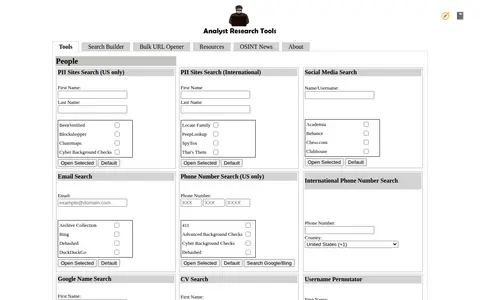
Analyst Research Tools is a collection of OSINT search links organized by category, including people, PII sites, social media, email, phone number, vehicle and username searches. It provides input forms for names, usernames, emails, phone numbers and other identifiers, alongside search builders, a bulk URL opener and the ability to select or deselect sites.
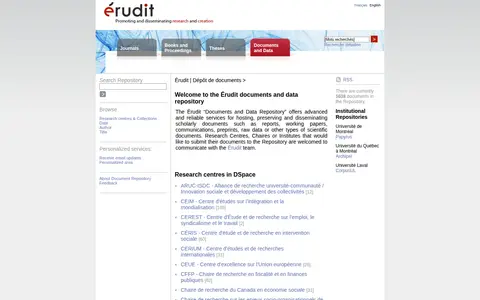
The Érudit Documents and Data Repository provides services for hosting, preserving and disseminating scholarly documents such as reports, working papers, preprints and raw data. Research centres, chairs and institutes may submit documents to the repository. It lists research centres in DSpace and offers detailed search, browsing by date, author and title, and personalized services including email updates.
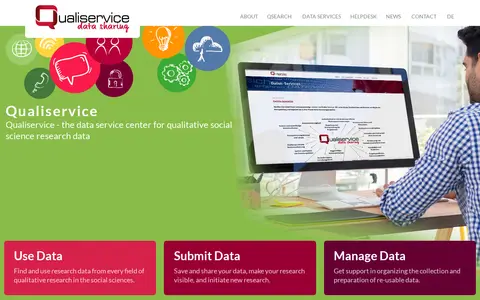
Qualiservice is a data service center for archiving and sharing qualitative research data in the social sciences. It lets researchers find and use qualitative research data from various fields, submit and share their own data, and get support in organizing the collection and preparation of reusable data. Contextual information is provided on a personalized basis, and the service is contactable by email.
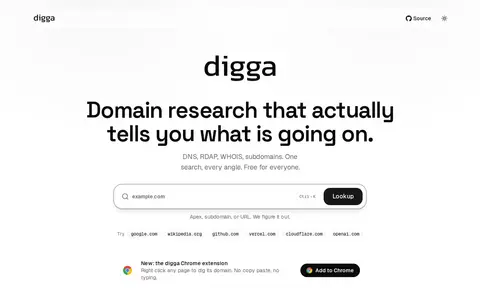
digga is a free domain and infrastructure research tool that looks up DNS records, RDAP and WHOIS data, subdomains, IP details and email authentication in one report. It supports many DNS record types and passive subdomain enumeration. The project is open source under AGPL 3.0 with no accounts or paywalls.
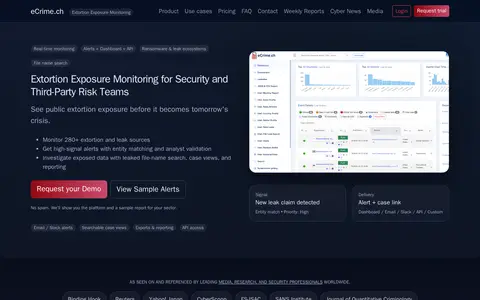
eCrime.ch is an extortion exposure monitoring platform for enterprise security, incident response and third-party risk teams. It detects, verifies and delivers ransomware and data-leak signals with context such as entity mapping, artifacts, links and timelines. The site states it monitors 280+ extortion and leak sources and delivers alerts through dashboard, email, Slack, API and reports. A REST API provides tracker, intelligence, file-search, screenshot, actor, leak-site and torrent-monitoring data.
Odysseus is a self-hosted AI workspace for running language models on one's own hardware. It offers chat, autonomous agents, tools and MCP connections, model serving, an email assistant, deep research, model comparison and persistent memory. The project is described as local-first and privacy-first, with no telemetry.
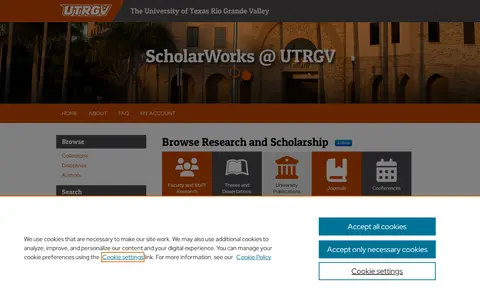
ScholarWorks @ UTRGV is the open-access institutional repository of the University of Texas Rio Grande Valley, operated by the university library. It collects and provides access to faculty research, graduate theses and dissertations, and Special Collections materials such as historical documents, oral histories, maps, and photographs. Content can be submitted by email or deposited through departmental faculty collections.
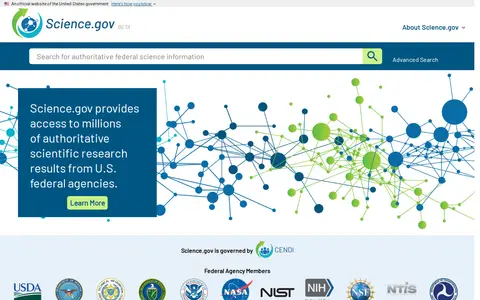
Science.gov is a gateway to government science information from U.S. Government science agencies. It provides access to millions of authoritative scientific research results, including research and development outputs. Users can search across multiple databases, view results ranked by relevance, and access bibliographic citations, abstracts, and often full-text documents. Advanced search allows field-specific queries and source filtering. Format tabs and result actions such as download, print, and email are available.
Vellum is a personal AI assistant available locally or in the cloud, with long-term memory across conversations. It can send emails, manage calendars, browse the web, create slides, write code, run research, and execute recurring background tasks. It offers fine-grained permissions requiring approval for high-stakes actions until marked trusted. Two plans exist: Base (free) and Pro packages Mighty, Super, and Ultra.
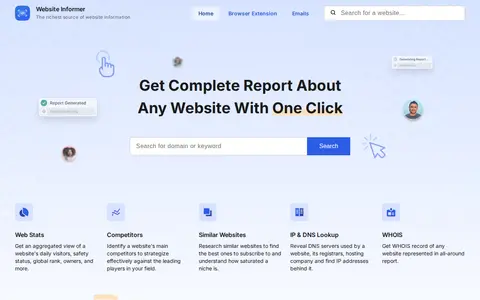
Website.informer offers a free aggregated report on any domain, including WHOIS, visitors, IP and DNS details, competitors, and owners. It provides website statistics such as daily visitors, safety status, and global rank, plus competitor and similar-site research. It also offers IP and DNS lookup, WHOIS records, a browser extension for website analysis and security checks, and email-to-domain matching from WHOIS data.
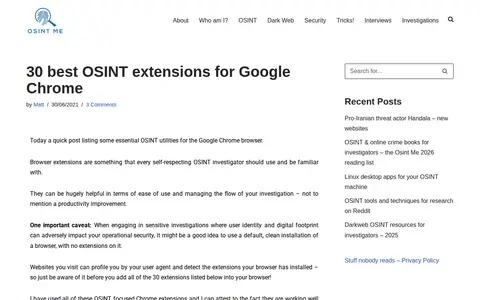
A blog post listing OSINT utilities for the Google Chrome browser. It states that browser extensions can aid investigators, recommends a clean browser installation for sensitive investigations, and includes items such as Exif Viewer Pro, Hunter Email Finder, and Instant Data Scraper.
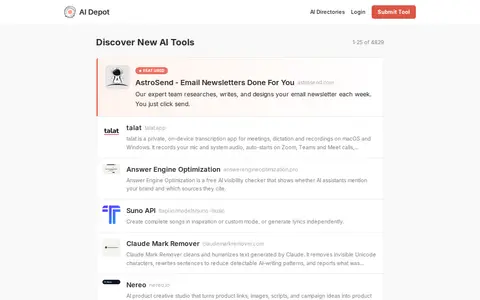
A directory of AI tools that lists featured products with short descriptions and links. Featured entries include email newsletter services, video editing, image watermark removal, AI visibility trackers, transcription and text humanizing tools. The page shows 1-25 of 4832 tools.
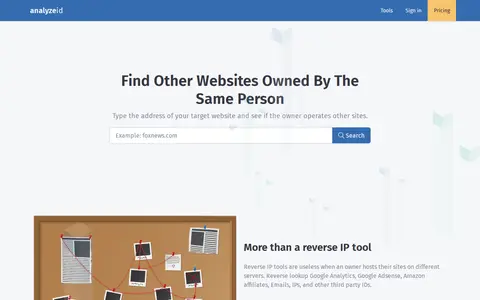
AnalyzeID is a reverse lookup tool that searches Google Analytics, Google Adsense, Amazon affiliate, email, IP and other third-party IDs to find other websites owned by the same person. The site lists uses such as researching site owners, checking whether sellers are mass producing sites, and finding money sites. It presents itself as more than a reverse IP tool when owners host sites on different servers.
The Australian National University is a university offering study options for undergraduate, postgraduate, postgraduate research and prospective international students. Its students use online platforms including Canvas as the learning management system, email, student records and course timetables whether on campus or studying remotely.