
planetebook.com
Planet eBook helps search books, ebooks, papers, library records, or reading archives.
Directory
Published directory entries matching your search.
Planet eBook helps search books, ebooks, papers, library records, or reading archives.

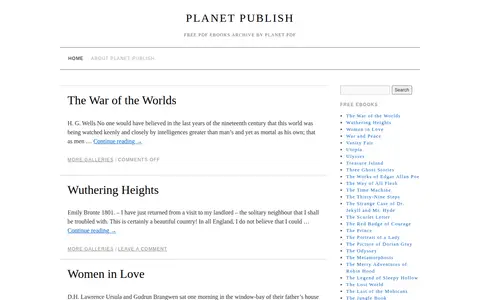
Planet Publish is a free PDF eBooks archive by Planet PDF. It hosts full texts of classic works, including The War of the Worlds, Wuthering Heights, Women in Love, War and Peace, Vanity Fair, Utopia, Ulysses, Treasure Island and Three Ghost Stories.

A globe visualization created by Nadieh Bremer and commissioned by Planet. It shows the locations of photos taken by Planet's satellites, and the page states that the desktop version shows 100% of the photos.
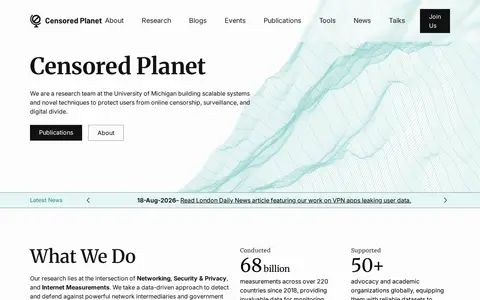
Censored Planet helps search books, ebooks, papers, library records, or reading archives.
Anime-Planet is a site for discovering anime and manga, tracking progress, and receiving personalized recommendations. It shows popular anime and manga this week, newest recommendations based on titles liked, and current anime listings.

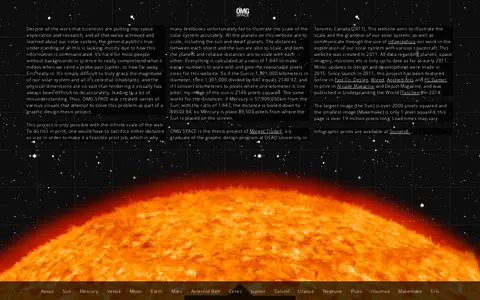
OMG SPACE is a series of visuals created as a graphic design thesis project to illustrate the true scale of the solar system. All planets, including the sun and dwarf planets, are shown to scale, as are their distances from the sun, at a ratio of 1:647. Created in 2011 by Margot Trudell, the site's data is only current to early 2011, with minor design and development updates in 2015.

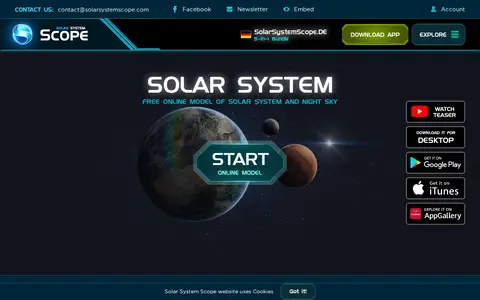
Solar System Scope is an online 3D simulation of the Solar System and night sky in real time, showing the Sun, planets, dwarf planets, comets, stars and constellations. It also offers a free model of the Solar System and night sky with accurate positions of objects. A desktop version and an Android app are available.
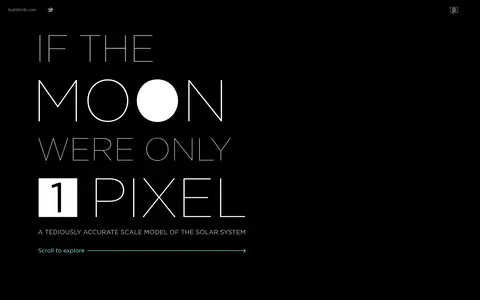
A web page that maps the solar system to scale with the Moon at one pixel. It presents the Sun, planets and some moons in sequence across a long scroll, with notes on the large distances between them. It states that distances shown are averages and depend on orbital positions.

Celestia is a free space simulator that provides real-time 3D visualization of space. It displays objects and orbits based on scientific data and runs on Windows, Linux, macOS, iOS and Android. Users can travel through the solar system, to over 100,000 stars, or beyond the galaxy. Its catalogues are expandable with add-ons, and users can create their own objects and planetary systems.
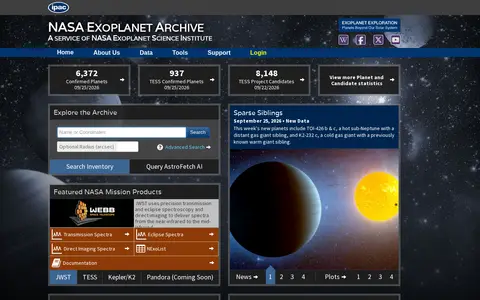
A service of the NASA Exoplanet Science Institute that hosts data on confirmed planets and candidates, including TESS, Kepler/K2 and JWST products. It provides search and query tools, mission data holdings, and AstroFetch, an AI assistant that answers natural-language questions using archive data.

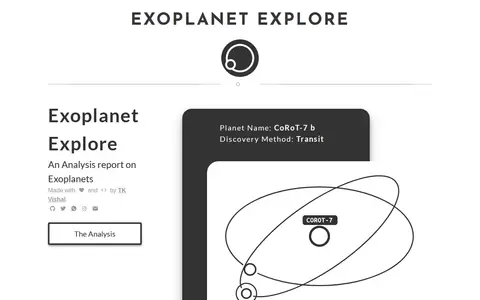
Exoplanets Explore is an interactive data visualisation about exoplanets by TK Vishal. It includes an analysis report, planet names with discovery methods, and comparisons of features such as the largest and smallest known planets.

In-The-Sky.org provides astronomy news and interactive guides to the night sky. The site offers a planetarium, sky guide, weather forecast, object search and catalogs, an orrery and 3D universe views. It also lists events such as oppositions, occultations and meteor showers, with rise and set times shown for a selected location.
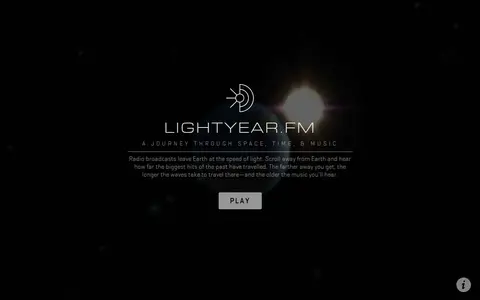
Lightyear.fm is a browser-based visualization that depicts radio broadcasts leaving Earth at the speed of light and traveling outward into space. Scrolling away from Earth shows how far past hits have traveled, with more distant points carrying older music. It includes planet and star data and notes that many stars were removed for display purposes and radii are not accurate.

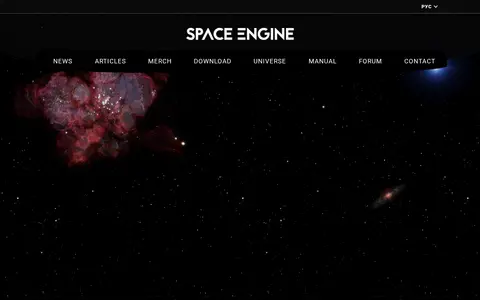
SpaceEngine is a virtual universe simulator for computers. Users can travel from star to star and galaxy to galaxy, landing on planets, moons and asteroids, and can alter the speed of time. Real celestial objects appear alongside procedurally generated regions based on scientific knowledge.

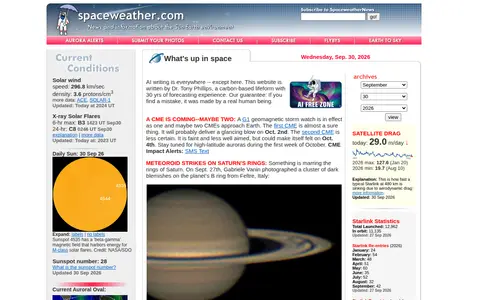
SpaceWeather.com presents news and information about solar flares, geomagnetic storms, auroras, meteor showers, and near-Earth asteroids. The page displays current solar wind speed and density, X-ray solar flare levels, the daily Sun image, sunspot number, auroral oval, planetary K-index, and interplanetary magnetic field data.
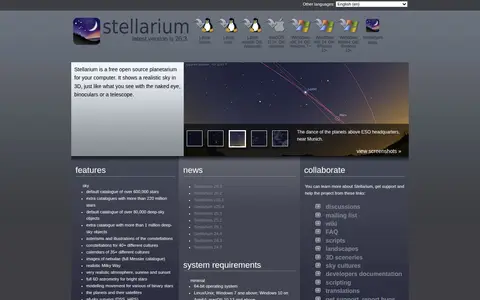
Stellarium is a free open source planetarium for computers. It shows a realistic sky in 3D, as seen with the naked eye, binoculars or a telescope, and offers time control, telescope control and a plugin system. The site describes it as easy to use and provides a features list and system requirements.

TheSkyLive provides information about celestial objects and tools for exploring and observing the night sky. It includes star maps, a 3D Solar System viewer, visibility listings for planets, comets and asteroids, and guides to eclipses and the Moon. Users can set an observing location, and without one the site defaults to Greenwich.

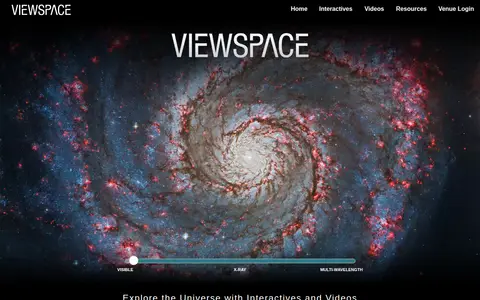
ViewSpace is a free, web-based collection of astronomy and Earth science videos and interactives. It offers image tours, image sliders, and a video library that let users explore the planet, solar system, galaxy, and universe. The project is developed by the Space Telescope Science Institute with NASA support and has been exhibited in museums, planetariums, and science centers since 2000.