


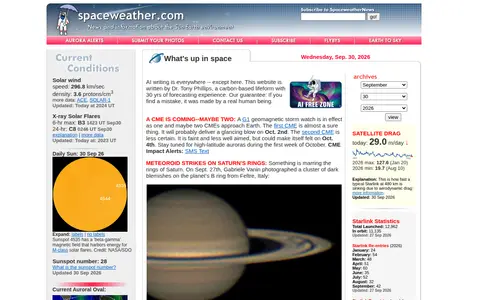
SpaceWeather.com presents news and information about solar flares, geomagnetic storms, auroras, meteor showers, and near-Earth asteroids. The page displays current solar wind speed and density, X-ray solar flare levels, the daily Sun image, sunspot number, auroral oval, planetary K-index, and interplanetary magnetic field data.
TheSkyLive
TheSkyLive provides information about celestial objects and tools for exploring and observing the night sky. It includes star maps, a 3D Solar System viewer, visibility listings for planets, comets and asteroids, and guides to eclipses and the Moon. Users can set an observing location, and without one the site defaults to Greenwich.
Screenshot unavailable. The listing stays available while a preview is prepared.
Features
- comprehensive information about the most interesting celestial objects Source: theskylive.com
Links
Tags
-
0SpaceWeather.com presents news and information about solar flares, geomagnetic storms, auroras, meteor showers, and near-Earth asteroids. The page displays current solar wind speed and density, X-ray solar flare levels, the daily Sun image, sunspot number, auroral oval, planetary K-index, and interplanetary magnetic field data.
-
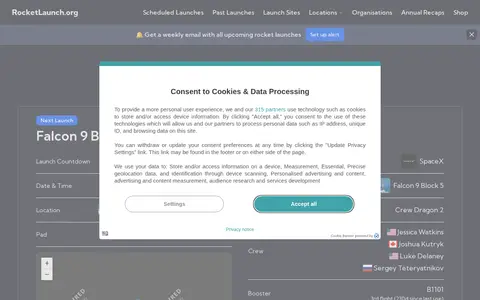
0RocketLaunch.org lists rocket launches scheduled for the day, including launches from SpaceX, NASA and other agencies. It provides live updates, videos, mission details and a live countdown, and offers pages for past launches, scheduled launches, launch sites and launch providers.
-
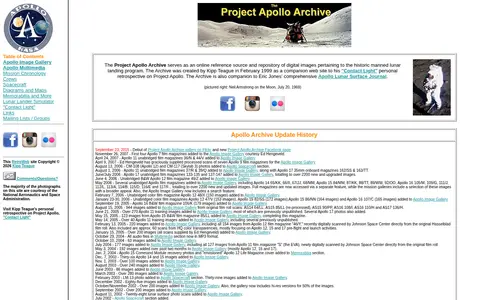
0The Project Apollo Archive is described as one of the web's earliest repositories of high-quality images associated with NASA's historic manned lunar landing program. The page states that it requires browser support for frames and JavaScript.
-
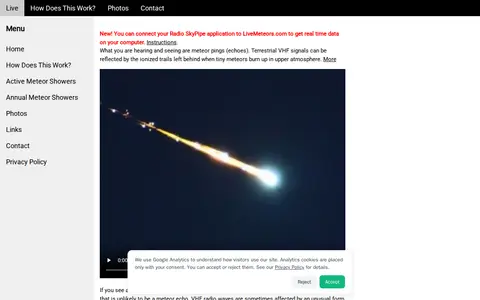
0LiveMeteors.com lets listeners hear live meteor radio echoes, described as meteor pings while meteors strike Earth's atmosphere. Terrestrial VHF signals can be reflected by ionized trails left when tiny meteors burn up in the upper atmosphere. The site notes that strong continuous signals lasting more than a minute are unlikely to be meteor echoes, and that Sporadic E propagation can prevent detection.
-
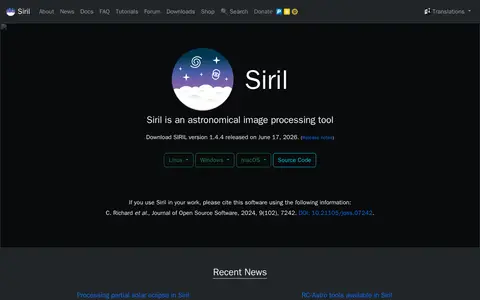
0Siril is an astronomical image processing tool. It supports preprocessing steps such as calibration, stacking and enhancement, and tools for analyzing star brightness variation and astrometry. It can process SER videos and FITS cubes, and algorithms run on all computer cores. Versions are offered for Linux, Windows and macOS.
-
0A beta interactive astronomy calendar that lists meteor showers, conjunctions and eclipses and gives moon and sun rise and set times for each day of the year, adjusted to the user's location. The site also describes a printed wall calendar with astronomical times customized to each user's location.
Community notes
Reviews and discussion
No reviews yet
Be the first to share how this project worked for you.
Join the discussion
Sign in with a verified account to leave a review or join the discussion.
Sign in to review