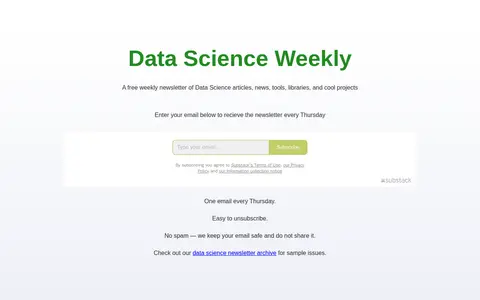

Data Science Weekly is a free weekly data science newsletter published by DATAYOU, LLC. It delivers curated data science news, articles, job listings, tutorials, and learning resources to subscribers every Thursday. The service also maintains an archive of past newsletter issues and offers additional data science guides and course materials on its website.
Directory
Search results
Published directory entries matching your search.
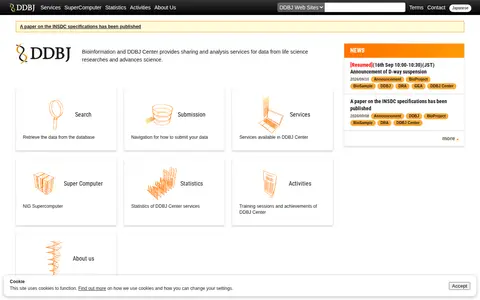
The DNA Data Bank of Japan (DDBJ) is a center that provides sharing and analysis services for life science research data, aligned with INSDC specifications. It offers search and submission functions for biological data, access to a supercomputer, training sessions, service statistics, and resources including BioProject, BioSample and DRA databases, alongside operational news and updates.
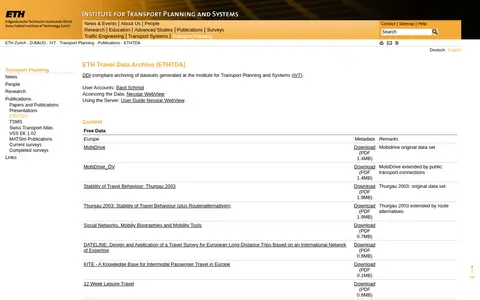
A virtual platform for travel data established in 2002 at ETH Zurich's Institute for Transport Planning and Systems. It lets end users browse archived travel data over the web and perform simple statistical analysis. The archive provides information on travel data developed or analysed at the institute, including details of the originating travel survey, and is built around the NESSTAR system.
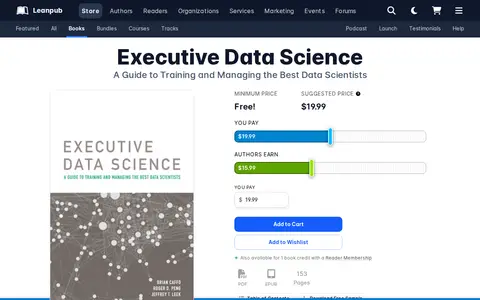
A book by Brian Caffo, Roger D. Peng and Jeffrey Leek on assembling and leading a data science enterprise, based on the Johns Hopkins Executive Data Science Specialization. It covers a crash course in data science, recruiting and evaluating a team, and the structure of the data science pipeline. Available as PDF and EPUB; printed copies are sold through Lulu.
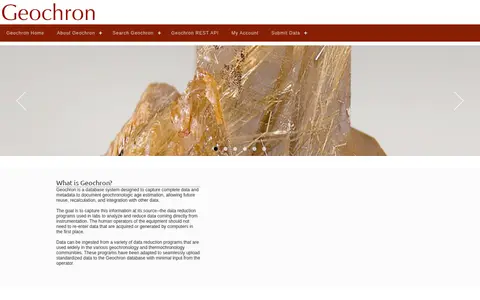
Geochron is a database system for capturing data and metadata documenting geochronologic age estimation, enabling future reuse, recalculation and integration. Data can be ingested from data reduction programs used in geochronology and thermochronology communities, which are adapted to upload standardized data to the database. A REST search service accepts GET variables such as geographic bounds, ages, analysis method, material, rock type and laboratory.
An article comparing the roles of data scientist and data engineer. It states that the positions are sometimes confused for each other and are often treated as the same, though the two roles work together. It notes that companies can encounter problems with team efficiency and system performance when the roles are conflated, and that the average company needs far more data engineers.
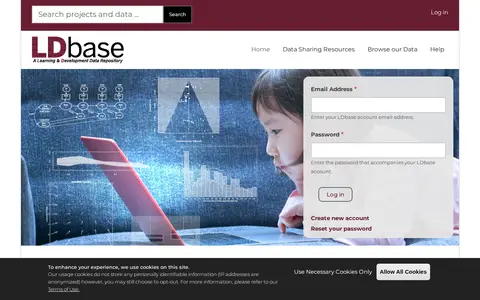
LDbase is an open science data repository for the educational and developmental science communities. It provides a secure platform to store and access research data, alongside resources related to data management and analysis. Unlike dataset-oriented repositories, LDbase is structured around projects to align with the workflows of its target field. Users can browse data, search for projects, start new projects, and access support via regular virtual office hours.
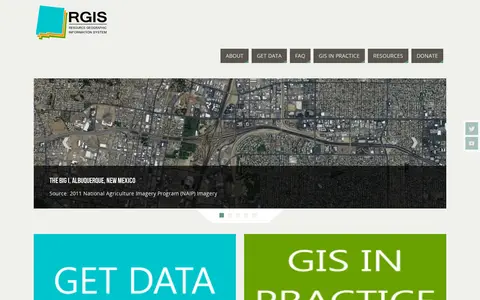
The New Mexico Resource Geographic Information System Program provides a data portal for GIS information. Its Image Archive Program, maintained by the Earth Data Analysis Center at the University of New Mexico, hosts historical aerial photography data for New Mexico and the US Southwest, alongside space shuttle imagery, satellite imagery, topographic maps, and digital data.
An ArcGIS Hub open data portal for North Lanarkshire Council. It offers data discovery, analysis and download in formats including CSV, KML, Zip, GeoJSON, GeoTIFF and PNG, with API links for GeoServices, WMS and WFS. Users can analyze data with charts and thematic maps and create StoryMaps and Web Maps.
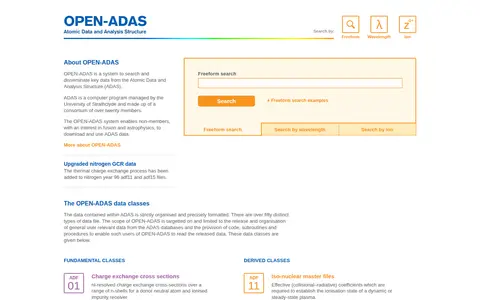
OPEN-ADAS is a system for searching and distributing key data from the Atomic Data and Analysis Structure (ADAS), a computer program managed by the University of Strathclyde. It allows non-members interested in fusion and astrophysics to download and use ADAS data. The service supports searches by freeform text, wavelength and ion, and covers numerous data formats.
An ArcGIS Hub open data portal from Ottawa Riverkeeper for discovering, analyzing and downloading data. Data can be downloaded in CSV, KML, Zip, GeoJSON, GeoTIFF or PNG, and API links are provided for GeoServices, WMS and WFS. Analysis is available through charts and thematic maps, with options to create StoryMaps and Web Maps.
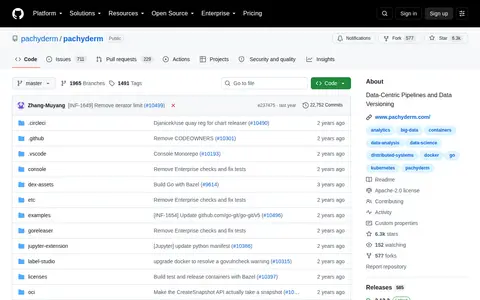
Pachyderm is a project for data-centric pipelines and data versioning. It provides parallelized processing of multi-stage, language-agnostic pipelines with data versioning and data lineage tracking, and pipelines trigger automatically when data changes. It runs on Kubernetes and uses standard object stores for storage.
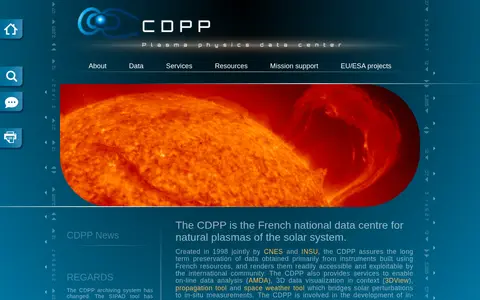
The CDPP is the French national data centre for natural plasmas of the solar system. Created in 1998 by CNES and INSU, it preserves data primarily from instruments built using French resources and makes them accessible to the international community. It also offers online services including data analysis, 3D visualisation, a propagation tool and a space weather tool.
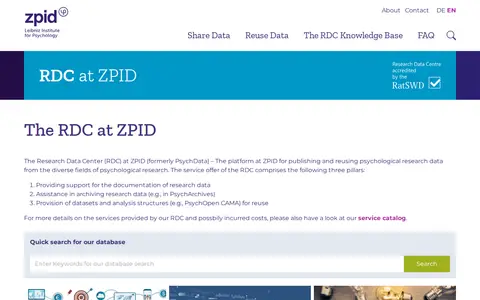
The Research Data Center at ZPID is a platform for publishing and reusing psychological research data across fields of psychology. It offers support for documenting research data, assistance archiving data in PsychArchives, and provision of datasets and analysis structures such as PsychOpen CAMA for reuse.
The SCC Open Data Site is an ArcGIS Hub platform that provides access to downloadable datasets in formats including CSV, KML, Zip, GeoJSON, GeoTIFF and PNG. It offers API links for GeoServices, WMS and WFS, supports data analysis with charts and thematic maps, and enables users to create StoryMaps and Web Maps using the available data.
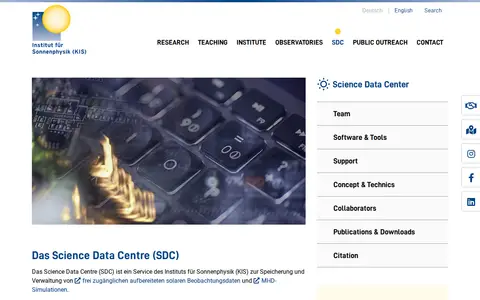
The Science Data Centre (SDC) of the Leibniz-Institute for Solarphysics is a service for storing and managing openly accessible processed solar observation data and MHD simulations. It focuses on curation, archiving and distribution of ground-based solar data from telescopes at the El Teide Observatory on Tenerife, and on developing pipelines and analysis tools. An online archive is available.
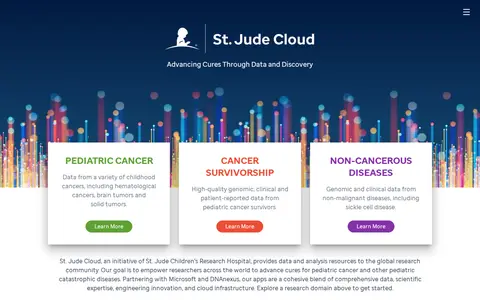
St. Jude Cloud is a pediatric catastrophic disease data sharing ecosystem created by St. Jude Children's Research Hospital. It provides data and analysis resources to the global research community, including genomic data on pediatric cancers, cancer survivorship and non-cancerous diseases. Its applications cover a genomics platform, a pediatric cancer knowledge base, visualizations, and patient-derived xenograft data.
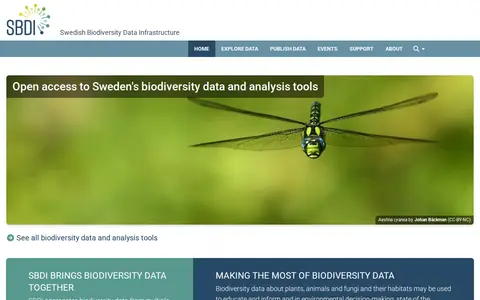
The Swedish Biodiversity Data Infrastructure (SBDI) is a national initiative that aggregates biodiversity data from multiple sources and makes it available and usable online. It also provides analysis tools and hosts events for researchers working with biodiversity data.
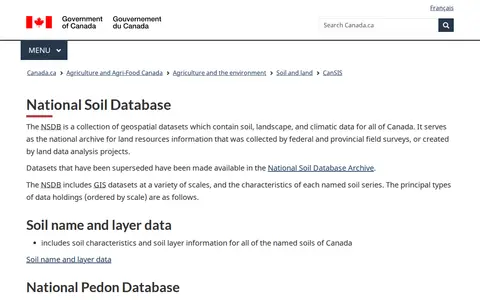
The National Soil Database is a collection of geospatial datasets containing soil, landscape, and climatic data for all of Canada. It serves as the national archive for land resources information collected by federal and provincial field surveys or created by land data analysis projects, including soil name and layer data, pedon data, and soil landscape grids.
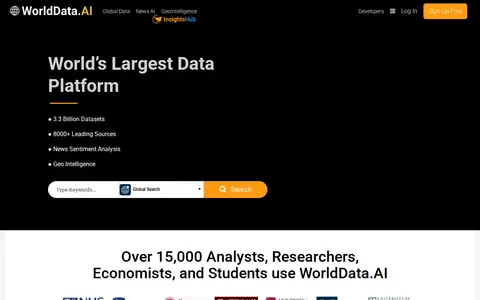
WorldData.AI is a data platform that aggregates curated data from public sources. It combines datasets, news analysis and location-based data in a single search interface. The site lists a free trial plan with 8000 credits per month, limited access to Global Data, News AI and Geo Intelligence, and a bulk download limit of 250 datasets.
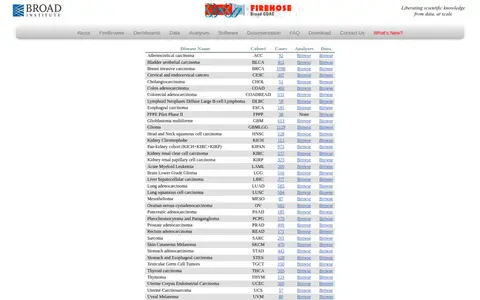
Broad GDAC Firehose is a portal listing cancer disease cohorts, such as adrenocortical carcinoma and bladder urothelial carcinoma, with case counts and links to browse analyses and data. Downloading primary data and analysis results constitutes agreement to adhere to TCGA guidelines on responsible data use.
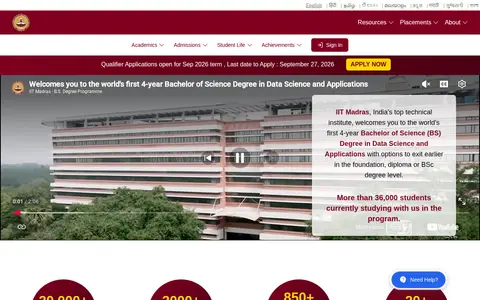
The Indian Institute of Technology Madras offers the BS in Data Science & Applications, a web-enabled undergraduate program focused on data science and programming. Learners may earn a Bachelor’s degree (BS or BSc, based on completed credits) or a diploma in Programming or Data Science upon successful completion of required courses. The program has no age limit, offers scholarships, and provides academic resources in multiple Indian languages.
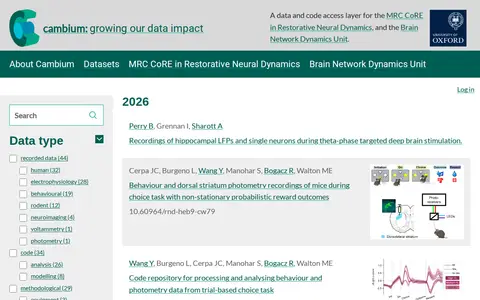
Cambium is a data and code access layer operated by the MRC Brain Network Dynamics Unit, supporting the MRC CoRE in Restorative Neural Dynamics. It hosts research outputs including datasets and code resources affiliated with the unit's research groups, covering data types such as recorded data, analysis code, modelling materials, and methodological documentation. The platform provides search functionality for these resources.
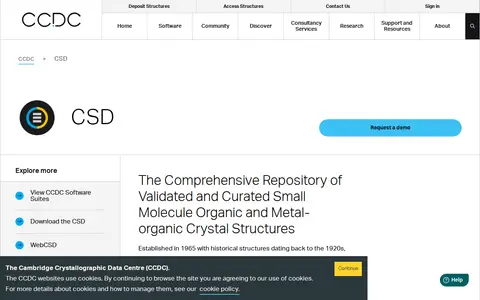
The Cambridge Structural Database (CSD), maintained by the Cambridge Crystallographic Data Centre, is the largest curated crystal structure database. It supports structural chemistry research across fields including drug discovery, solid form analysis, and functional materials design, with associated software tools for searching, analysing, and working with crystal structure data. The platform also offers community resources, training support, and data deposit services.