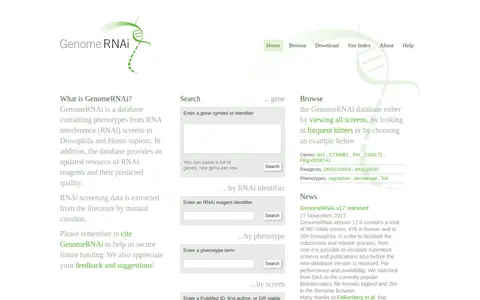
GenomeRNAi is a database of phenotypes from RNA interference screens in Drosophila and Homo sapiens. It also provides a resource of RNAi reagents and their predicted quality. Screening data is extracted from the literature through manual curation. The database supports searching by gene, RNAi identifier, phenotype or screen, and browsing by screens or frequent hitters.
Directory
Search results
Published directory entries matching your search.
Geochron is a database system for capturing data and metadata documenting geochronologic age estimation, enabling future reuse, recalculation and integration. Data can be ingested from data reduction programs used in geochronology and thermochronology communities, which are adapted to upload standardized data to the database. A REST search service accepts GET variables such as geographic bounds, ages, analysis method, material, rock type and laboratory.
GeoReM is a geochemical database previously managed by the Max Planck Institute for Chemistry in Mainz. The database has moved and is under reconstruction, now managed through a collaboration between the International Association of Geoanalysts (IAG) and the Digital Geochemical Infrastructure project (DIGIS) at the University of Göttingen.
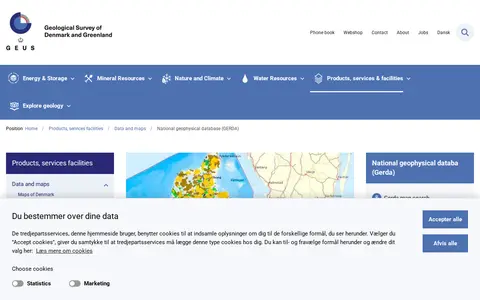
GERDA is the national geophysical database for surface-near geophysics. It provides information about its stored data, supported exchange formats, and options for data download and upload. The database covers geoscience topics including deep and shallow geothermal energy, reservoir characterisation, hydropower, seismology, marine-physical planning, oil and gas, economic geology, and Greenland's mineral resources.
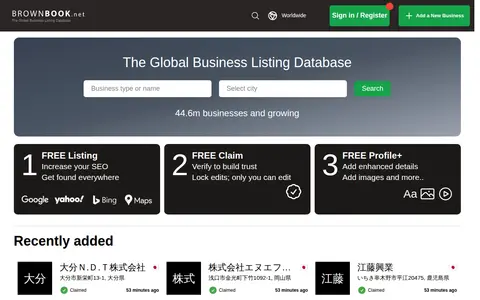
Brownbook is a global business listing database. It offers free business listings for search engine optimization and to help businesses get found on search engines including Google, Yahoo, Bing, Ask, and AOL. Users can also use free claim and free profile options to add enhanced details and images to their listings. The database contains over 44.6 million businesses and is growing.
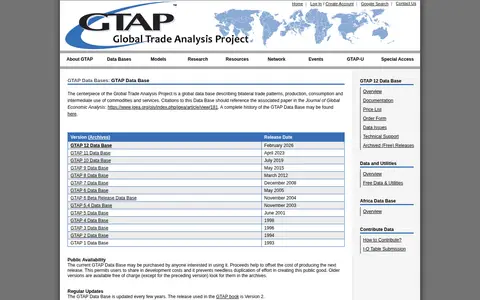
The Global Trade Analysis Project maintains a global database describing bilateral trade patterns, production, consumption and intermediate use of commodities and services. The current database may be purchased; older versions are available free of charge except for the preceding version. It is updated every few years.
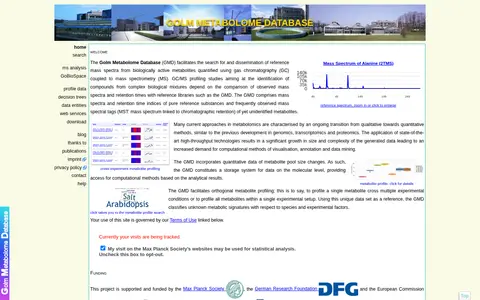
The Golm Metabolome Database (GMD) is a resource for searching and disseminating mass spectra from biologically active metabolites quantified using GC-MS. It offers search, MS analysis, library search, prediction and related data access.
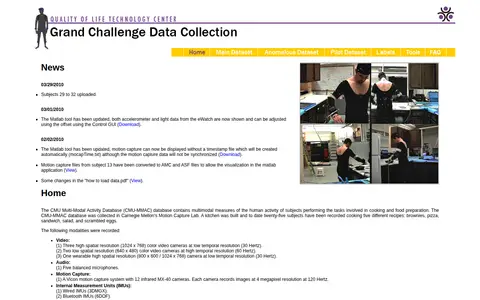
The CMU Multi-Modal Activity Database (CMU-MMAC) holds multimodal recordings of subjects cooking and preparing food, collected in Carnegie Mellon's Motion Capture Lab. The database includes video, audio, motion capture, IMU and wearable device data across three datasets. It lists a technical report, a Matlab tool and download and viewing options.
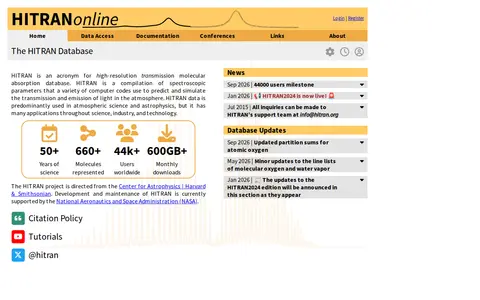
HITRANonline is a web interface to the HITRAN database, a compilation of high-resolution spectroscopic parameters used by computer codes to predict and simulate atmospheric transmission and emission of light. The database is chiefly applied in atmospheric science and astrophysics. The site provides data access, documentation, cross-section definitions, tutorials and citation policy.
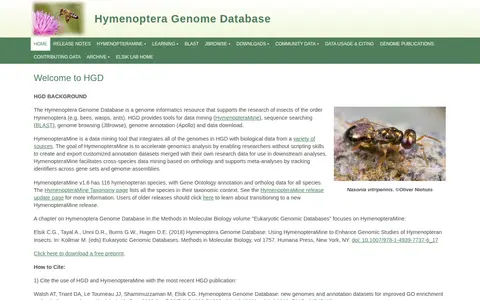
Hymenoptera Genome Database is a genome informatics resource for insects of the order Hymenoptera, such as bees, wasps and ants. It offers data mining through HymenopteraMine, sequence searching with BLAST, genome browsing in JBrowse, annotation in Apollo and data download. HymenopteraMine integrates all HGD genomes with biological data from various sources.
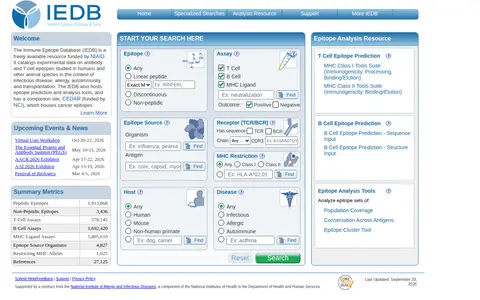
The Immune Epitope Database (IEDB) is a free public resource for searching and exporting immune epitope data. It hosts more than 95% of all published epitope data related to infectious diseases, allergies, autoimmune conditions, and transplant research, and also provides epitope prediction tools.
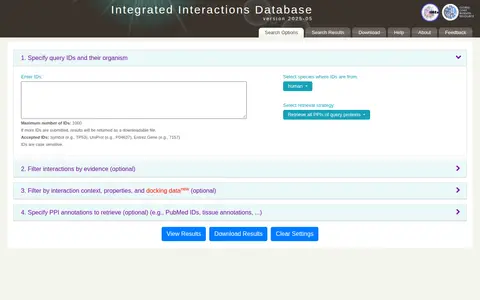
The Integrated Interactions Database (IID) is a resource for protein-protein interaction (PPI) data. It allows users to submit up to 1000 protein identifiers, including gene symbols, UniProt IDs, and Entrez Gene IDs, along with the source organism, to retrieve PPIs. Users can filter results by evidence source, including experimental and predicted data, and set minimum thresholds for experimental evidence. Retrieved results can be downloaded.
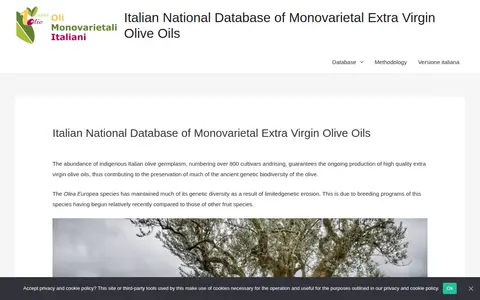
A national database of monovarietal extra virgin olive oils from Italy. It covers the country's olive germplasm, numbering over 800 cultivars, and describes how genotype affects the chemical and sensory characteristics of the oils and their link to production areas.
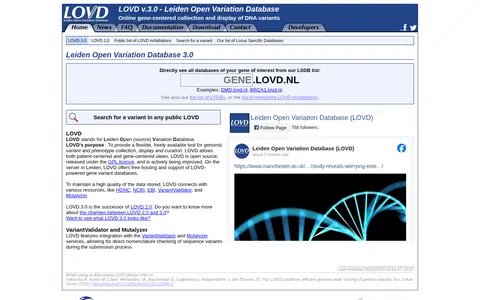
The Leiden Open Variation Database (LOVD) is an open source, GPL-licensed system for the collection, display and curation of genomic variant and phenotype data. LOVD 3.0 supports both patient-centered and gene-centered views of DNA variants. The project maintains a public list of LOVD installations and locus-specific databases, and the central Leiden server offers free hosting and support for LOVD-powered gene variant databases. The system is actively under development.
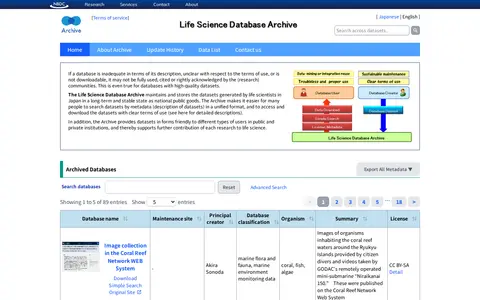
The Life Science Database Archive maintains and stores datasets generated by life scientists in Japan for the long term. It lets users search datasets by metadata in a unified format and access and download them under clear terms of use. It also provides datasets in forms suited to different users in public and private institutions.
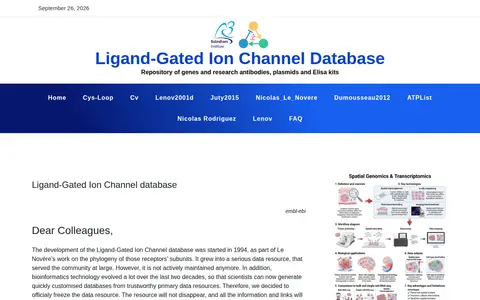
The Ligand-Gated Ion Channel Database holds nucleic and proteic sequences of ligand-gated ion channel subunits, one entry per gene, manually constructed and checked. It offers multiple sequence alignments, some phylogenetic studies, and atomic coordinates when available. Development began in 1994 and the resource is now officially frozen; the data and links remain but it is not actively maintained or considered up to date.
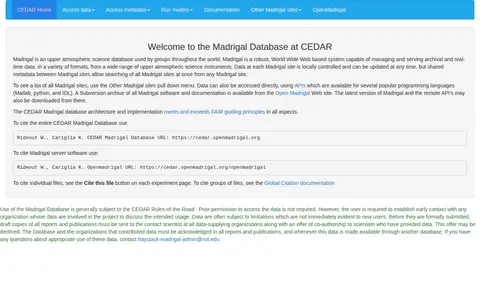
Madrigal is a web-based upper atmospheric science database that manages and serves archival and real-time data from various instruments. Data is locally controlled at each site, while shared metadata enables searching across all Madrigal sites. APIs for Matlab, Python and IDL allow direct data access.
The MCHF/MCDHF Database is a NIST collection of transition data from relativistic theories computed by different computational methods. The Landé gJ factor is provided for a few collections. Data is accessed by selecting an element from the periodic table, then a spectrum, a reference number, and a property. Atomic structure codes used in the calculations, including HFFortran95, ATSP, ATSP2K and GRASP2K, are available for download.
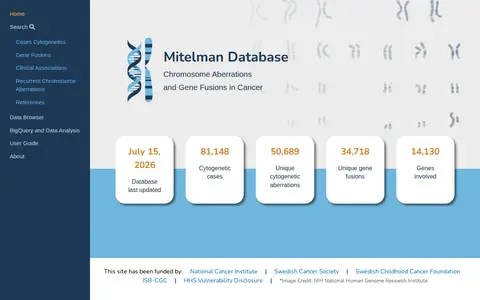
The Mitelman Database of Chromosome Aberrations and Gene Fusions in Cancer relates cytogenetic changes and their genomic consequences, particularly gene fusions, to tumor characteristics. It contains individual cases and associations. The site is optimized for Google Chrome or Mozilla Firefox desktop browsers.
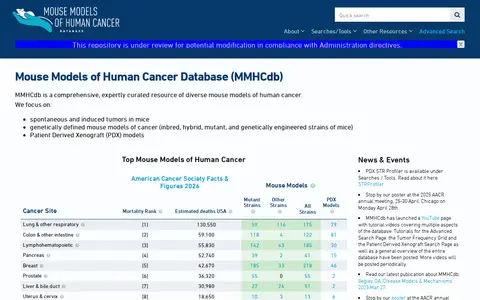
The Mouse Models of Human Cancer Database (MMHCdb) is a curated resource of mouse models of human cancer. It covers spontaneous and induced mouse tumors, genetically defined models such as inbred, hybrid, mutant and genetically engineered strains, and patient-derived xenograft models. It is intended to help researchers choose experimental models and review mutation patterns in specific cancers.
The Mouse Phenome Database is a resource for exploring physiology and behavior through genetics and genomics. It provides phenotypes, genotypes, strains, panels, QTL, studies and protocols, with search by strain, procedure, treatment, investigator, project, measure, PubMed number, ontology term, gene or genomic region.
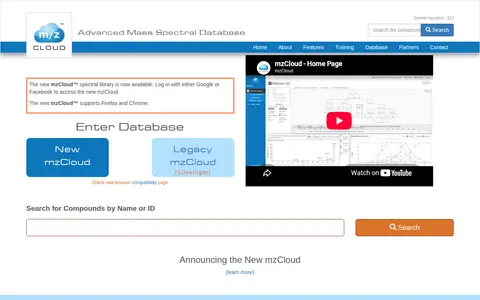
The MultiDark Database provided results from cosmological simulations performed within the MultiDark project. It could be queried by entering SQL statements directly into a Query Form, and access to the public and private databases was password protected, requiring registration. The site notes that MultiDark has moved to CosmoSim, where its application is integrated, and the old server is no longer available.
mzCloud is a curated mass spectral database of high-resolution tandem mass spectra arranged into spectral trees. It supports spectrum, tree, structure, substructure, m/z, and compound name searches, and is intended to help identify compounds, including those not present in the library. The database includes annotated fragments, molecular formulas, identifiers, and experimental metadata. It is an open consortium effort covering fields such as metabolomics and toxicology.
The National Forestry Database is a Canadian resource that collects and compiles national forest data and forest management statistics. Its topics include forestry highlights, wood supply, forest fires, forest insects, harvest, regeneration, revenues, pest control, and provincial and territorial profiles. It is available in English and French.