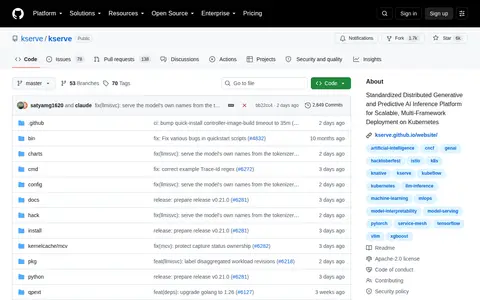

KServe is a standardized distributed generative and predictive AI inference platform for scalable, multi-framework deployment on Kubernetes. It is a Cloud Native Computing Foundation incubating project. The platform supports backends such as vLLM and llm-d for serving LLMs, and multi-framework predictive serving. Standalone installation on standard Kubernetes is described as more lightweight but without canary deployment or request-based autoscaling with scale-to-zero.
Directory
Search results
Published directory entries matching your search.
Kubeflow is described as the cloud native AI platform, composed of modular open source projects forming a Kubernetes-native stack for data and AI workloads. Its subprojects include Kubeflow Pipelines for building and deploying portable machine learning workflows, Kubeflow Trainer for distributed AI training and LLM fine-tuning, Kubeflow Katib for automated machine learning, Kubeflow Notebooks for interactive development environments, and Kubeflow Hub for indexing models and metadata. It is a Cloud Native Computing Foundation project.
Liliputing covers technology products, software, computing and internet industry developments.
A computing-focused community centered around link aggregation and discussion. Users post links with tags and comment on them, with recent posts covering security, CSS, operating systems, databases and programming languages.
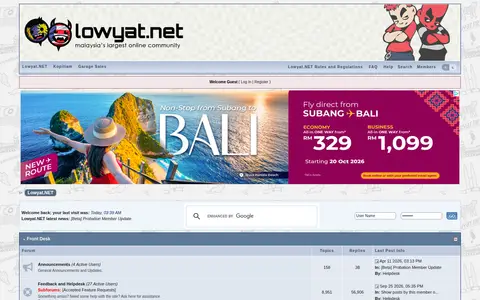
Lowyat.NET is a Malaysian forum community for technology enthusiasts. It hosts discussion boards covering hardware, software, mobile computing, overclocking and desktop customization, along with buy and sell sections and a feedback and helpdesk area.
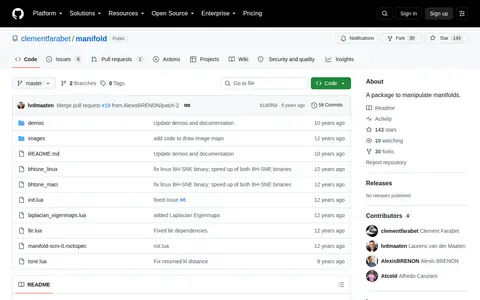
Manifold is a package for manipulating manifolds, built for Torch7. It is installed via luarocks and depends on the libatlas3-base package. The package offers basic functions such as computing neighbors and distances, and embeddings using random projections, LLE and tSNE. Demos are included, such as a t-SNE map produced on 5,000 MNIST digits.
The Master of Data Science (M.A.S.) at Illinois Institute of Technology is a master's program in the School of Computing. It covers machine learning, deep learning, big data analytics and data visualization, with courses available online, on campus or hybrid and full-time, part-time or self-paced schedules.
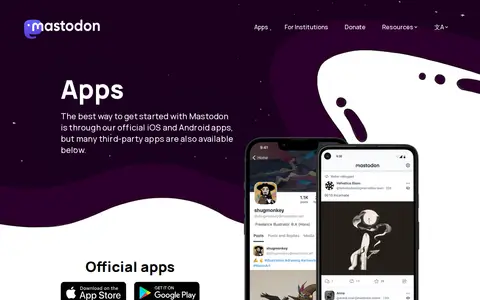
This Mastodon page lists official and third-party apps for the decentralized social network, organized by platform including Android, iOS, Web, Desktop and Retro computing, with free, paid and open-source labels. It also notes a progressive web app and an open API.
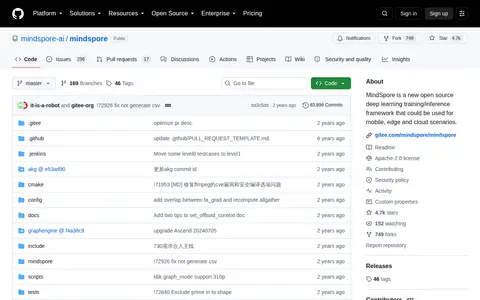
MindSpore is an open source deep learning training and inference framework that could be used for mobile, edge, and cloud computing scenarios. Its source code is hosted in the mindspore-ai/mindspore repository on GitHub.
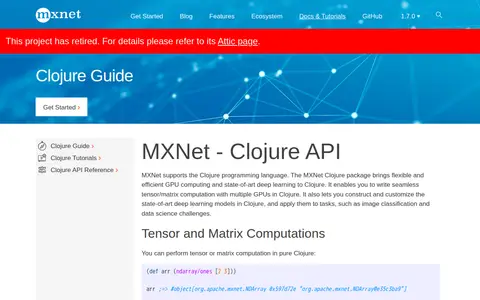
The MXNet Clojure package brings GPU computing and deep learning to the Clojure programming language. It enables tensor and matrix computation with multiple GPUs in Clojure, and allows constructing and customizing deep learning models for tasks such as image classification and data science challenges.
The National High Energy Physics Science Data Center is a data infrastructure built and operated by the Institute of High Energy Physics, Chinese Academy of Sciences. It provides data resources, software tools and computing capacity for high energy physics and related fields. The center offers recommended datasets, analysis tools and data monitoring, and publishes news and updates.
neuGRID is a web portal for advanced neuroscience research, serving users from students to senior neuroscientists focused on neurodegenerative diseases including Alzheimer's disease, Lewy body disease, frontotemporal dementia and white matter diseases. It uses high performance computing resources to enable faster visualization, analysis and interpretation of neuroimaging data than traditional lab-based workflows, and functions as a recognized data repository. It also provides datasets, pipelines, apps and neuroimaging machine learning tools.
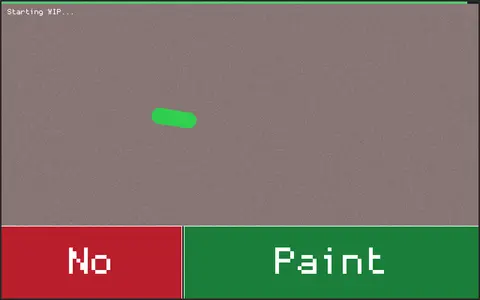
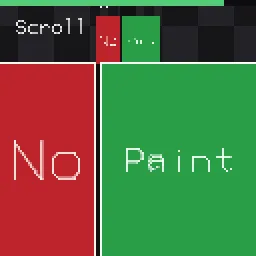
No Paint is a browser-based creative computing platform part of the Aesthetic Computer project. It enables users to create art, games, and tools using JavaScript and KidLisp, navigating via typed commands in a prompt. Users can accept or discard proposed creative outputs by pressing Paint or No. Documentation, source code, and program pieces are available via linked external repositories.
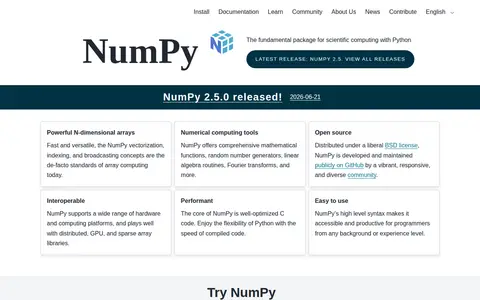
NumPy is a Python library providing a multidimensional array object and routines for fast operations on arrays, including mathematical, logical, sorting, Fourier transforms, linear algebra and random simulation. It is open source under a BSD license and is described as the fundamental package for scientific computing in Python, with core code written in optimized C.
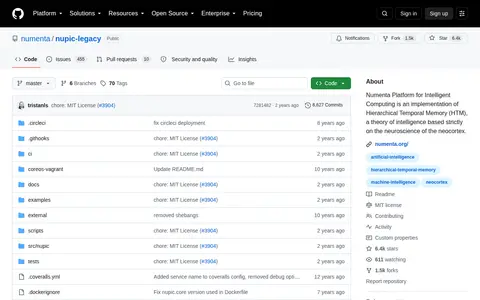
Numenta Platform for Intelligent Computing.
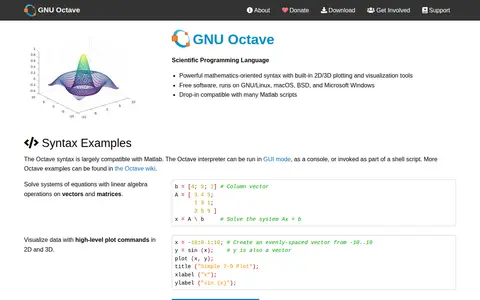
GNU Octave is a programming language for scientific computing with mathematics-oriented syntax and built-in 2D/3D plotting and visualization tools. It is free software licensed under the GNU General Public License and runs on GNU/Linux, macOS, BSD, and Microsoft Windows. Its syntax is largely compatible with Matlab, and it can be extended by packages.
Open Data Pakistan is a portal providing open datasets, described as a collaborative effort of the National Center for Big Data and Cloud Computing at LUMS and the Higher Education Commission. The site lists datasets across categories such as agriculture, cities, connectivity, culture, demography, economy, education, environment and health, including Punjab statistical publications and survey and property data.
Overclock3D covers technology products, software, computing and internet industry developments.
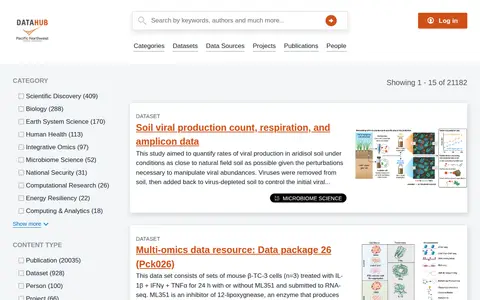
The Pacific Northwest National Laboratory DataHub is a searchable repository of scientific data and publications. The site offers filtering by category, content type and tags across topics such as biology, earth system science and computing. Listed content types include publications, datasets, people, projects, data sources, institutions and software.
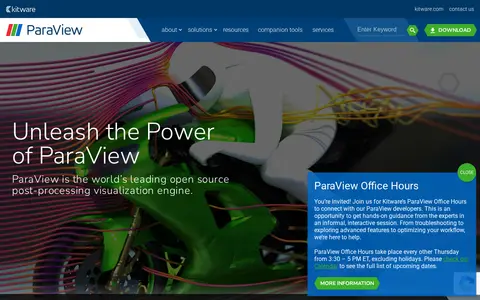
ParaView is an open-source, multi-platform data analysis and visualization application built to analyze extremely large datasets using distributed memory computing resources. It runs on Linux, macOS and Windows, from laptops to supercomputers, and includes readers for many file formats and more than 200 filters. It can also run in situ using ParaView Catalyst and in a web browser using trame.
phoronix covers technology products, software, computing and internet industry developments.
PyCUDA is a software project associated with Andreas Klöckner, who teaches and conducts research in scientific computing at the University of Illinois at Urbana-Champaign. The project has a dedicated documentation site.
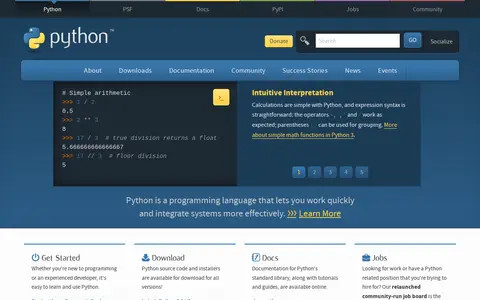
Python is a programming language whose official site provides downloads, documentation, a beginner's guide and news. The site lists application areas including web development, GUI development, AI and machine learning, scientific and numeric computing, software development and system administration. The Python Software Foundation supports the language and its community.
RestorePrivacy covers technology products, software, computing and internet industry developments.