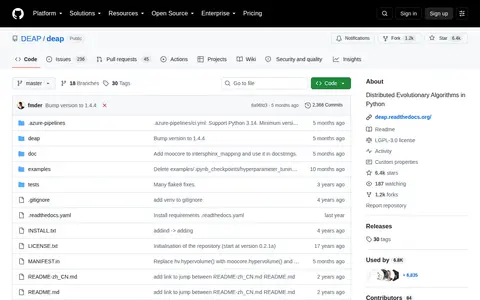
DEAP is an evolutionary computation framework for Python aimed at rapid prototyping and testing of ideas. It provides genetic algorithms over representations such as lists, arrays, sets, dictionaries, trees and Numpy arrays, genetic programming with prefix trees, evolution strategies including CMA-ES, multi-objective optimisation, and co-evolution of multiple populations. It supports parallelisation via multiprocessing and SCOOP and works out of the box with Python 3 since version 0.8.
Directory
Search results
Published directory entries matching your search.
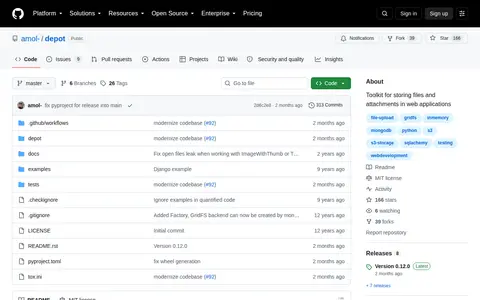
Depot is a framework for storing and serving files in Python web applications. It supports backends including local disk, in-memory storage, GridFS, Amazon S3 and Google Cloud Storage, and attaches files to SQLAlchemy or Ming/MongoDB models with file rollback on transaction rollback. It is installed from PyPI as the filedepot distribution and requires Python 3.10 or later.
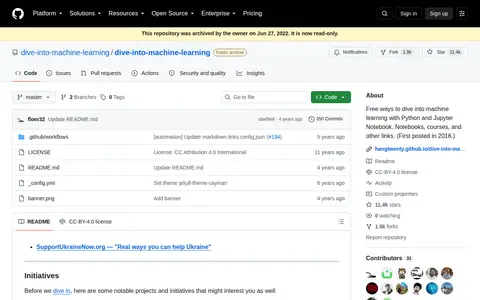
Archived, read-only GitHub repository of free resources for learning machine learning with Python and Jupyter Notebook, including notebooks, courses and other links. It was first posted in 2016 and was archived by the owner on Jun 27, 2022.
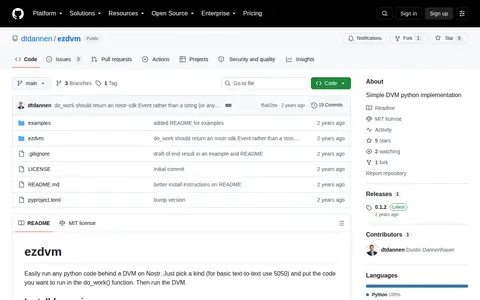
) - Quickly put any python code in a DVM! Simple library built on nostr-sdk python bindings
Fiber is a Python-based distributed computing library for modern computer clusters. It provides the same API as Python's standard multiprocessing library, uses Nanomsg for communication, and allows dynamic allocation of CPU, memory, and GPU resources. Installation uses pip install fiber.
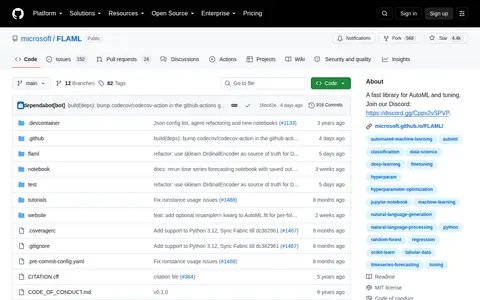
FLAML is a lightweight Python library from Microsoft for automating machine learning and AI operations. It performs model selection and hyperparameter optimization under resource constraints, including tuning foundation model inference hyperparameters. It requires Python 3.10 or later, is installable via pip, and can be used as a scikit-learn style estimator.
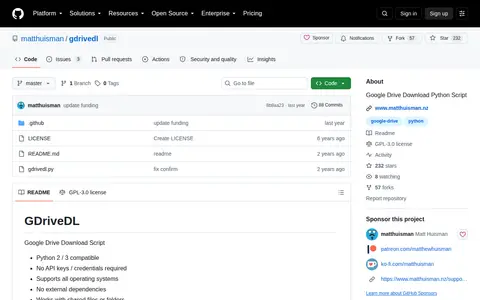
A Google Drive download script written in Python, compatible with Python 2 and 3. It requires no API keys or credentials, supports shared files or folders, and accepts one or more shared Google Drive URLs as input.
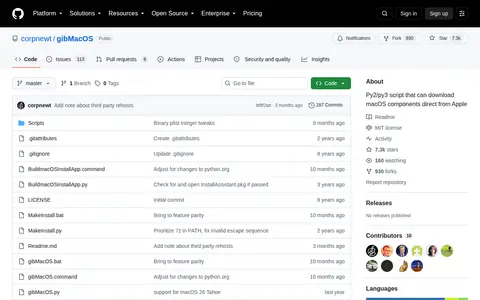
gibMacOS is a Python 2 and Python 3 script that can download macOS components directly from Apple. It can also build Internet Recovery USB installers from Windows using dd and 7zip, though internet recovery USBs can no longer be built via MakeInstall on Windows since macOS 11.
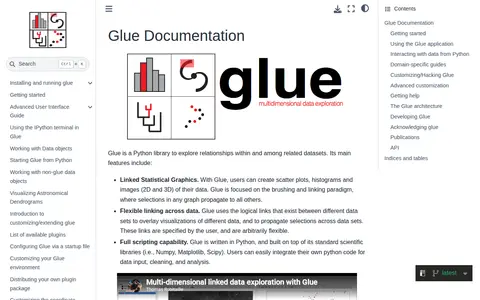
Glue is a Python library for exploring relationships within and among related datasets. It provides linked statistical graphics such as scatter plots, histograms and 2D and 3D images, with selections in one graph propagating to others. It supports user-specified links across datasets and scripting through Python's scientific libraries.
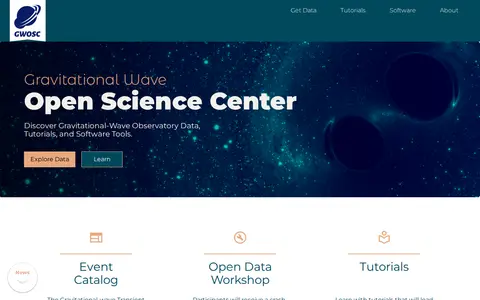
The Gravitational Wave Open Science Center provides access to data from gravitational-wave observatories, along with tutorials and software tools. Its read-only API offers programmatic access to observation runs, event catalogs, single event detections, parameter estimations, data quality and injection segments, and strain datasets and statistics, mostly in JSON format with a Python client recommended for Python projects.
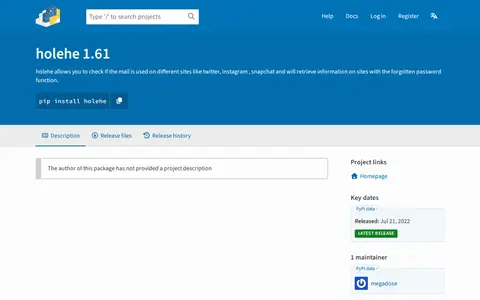
Python OSINT tool that checks whether an email address is registered on many sites without sending mail.
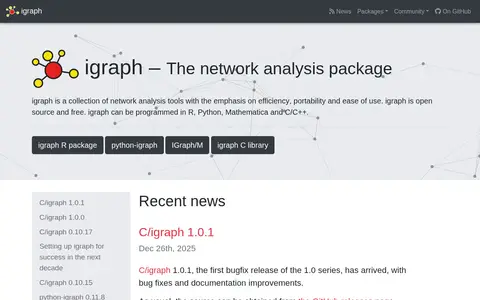
igraph is a collection of network analysis tools emphasizing efficiency, portability and ease of use. It is open source and free, and can be programmed in R, Python, Mathematica and C/C++. Implementations include the igraph R package, python-igraph, IGraph/M and the igraph C library.
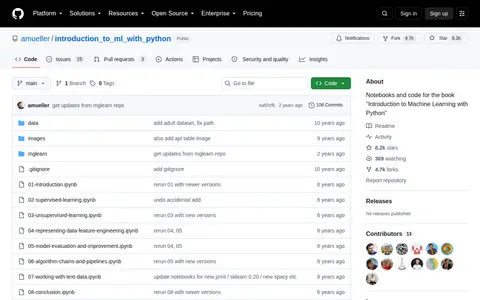
A GitHub repository holding the notebooks and code for the book "Introduction to Machine Learning with Python" by Andreas Mueller and Sarah Guido, together with the mglearn library of helper functions for figures and datasets. The book requires scikit-learn 0.20.0, and the code also needs numpy, scipy, matplotlib, pandas and pillow.
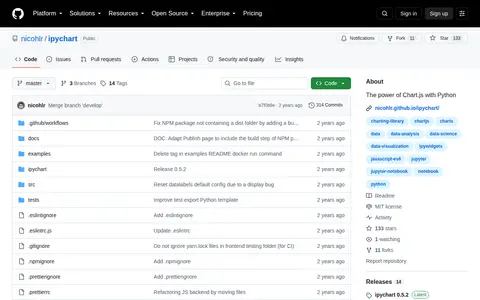
ipychart is a Python library that brings the power of Chart.js to Python. It is hosted on GitHub at https://github.com/nicohlr/ipychart. The repository includes installation instructions, documentation, usage examples, and development information.
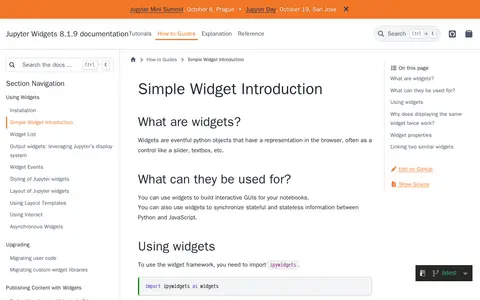
This page is the Simple Widget Introduction of the Jupyter Widgets documentation. It describes widgets as eventful Python objects with a browser representation, used to build interactive GUIs for notebooks and synchronize information between Python and JavaScript. It covers display, views, closing widgets, and properties.
LearnByExample is a blog covering Python, regular expressions, Linux, scripting, Vim and self-publishing, along with technical articles and book announcements. Posts include a Python regular expression cheatsheet, guides to sed substitution and awk, and tutorials on using pandoc to generate PDF and EPUB files from markdown.
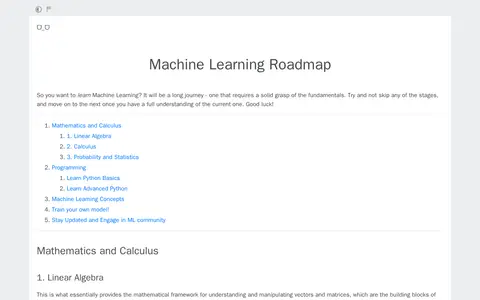
A staged learning roadmap for machine learning that covers mathematics and calculus, programming, and machine learning concepts. It advises moving to the next stage only after fully understanding the current one. The mathematics section covers linear algebra, calculus, and probability and statistics, and the programming section covers Python basics and advanced Python.
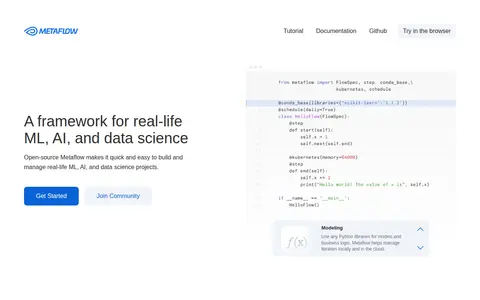
Metaflow is an open-source framework for building and managing ML, AI, and data science projects. It supports using Python libraries, orchestration workflows in Python, versioning, and scaling compute to the cloud, including GPUs. It was originally developed at Netflix and open-sourced in 2019.
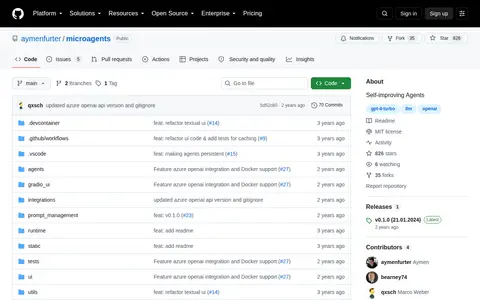
Microagents is an experimental framework for dynamically creating self-improving agents in response to user tasks. Generated agents are assessed and stored for reuse across chat sessions. It uses Python, OpenAI's GPT-4 Turbo, and Text-Embedding-Ada-002. Agents execute Python code directly and do not currently operate within a sandbox.
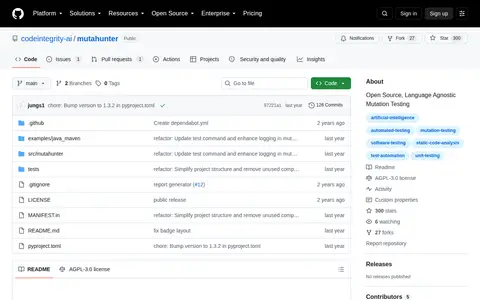
Mutahunter is an open-source, language-agnostic mutation testing tool that uses large language models. It is installed as a Python package requiring Python 3.11 or later and run against a repository with a test command, source path and test path, reporting mutation coverage and survived or killed mutants.
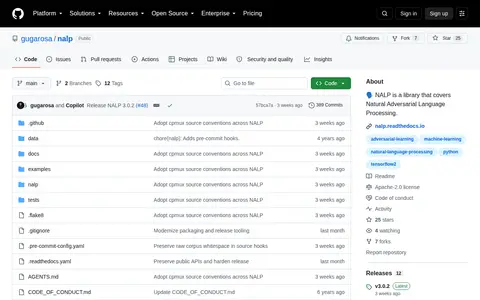
NALP is a Python library covering Natural Adversarial Language Processing. It combines natural language processing and adversarial learning, from embeddings to neural networks. The package offers corpus loading for raw text and audio, encoders, and pre-loaded neural network models. Version 3.0.2 requires Python 3.11+.
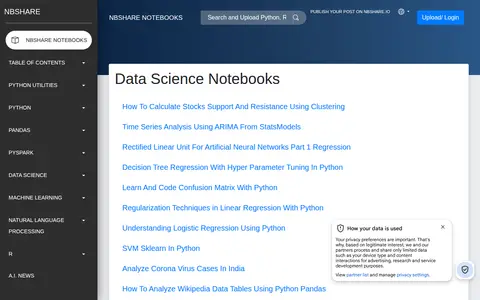
nbshare.io is a platform for learning data analytics using Python and R. It hosts a collection of notebooks covering topics including artificial intelligence, machine learning, basic Python coding, data analytics, web scraping and other related technical subjects.
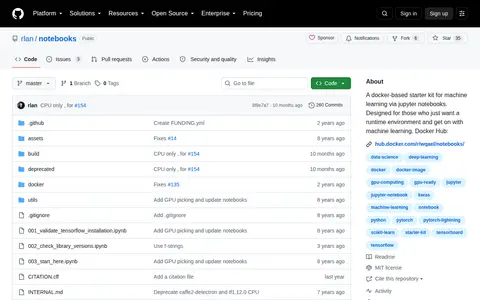
Notebooks is a Docker-based starter kit for machine learning through Jupyter notebooks, intended for users who want a ready runtime environment. Its images cover combinations of Keras, TensorFlow and PyTorch with CUDA v8 through v11, and include JupyterLab, scikit-learn, pandas and visualization, vision and NLP libraries. Python 3 only, as Python 2 is end-of-life.
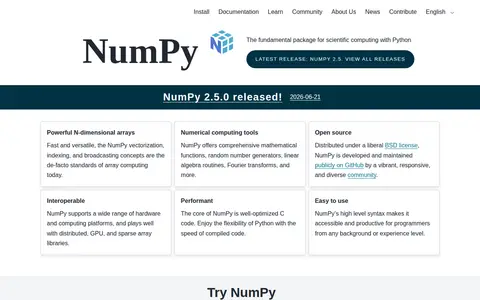
NumPy is a Python library providing a multidimensional array object and routines for fast operations on arrays, including mathematical, logical, sorting, Fourier transforms, linear algebra and random simulation. It is open source under a BSD license and is described as the fundamental package for scientific computing in Python, with core code written in optimized C.