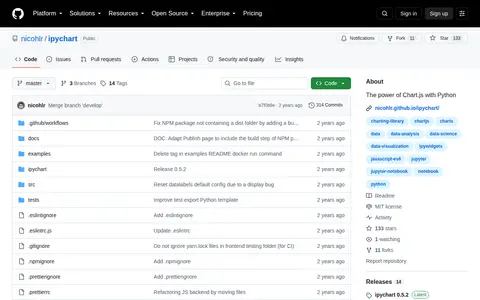

ipychart is a Python library that brings the power of Chart.js to Python. It is hosted on GitHub at https://github.com/nicohlr/ipychart. The repository includes installation instructions, documentation, usage examples, and development information.
Directory
Search results
Published directory entries matching your search.
IsoArcH is a non-profit initiative for standardizing, preserving and sharing isotope data across archaeology, anthropology, environmental science and forensics. It offers a standardized data model, an interactive query and visualization tool, a dataset catalog, DOI assignment and cloud services. Every dataset is reviewed before appearing online. The database is described as free to use.
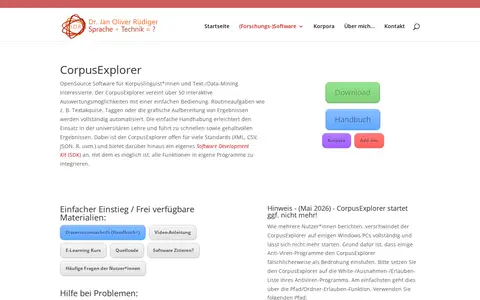
ML, DL and Data Science - with a focus on text-/data-mining.
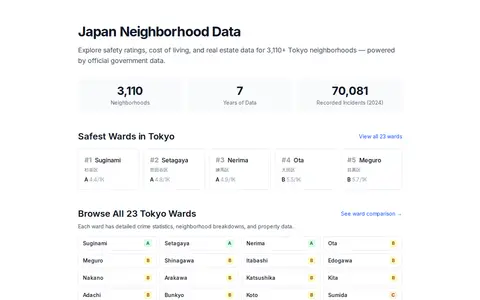
Japan Neighborhoods provides data-driven neighborhood guides for Japan. It offers crime statistics, safety scores, demographic data, cost of living, and real estate information for over 5,000 Tokyo neighborhoods. The data is sourced from official government sources and presented through safety rankings, interactive maps, and property listings.
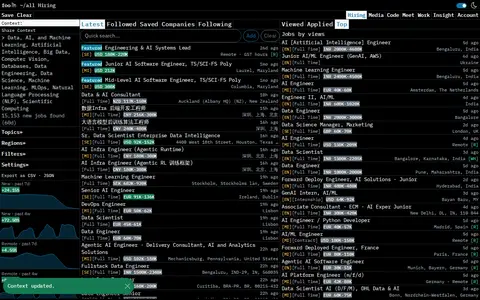
The go-to, no-nonsense, fast and lean job site in AI, ML, Data Science and Big Data.
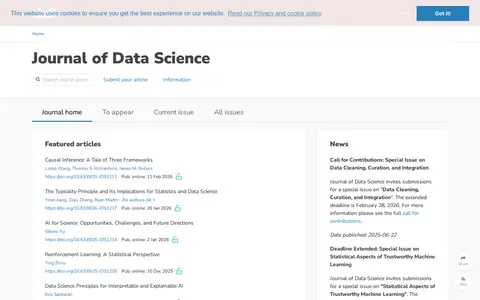
The Journal of Data Science is an academic journal listing featured articles, news, and calls for contributions. Featured articles include items on causal inference, reinforcement learning, and AI for science, each with a DOI and online publication date. The page also lists special issue calls for contributions and most-read articles.
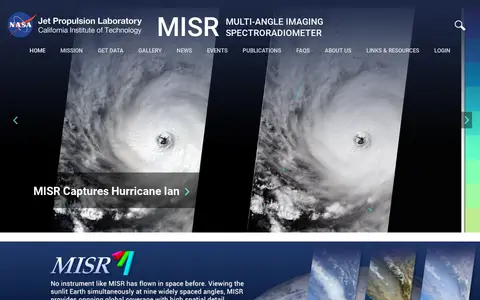
The Multi-angle Imaging SpectroRadiometer (MISR) is a NASA instrument onboard the Terra satellite, presented by the Jet Propulsion Laboratory. The site offers news, events, image quizzes and visualizations including 3D globe animations, world maps and stereo anaglyphs. It also references a tool for the MISR Plume Height Project.
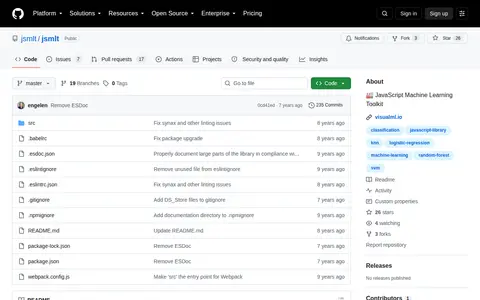
JSMLT is an open source JavaScript library for education in machine learning. It implements supervised learning algorithms, including SVM, random forest, decision tree, perceptron, neural networks, k-nearest neighbors and logistic regression, and provides visualization examples for exploring how the algorithms work.
JSON Schema is a declarative language for annotating and validating JSON documents' structure, constraints, and data types. It enables JSON data consistency, validity, and interoperability, and has a tooling ecosystem of validators, generators, and linters. Documentation covers schema design, guides, and keyword reference.
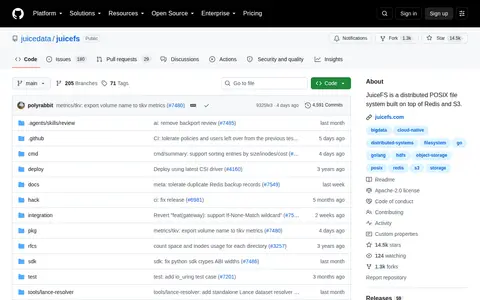
Distributed POSIX file system built on top of Redis and S3.
Jupyter Notebook is a web-based interactive computing platform combining live code, equations, narrative text, visualizations, and dashboards. It supports over 40 programming languages, including Python, R, Julia, and Scala, and notebooks can be shared via email, Dropbox, GitHub, and the Jupyter Notebook Viewer.
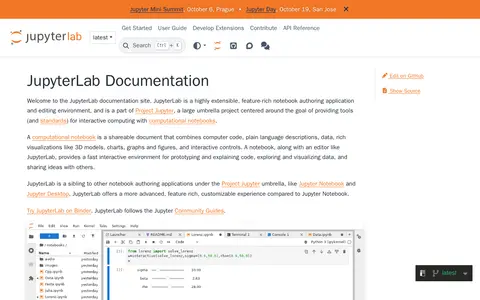
JupyterLab is an extensible notebook authoring application and editing environment within Project Jupyter. A notebook combines code, text descriptions, data and visualizations. JupyterLab provides an environment for prototyping and explaining code, exploring and visualizing data, and sharing ideas. It is a sibling to Jupyter Notebook and Jupyter Desktop and is described as offering a more advanced, customizable experience than Jupyter Notebook.
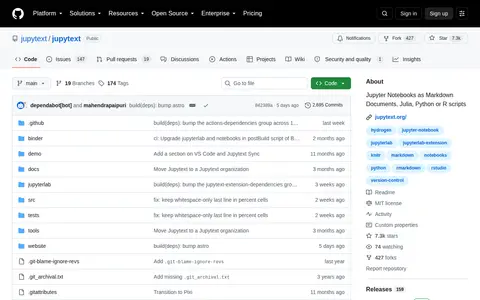
Jupyter Notebooks as Markdown Documents, Julia, Python or R scripts.
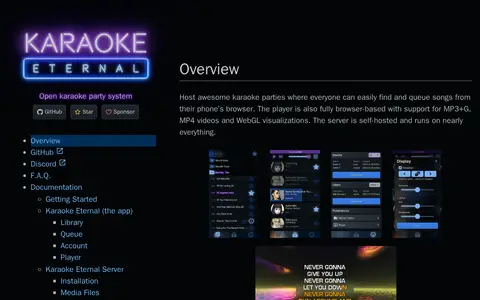
Karaoke Eternal is a self-hosted open karaoke party system. Guests can find and queue songs from their phone's browser, and the browser-based player supports MP3+G files, MP4 videos and WebGL visualizations. The server runs on Windows, Mac, Raspberry Pi or NAS devices and stores data on the server only.
Karnataka Open Data Portal is part of India's Open Government Data Platform, serving as a single point of access to open format resources published by Indian government ministries, departments and organizations. It also provides information on open data events, visualizations, blogs and infographics.
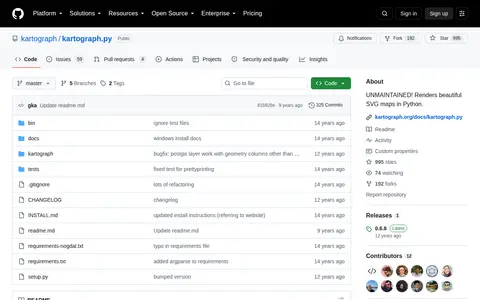
Kartograph.py is a Python library for rendering beautiful SVG maps. The project is currently unmaintained, but its source code remains available on GitHub. It allows users to create map visualizations programmatically.
KBase is the Department of Energy Systems Biology Knowledgebase, a software and data science platform for systems biology. It is intended for bench biologists and bioinformaticians, offering digital notebooks called Narratives for shareable, reproducible workflows with data, visualizations and commentary.
Data Mining, Analytics, Big Data, Data, Science not a blog a portal.
An article comparing the roles of data scientist and data engineer. It states that the positions are sometimes confused for each other and are often treated as the same, though the two roles work together. It notes that companies can encounter problems with team efficiency and system performance when the roles are conflated, and that the average company needs far more data engineers.
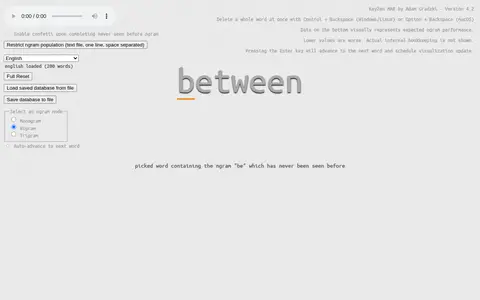
KeyZen MAB is a browser-based typing practice tool by Adam Gradzki, version 4.2. It offers monogram, bigram and trigram ngram modes, with a visualization of expected ngram performance. Users can load a corpus and delete a whole word with Control + Backspace (Windows/Linux) or Option + Backspace (macOS).
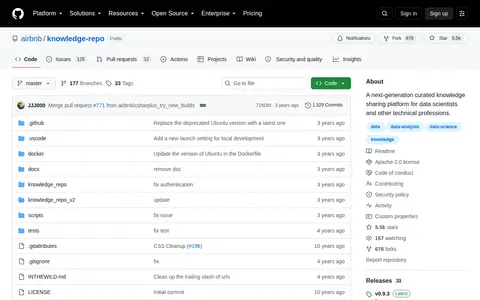
Knowledge Repo is a next-generation curated knowledge sharing platform designed for data scientists and other technical professionals. It is maintained as a public open source repository on GitHub under the Airbnb organization.

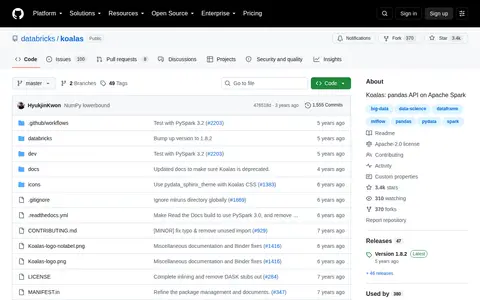
Koalas, from Databricks, implements the pandas DataFrame API on top of Apache Spark. The repository is marked deprecated and in maintenance mode; Koalas supports Apache Spark 3.1 and below, and PySpark is recommended directly for Spark 3.2 and above. It is available under the Apache-2.0 license.
Kyso was a universal aggregator for all research formats that ceased operation on September 31, 2023, and is now maintained as an open source project. It launched in 2018 to help the data science community share insights and address collaboration challenges across varied workflows and tools, with an initial focus on Jupyter Notebooks. During its operation, it served thousands of users and hundreds of organizations.
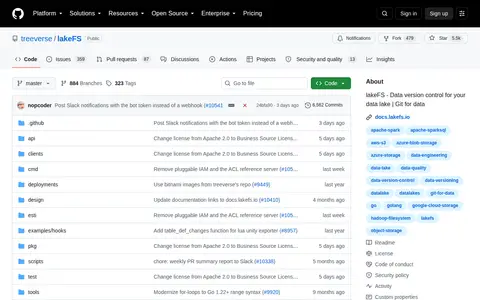
lakeFS is a source-available data version control tool that turns object storage into a Git-like repository, allowing data lakes to be managed like code. It supports AWS S3, Azure Blob Storage and Google Cloud Storage, is API compatible with S3, and works with frameworks such as Spark, Hive, AWS Athena, DuckDB and Presto.