Marginalia vs Mwmbl
Marginalia vs Mwmbl: compare custom filters, community curation and Mwmbl's 30 free Seed Searches. Find the better free search engine for your reading.
On this page
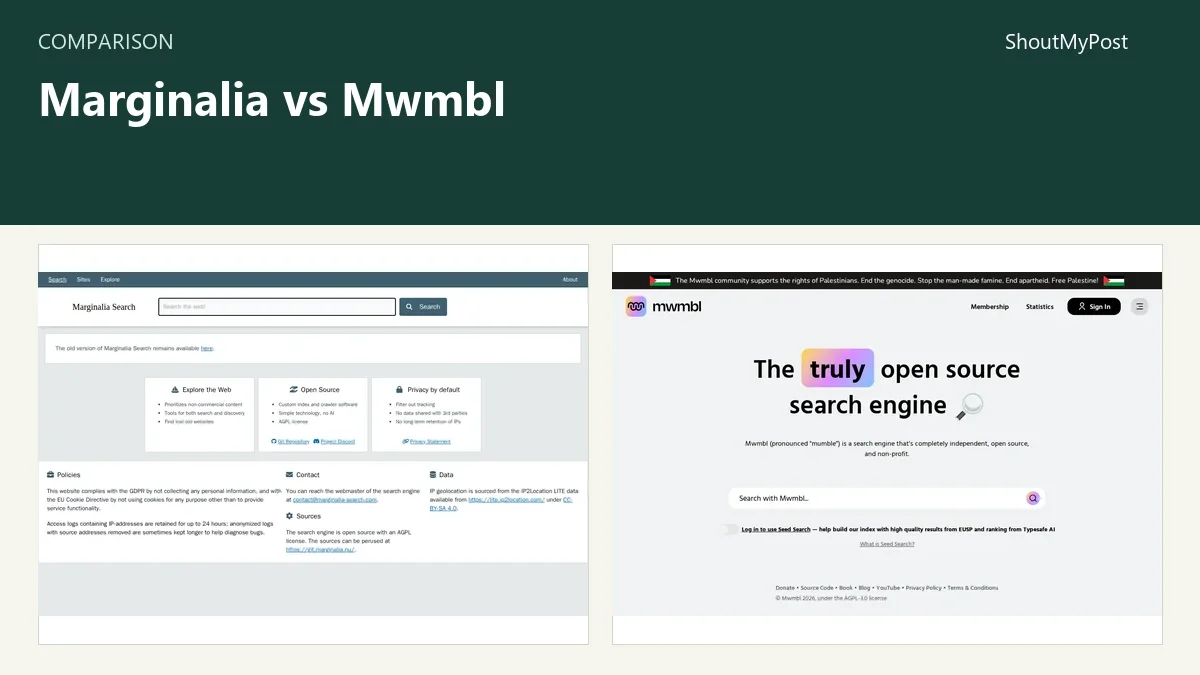
Marginalia vs Mwmbl comes down to discovery or contribution. Marginalia wins for readers hunting personal sites and text-heavy pages. Pick Mwmbl if you want to help improve shared results. Both offer free web search: Marginalia changes your view of the web; Mwmbl lets contributors change what other searchers find.
Marginalia vs Mwmbl: the choice starts with Seed Search
Mwmbl's optional Seed Search gives logged-in users 30 free searches a month. It combines Mwmbl results with EUSP results, uses TypeSafe AI's Jev model to rank them, and adds newly discovered pages to Mwmbl's index. It stays enabled until you switch it off.
That surprised me more than the familiar small-index comparison. An independent index doesn't tell you the complete route a query takes. If your aim is searching without AI ranking, Marginalia is the clearer choice. If your aim is helping an open index grow, Mwmbl's approach may be exactly what you want.
The Marginalia Search listing and Mwmbl listing link to the two services. This comparison separates ordinary browsing from optional contribution tools, so a crawler's controls don't get mistaken for something every searcher needs.
At a glance
Official pages checked October 9, 2026. The final column names the source for both cells; amounts below refer to searching the hosted sites, unless a cell explicitly says API.
| Factor | Marginalia | Mwmbl | Source and date checked |
|---|---|---|---|
| Free search | Free public web search | Free basic search without an account | Marginalia homepage; Mwmbl Terms; Oct. 9, 2026 |
| Paid price | No paid browsing tier listed; separate paid API access | No paid basic-search tier listed | Marginalia API guide; Mwmbl Terms; Oct. 9, 2026 |
| Main limit | Coverage favors the small, text-heavy web | Seed Search: 30 free searches per month when logged in | Marginalia homepage; Mwmbl Seed Search; Oct. 9, 2026 |
| Platforms | Web browser | Web browser | Both public homepages; Oct. 9, 2026 |
| Main feature | Search plus discovery and custom filtering | Search plus user curation of shared results | Marginalia homepage/filter editor; Mwmbl Curation Guidelines; Oct. 9, 2026 |
| Integrations | Search API with XML filters | Crawling API; contributor crawler tools | Marginalia API guide; Mwmbl Terms and contributor docs; Oct. 9, 2026 |
| Account | Browser filters don't need a search account | Basic search doesn't need one; curation does | Marginalia filter announcement; Mwmbl Terms; Oct. 9, 2026 |
| Open source | Yes, AGPL | Yes, AGPL-3.0; dataset has a separate license | Marginalia official source notice; Mwmbl Terms; Oct. 9, 2026 |
| Recent update signal | July 22, 2026 developer update on crawls and query execution | June 3, 2026 privacy update covering Seed Search; GitHub has no published releases | Marginalia developer blog; Mwmbl Privacy and Releases; Oct. 9, 2026 |
| Privacy | Policy says access logs are retained up to 24 hours | Says IP addresses aren't stored on disk and search logs aren't linked to an account | Marginalia Privacy; Mwmbl Privacy; Oct. 9, 2026 |
| Data location | Privacy page doesn't name a hosting region | Other personal-data processing is in the EEA/UK; search providers may process queries elsewhere | Both privacy pages; Oct. 9, 2026 |
Finding unfamiliar pages: Marginalia has the clearer purpose
Marginalia's homepage describes a search engine built around the small, old and unusual web. Its own crawler and index give it a different starting collection from a metasearch page that simply asks larger engines for results.
My pick is Marginalia when the question is “who has written about this?” A repair diary, an independent programming essay or a personal history page can be valuable without looking like a publication. You may want a writer's explanation more than the usual top-level destination for the subject.
That preference also gives Marginalia its weakness. When you already know the exact book, company or paper you want, discovering surrounding writing can feel like an extra task. It makes sense to separate an exploratory query from a destination query before deciding the engine has failed you.
Mwmbl's public service has a broader search mission, with community contributions helping build the collection. I'd start there when I want to find a page and can also contribute a missing result. That makes it a better match for someone who enjoys improving a shared resource, even if the immediate search doesn't return everything they hoped for.
For either engine, keep a short list of queries you actually repeat: an exact project name, a subject you read about, and a reference you need for work. Compare the pages you can open and use. A long result count won't settle whether the engine finds the material your day depends on.
Winner for finding unfamiliar personal writing: Marginalia.
Changing results: private filters or public curation
Marginalia lets you include, exclude and weight domains and terms. Those choices affect the filter you're using. For example, a filter can favor personal sites about electronics without limiting every other reader to the same collection.
Use that approach when your preference is personal. Someone researching the history of a device may want older pages; someone installing its current software may want newer instructions. Neither choice makes sense as a permanent rule for all searches about that device.
Mwmbl's curation tools have a different audience. Its Curation Guidelines describe approving results with a tick button and adding a missing URL with Add new. Contributions can improve the results other people receive for the query. The guide currently covers English queries and bans self-promotion.
That's the better route when a page is a good answer for everyone asking the same question. Adding a clear reference to a shared result set helps the next person, too. Moving your employer's page above independent answers because you want traffic would work against the point of the tool.
I wouldn't choose Mwmbl curation as a substitute for a private reading filter. One person may dislike shopping results while another genuinely wants a shop. Marginalia gives the first person a way to change their own search without declaring that the second person's destination is bad.
For a research group, decide whether you're sharing discoveries or sharing rules. A list of good pages can live in ordinary bookmarks. A filter describes what the next search should include. A public curation says something about the best answers to a particular query. Keeping those jobs separate prevents a favorite-site list from becoming a misleading ranking.
Winner for personal control: Marginalia. Winner for improving shared results: Mwmbl.
Privacy: Mwmbl names the outside search providers
Mwmbl's June 2026 privacy policy says standard searches may send queries to external content sources. Seed Search sends the query to EUSP and sends the query plus candidate results to TypeSafe AI. Mwmbl says it doesn't forward your account identity to them, but their processing can happen outside the EEA or UK.
That leaves a real choice. You can prefer the broader result route while still wanting to understand which companies receive the search text. An account identifier and a query are different pieces of information; removing one doesn't make the other meaningless.
Marginalia's privacy page describes short log retention and says it doesn't collect information about clicked results. I'd choose it for this comparison if minimizing the search-provider chain is the main goal. Its public statement still allows a short operational logging window, so don't read “privacy-focused” as “no logs of any kind.”
Opening a result also takes you to another website. The search engine's policy doesn't control that destination's sign-in, analytics or cookies. For a private work question, the wording of the query matters before you ever choose which result to open.
Winner for the simpler search-provider route: Marginalia.
Cost and maintenance: both are free to browse
You can use the ordinary search pages without buying a subscription. I wouldn't turn this choice into a price contest. The bigger cost is a failed search that sends you back to another engine, or time spent maintaining rules you no longer need.
Developers face a separate decision. Marginalia's API guide offers free noncommercial keys by email, an optional paid noncommercial key, and metered commercial access. The guide doesn't show a clear US-dollar amount, so there's no converted price here. A commercial application should use the commercial route instead of treating free browser search as an API allowance.
There are recent maintenance signals for both projects. Marginalia's July 2026 developer post describes new query execution and crawl work. Mwmbl's current policy describes its newer search feature; its GitHub Releases page has no published releases. A missing release list alone isn't a reason to call a hosted service abandoned.
For everyday reading, bookmark the search pages before changing every device's default. For an integration, look at the documented access route and response format first. A search page that works for a human is only part of what a dependable application needs.
Winner on basic-search cost: a tie. Marginalia gives developers the clearer documented split between free noncommercial and paid commercial access.
What users say
The January 2025 Marginalia discussion includes praise for Linux, history and personal-site discovery. It also includes complaints about finding exact destinations. Viktor Löfgren answered that destination searches weren't his main priority; finding human writing about a subject was.
The September 2023 Mwmbl discussion mixes enthusiasm for an independent, community-built engine with complaints about missing results. Readers liked the project and its quick responses when it found a match. Daoud Clarke encouraged people to help crawl; he also said Marginalia had inspired Mwmbl.
Those two conversations make my recommendation quite specific. Choose Marginalia for a reading habit built around discovering writers. Choose Mwmbl if contributing missing pages is part of the appeal. If an exact destination is essential, keep a second search route available instead of expecting either specialist project to cover every request.
Choose Marginalia if
- You're searching for personal writing and hobby pages.
- You want domain and term preferences for your own searches.
- You want web-page discovery without an AI-ranked Seed Search mode.
Choose Mwmbl if
- You want to contribute to shared search results.
- You're comfortable with its documented outside-provider search route.
- You want a free engine whose open index can grow from community activity.
Other options
Wiby is another route into simple, personal websites. Kagi Search is worth considering when you want paid search with account-based customization; the existing Kagi lens guide explains one part of that setup.
Presearch offers a different search model, and the published Presearch alternatives page compares it with several other choices. The Search & Discovery directory is the place to browse beyond these two engines.
FAQ
Is Mwmbl free without an account?
Yes, Mwmbl's basic search is free and doesn't need an account. Its Terms separate that public search from curation and contributions, which use accounts. Start with the ordinary search page if you just want to read results. Signing up makes sense when you want to participate in the project instead of only visiting it.
Can Marginalia replace a general search engine?
For small-web reading it can become your first stop, but I'd keep another engine for exact destinations. Marginalia's stated focus is discovering text-heavy and noncommercial pages. A person looking for independent repair notes has a different goal from someone trying to reach a company's current support page. Pick your default around the queries you repeat most.
Can I move my results between Marginalia and Mwmbl?
There's no documented one-click transfer of a result set between these services. You can keep the destination URLs as bookmarks and run the same query in the other engine. Marginalia's XML filter definitions describe its own search rules; they aren't a Mwmbl curation import. Retain the original pages you need instead of relying on result order staying the same.
Sources
Marginalia homepage, Filter Settings, API guide, Privacy Considerations and July 22, 2026 developer update. Mwmbl homepage, Terms, Curation Guidelines, Seed Search, Privacy and GitHub Releases. Official facts checked October 9, 2026. The two linked Hacker News discussions supply the user feedback.
Related articles
Current evidence
Verified facts
Each value shows its source and when it was checked.
No shared facts have current source and check-date evidence yet. Facts without that evidence are left out.