Presearch Alternatives
Compare six Presearch alternatives after its July 2026 shutdown. Find paid customization, free general search, and open-source or small-web options.

On this page
Presearch alternatives became a necessity when the service closed in July 2026. Kagi is my pick for daily search with personal controls; Qwant is the free starting point. These six choices come from official docs, prices, and user discussions. They range from broad search engines to smaller indexes built for finding personal sites.
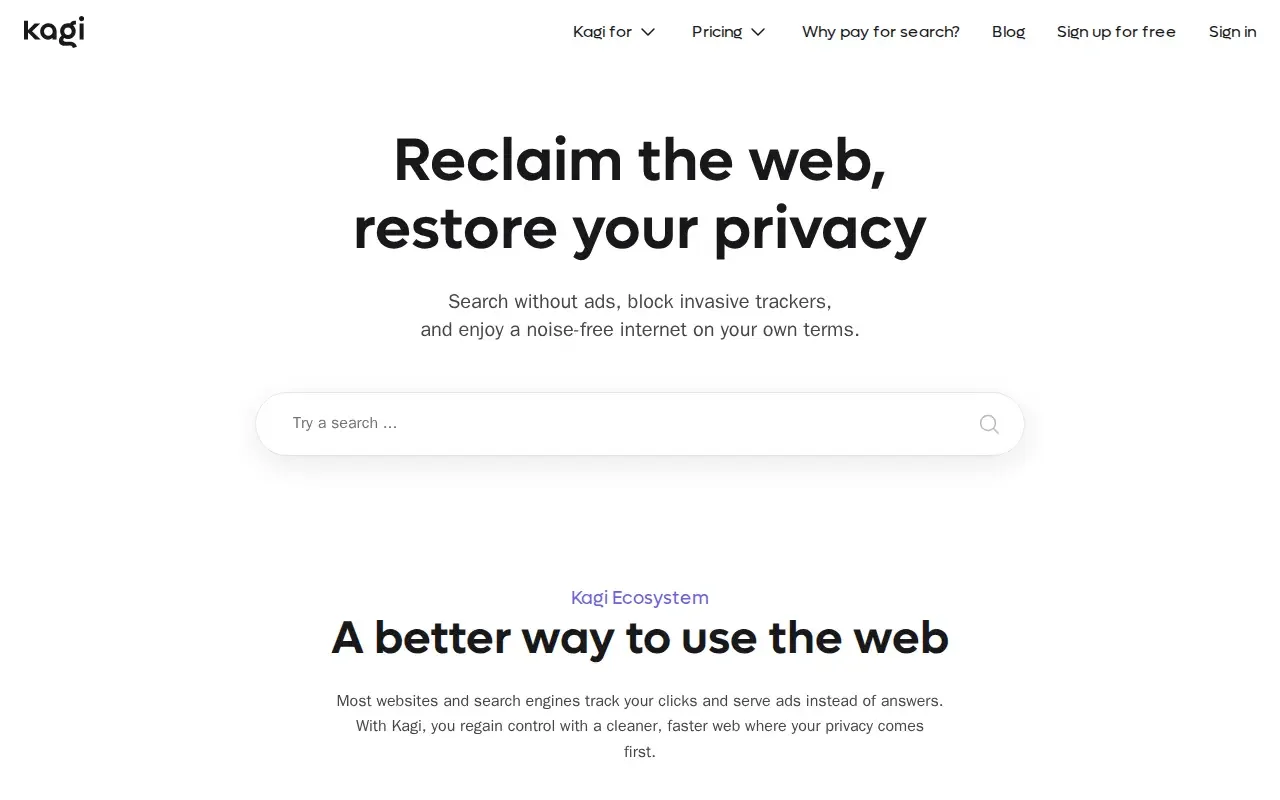
Image credit: Kagi Search listing on ShoutMyPost.
Why people look for Presearch alternatives
The Presearch project built an open-source, decentralized search service. On July 24, 2026, its team announced that the business could no longer cover its operating costs.
Replacing it means making a few choices:
- The service deadline was July 28 after a July 27 extension. You need somewhere else to run searches now, even if you still want to read its source code.
- Presearch's closure notice described problems with its inherited token model. The replacements use other ways to pay the bills: Kagi subscriptions, Qwant advertising, or MetaGer credits.
- A replacement can also change what you find. Marginalia and Wiby focus on smaller parts of the web. Think about whether you need one engine for daily lookups or a second one for exploring.
If you still have a Presearch-related asset or account issue, use the project's official closure information and verify the destination before sharing credentials. A new search engine won't recover those assets for you. Treat unsolicited recovery offers as a scam risk.
Quick picks
| Your priority | My pick | Why |
|---|---|---|
| Best daily search engine | Kagi | Paid search with domain preferences and custom lenses. |
| Best free starting point | Qwant | A general search engine you can use without paying for a search plan. |
| Best for teams that want managed subscriptions | Kagi | It offers a documented Team plan alongside individual plans. |
| Best open-source metasearch option here | Searx Party | A hosted SearXNG instance that doesn't require you to deploy the software. |
| Best for finding independent text-heavy sites | Marginalia Search | Its own crawler and index focus on a different slice of the web. |
| Best for leisurely discovery | Wiby | Its small-web focus and discovery tools encourage browsing beyond a quick answer. |
Compare the six options
Prices and plan details were checked October 8, 2026. Kagi's figures below are US dollars for monthly billing, plus applicable sales tax. MetaGer displays euro pricing, so its official price page is linked without a currency conversion.
| Tool | Best for | Platforms | Free access | Paid price | Open source | What it offers after Presearch |
|---|---|---|---|---|---|---|
| Kagi | Daily search with personal controls | Web; browser integration; Android Search app | 100-search trial | Starter $5/month billed monthly; Professional $10/month billed monthly, plus tax | Search service: no | Ad-free results, domain preferences, lenses, and team plans. |
| Qwant | General search without a subscription | Web; iOS and Android; browser integrations | Free search | No paid consumer search plan in its current public offer | Hosted search service: no | A conventional search starting point funded through ads and affiliate income. |
| MetaGer | Ad-free search paid by usage | Web; Android app; browser extension | Current ad-free access uses prepaid tokens | Paid token packages; official prices | Yes | Metasearch with source choices and prepaid access. |
| Marginalia | Noncommercial, text-oriented sites | Web | Public search is free | Free public service | Yes | An independent index and crawler focused on smaller sites. |
| Searx Party | Hosted open-source metasearch | Web | Public instance is free | Free public instance | SearXNG: yes | Results from multiple configured engines without running your own instance. |
| Wiby | Classic pages and hobbyist sites | Web | Public search is free | Free public service | Yes | A narrow index for lightweight pages and independent sites. |
Official table sources: Kagi plans, Kagi integrations, Qwant's business model, Qwant platforms, MetaGer, Marginalia, Searx Party, and Wiby.
Kagi: the strongest pick for a paid daily search routine
Kagi lets you block sites or pin them to the top of results. Lenses narrow a search to selected sites and filters. Its personalized-results guide explains the domain controls. That appeals most when the same websites keep getting in the way of your work.
A 2026 Hacker News discussion has enthusiastic Kagi recommendations alongside a paying user's complaint about worsening, SEO-heavy results. Paying for search doesn't settle the question of whether you'll like the pages it finds.
For a group that wants managed subscriptions, the Team plan makes Kagi the clearest option here.
The price is the drawback. The trial ends after 100 searches. Starter costs $5/month billed monthly, plus sales tax, for 300 searches; Professional costs $10/month billed monthly, plus tax, for unlimited search. Annual billing is also available.
Switch if you want ad-free general search and are willing to pay for site controls. Skip it if you need search to stay free.
Qwant: start here when paying for search is the obstacle
An August 2025 Qwant discussion reports repeated captchas on some VPN connections, while another VPN user had no such problem. If you use a VPN, check whether Qwant lets your searches through.
Qwant's business-model guide says search is free, funded by ads and shopping commissions. It offers web search and mobile apps, with browser instructions for Windows, Mac, and Linux. It's the broad-search choice here when you don't want to buy a plan or maintain a list of sites.
The weakness is the sponsored results. If removing ads was the reason you wanted a new engine, Qwant won't make that change for you.
Its region-setting guide explains how to adjust local results. When you need a nearby business or information for another country, check the chosen region before deciding that the engine has nothing helpful to show.
Switch if you want broad search without a monthly bill. Skip it if an ad-free results page comes first.
MetaGer: pay for searches without a standing subscription
In an April 2026 Mojeek forum discussion, a paying MetaGer user reported seeing only certain providers in the results. Another participant pointed to the setting for enabling Mojeek. A metasearch engine can offer several sources without having all of them active in your settings.
The service is operated by the nonprofit SUMA-EV and combines search sources. Its homepage links to the Android app and browser extension; the open-source project lets you inspect the software.
MetaGer uses prepaid tokens instead of a standing subscription. Its price page says an ad-free search with default settings uses one token, and buying credits doesn't create a standing order. That gives occasional searchers a different way to pay for ad-free results.
An August 2026 Google Play review liked MetaGer's use of Brave results. A January review on the same page disliked the app's implementation and preferred the desktop extension. If you're switching on a phone, check the app before buying a large credit package.
The drawback is having another balance to manage. If you want to open a tab and forget about payment, Qwant takes less thought. MetaGer's current prices are in euros, so follow its checkout information for your location instead of treating a converted estimate as the advertised price.
Switch if paying for ad-free searches as you need them works better for you. Skip it if a credit balance would become another thing you forget to check.
Marginalia Search: use it to find the web broad search misses
In a July 20, 2025 Hacker News discussion, a reader struggled to discover interesting sites through Marginalia. Developer Viktor Lofgren pointed to its Explore feature. You don't have to start with an exact query when your aim is finding something unfamiliar to read.
Marginalia runs its own crawler and index, focusing on small, text-oriented, noncommercial websites. Its project information and source repository explain how it approaches that part of the web. Public search is free.
Go with it when you're looking for personal writing or a niche subject that broad search keeps sending to the same few publishers. A small independent site can be worth reading even when it isn't competing to answer the most popular version of your question.
The smaller index is also its weakness. It isn't built to cover every ordinary query, and it won't be my first choice for a store's current opening hours.
Switch if independent, text-heavy sites are what you miss in your current results. Skip it as your sole default if most searches are for current commercial information.
Searx Party: try SearXNG without hosting it yourself
Searx Party is a public instance of SearXNG, the maintained open-source metasearch software. On October 8 its footer identified a build dated October 7, 2026. It is separate from the older Searx project.
Its footer's operator privacy-policy link returned an error on October 8. I'd wait for that policy to work before sending sensitive searches to Searx Party.
The appeal is trying open-source metasearch without running a server. The public web interface is free; the SearXNG repository documents the software behind it. That makes Searx Party easier to explore than deploying your own instance just to find out whether you like this way of searching.
A late-2025 discussion about SearXNG, the software behind Searx Party, praises ad-free searches without a login but also describes engines returning nothing after upstream blocking. A search source can stop answering even while the instance's own interface still loads.
You're relying on both the instance operator and the engines it asks for results. That is the drawback of a hosted setup: you don't control the server or how quickly its operator fixes a failed source. A software license alone doesn't tell you how a particular public server handles requests.
Switch if you want to explore hosted open-source metasearch. Skip it if you'd prefer to deal directly with an engine's publisher instead of a separate operator.
Wiby: the pick for browsing that isn't an urgent lookup
Wiby describes its mission as finding classic pages made by hobbyists and people writing about their interests. Its About page also explains the lightweight-web focus and links to its GPLv2 source.
A July 31, 2025 Hacker News comment describes bookmarking Wiby's Surprise me link for random visits to classic-web pages. Wiby is my pick for that kind of browsing, when finding an unfamiliar personal site is the point of the search.
Wiby offers free public search and a JSON interface. Its narrow focus is the drawback if you need one engine for work, shopping, and current events.
Switch if exploration and personal websites were your favorite part of independent search. Skip it as your main engine if most queries need broad, current coverage.
Other common picks
DuckDuckGo offers general search without saving your search history.
Brave Search uses Brave's own index and works in other browsers too.
Startpage sends queries anonymously to partners including Google and Bing.
Mojeek runs its own crawler and index.
Moving your search routine after Presearch
Presearch's closure notices covered withdrawal deadlines and limited support. They don't offer a search-settings export file, an account transfer, or a way to spend an old token balance on one of these engines. You'll need to set up any paid access at the new service and recreate the search preferences you want to keep.
Write down the settings you care about before copying them. A region choice or a short list of trusted sites is a manageable start; recreating every old preference can carry over choices you've stopped needing. Use one familiar query to see whether each setting helps you reach the kind of page you're looking for.
For browser setup, use Kagi's instructions or Qwant's desktop guide.
For more source choices, browse Search & Discovery, Search Engines & Tools, or the metasearch directory.
Questions about replacing Presearch
Did Presearch shut down?
Yes. The consumer search service closed in July 2026. The official GitHub organization is still a place to read the project's code, but it isn't a working replacement for the search website. For everyday searches, use a replacement such as Qwant or Kagi.
Is there a free Presearch alternative?
Yes. Qwant is the free general-search pick in this list. Marginalia, Wiby, and Searx Party also offer free access. You can keep more than one engine bookmarked: a broad search page for everyday questions and a smaller index for finding writing you wouldn't otherwise come across.
Which alternative is best if I don't want ads?
Kagi is the ad-free general-search pick; MetaGer is the prepaid option. The choice is how you prefer to pay: a plan or a balance you top up. Their free-access terms differ: Kagi has a 100-search trial, while MetaGer's ad-free access uses purchased tokens.
Which option is open source?
MetaGer, Marginalia, Wiby, and SearXNG provide source code. Searx Party runs SearXNG. If you want to learn how the software works, follow the source links in their sections. If you want to run it yourself, read that project's installation instructions before deciding to host it.
Sources
- Presearch closure announcement, July 24, 2026 and July 27 deadline update.
- Kagi pricing, domain preferences, and Team plans.
- Qwant funding and region settings.
- MetaGer homepage, prices, source code, and Google Play reviews.
- Marginalia project information and source code.
- Searx Party and SearXNG source.
- Wiby project information and privacy policy.
- DuckDuckGo privacy, Brave Search, Startpage search partners, and Mojeek's crawler and index.
- Wiby discovery discussion, July 2025.
- User and developer discussions linked in each tool's section.
Directory listings
Other options
Open a listing to review its directory details and current site link.
-
Alternative
Kagi Search
Kagi Search is a paid, ad-free search engine focused on user privacy. It blocks invasive trackers, delivers customizable, noise-free search results, and does not replace relevant answers with ads. The platform also provides companion tools including Kagi Assistant, the Orion Browser, Kagi Translate, Kagi News, and Kagi Summarize, plus team plans for organizational use. It markets itself as a human-first alternative to mainstream ad-supported search engines.
-
Alternative
Qwant
Qwant is a European-hosted search engine that does not store or sell user search data. It offers fast, reliable search results, a mobile app for iOS and Android, and a Flash Answers feature for instant answers.
-
Alternative
MetaGer
MetaGer is a privacy-focused metasearch engine and anonymous browsing tool. It allows users to search the web and browse websites without being tracked, and operates with no advertisements or activity logging. No personal details or account sign-up are required, as access keys are generated automatically. A one-time token payment activates ad-free, tracking-free search, anonymous browsing, and access to all current and future features, with 500 tokens costing approximately €5. The service is open source.
-
Alternative
Marginalia Search
Marginalia Search is a small, independent, do-it-yourself search engine that prioritizes content-rich, non-commercial websites that do not require cookie acceptance or newsletter subscriptions. It uses open source custom index and crawler software, operates without AI, and is licensed under AGPL. The service retains access logs containing IP addresses for up to 24 hours, complies with GDPR by not collecting personal information, and only uses cookies for core service functionality.
-
Alternative
searx.party
searx.party, branded as Searx Party, is an instance of SearXNG, a privacy-respecting, open source metasearch engine. Powered by SearXNG version 2026.9.25+12f8b6515, the site provides links to the SearXNG source code, issue tracker, engine statistics, a list of public instances, a privacy policy and contact information for the instance maintainer. It is associated with the Rock Eaters Network.
-
Alternative
Wiby
Wiby is a search engine focused on older-style, classic web pages. It is lightweight and centered on user-specified subjects of interest, with the goal of creating a web experience reminiscent of the early internet. Users can submit pages to the index, adjust their settings, and use the 'surprise me' feature.