The Plant Organelles Database 3 (PODB3) is a specialized database project on organelle dynamics, function, biogenesis, differentiation, movement and interactions. It consists of six parts, including an Electron Micrograph Database, a Perceptive Organelles Database, an Organelles Movie Database, an Organellome Database, a Functional Analysis Database and external links. Data and protocols come from submissions by plant researchers. Data are free only to non-profit institutions, universities and colleges.
Directory
Search results
Published directory entries matching your search.
The ERCOFTAC Classic Collection Database provides access to test cases from the original ERCOFTAC Database, started in 1995. Administered by the CFD and Turbulence Mechanics research group at The University of Manchester, it offers case descriptions, downloadable data and references, and is open to fluid dynamicists worldwide.
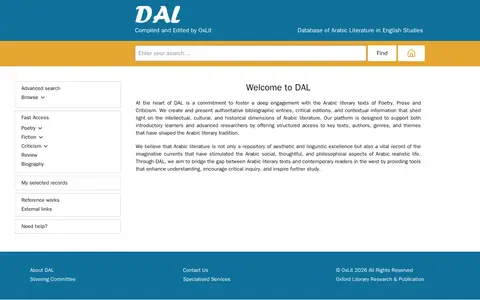
Database of Arabic Literature in English Studies (DAL) is a database compiled and edited by OxLit. It aims to advance the study, appreciation, and accessibility of Arabic literary heritage. DAL provides authoritative bibliographic entries, critical editions, and contextual information on poetry, prose, and criticism. The platform supports both introductory learners and advanced researchers with structured access to key texts, authors, genres, and themes.
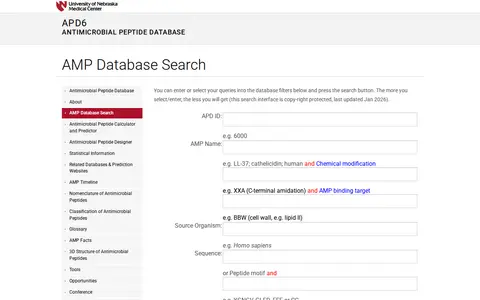
The Antimicrobial Peptide Database (APD6) is a resource focused on antimicrobial peptides. It offers a searchable interface with filtering options by attributes such as AMP ID, name, chemical modification, binding target, source organism, sequence, and peptide length. The database also includes supplementary materials including nomenclature guidance, classification systems, a glossary, 3D structure information, statistical data, related database links, and news updates.
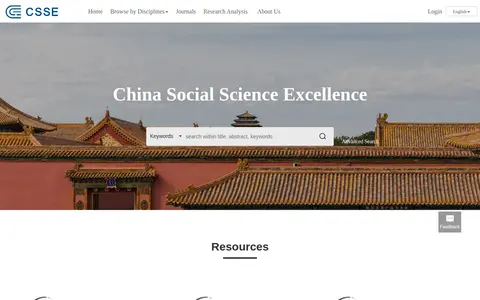
China Social Science Excellence is a platform from the Information Center for Social Science of RUC offering search across a full-text database of social science articles, a digest database, an index database and monographic studies. It covers disciplines including politics, law, philosophy, economics and management, literature, education, history and geography.
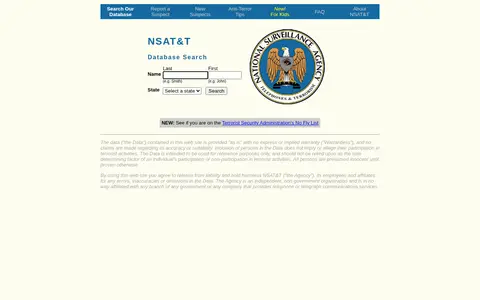
A website that presents a searchable database of names labeled as suspected terrorists under the name National Surveillance Agency for Telephones and Terrorism. It includes links for reporting a suspect, anti-terror tips, new suspects and an FAQ. The site states that inclusion does not imply participation in terrorist activities and that the agency is independent and non-government.
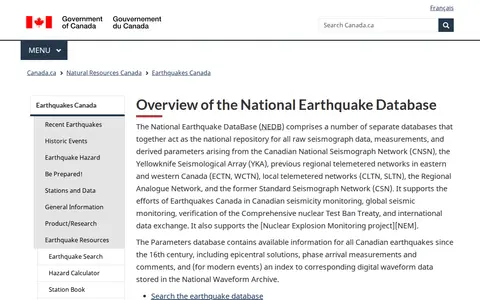
The National Earthquake DataBase (NEDB) is a set of separate databases forming the national repository for raw seismograph data, measurements and derived parameters from Canadian and other seismograph networks. Its Parameters database holds information on Canadian earthquakes since the 16th century, and its Stations database holds seismograph station data.
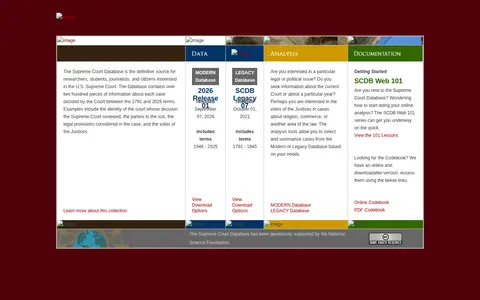
The Supreme Court Database is a dataset about U.S. Supreme Court cases, containing over two hundred pieces of information per case, including parties, legal provisions and Justice votes. It covers the 1946 to 2025 terms in the Modern Database and 1791 to 1945 in the Legacy Database, with analysis tools and codebooks for researchers, students, journalists and citizens.
RAND terrorism incidents database for searching attacks, locations, groups, and event details.
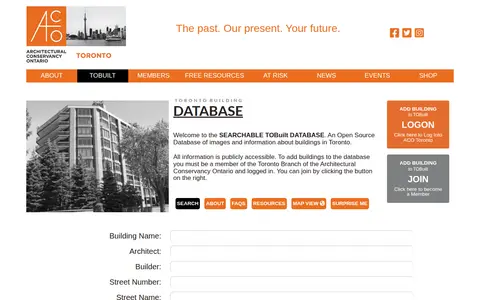
TOBuilt is an open source searchable database of images and information about buildings in Toronto. All information is publicly accessible. Adding buildings to the database requires membership in the Toronto Branch of the Architectural Conservancy Ontario and being logged in.
Academic Search is an academic research database offered by EBSCO. It provides access to more than 10,000 full-text journals spanning a wide range of academic disciplines, supporting research across numerous fields. Access to the database is available exclusively through participating institutions including academic libraries, universities, and other eligible organizations. The platform enables users to access peer-reviewed research, journal articles, and related scholarly resources for academic and professional purposes.
The Androgen Receptor Mutations Database is a resource hosted by The Lady Davis Institute for Medical Research that catalogs mutations of the Androgen Receptor Gene. It accepts new mutation submissions from reputable research or clinical laboratories, and users are asked to reference its 2012 update paper when citing the database.
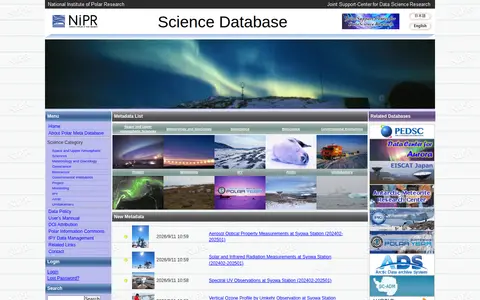
The National Institute of Polar Research Science Database is a metadata portal organizing polar science data into categories including space and upper atmospheric sciences, meteorology and glaciology, geoscience, and bioscience. It also covers governmental institutions, project monitoring, IPY, Arctic, and Umitakamaru. The database provides search, DOI attribution, and a data policy, and is licensed under Creative Commons Attribution 3.0 Unported.
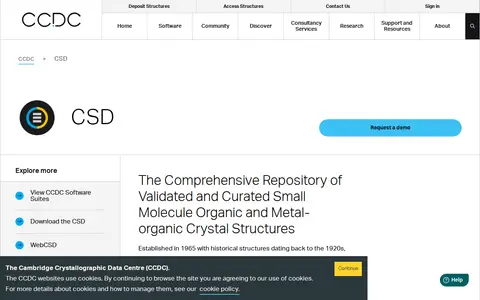
The Cambridge Structural Database (CSD), maintained by the Cambridge Crystallographic Data Centre, is the largest curated crystal structure database. It supports structural chemistry research across fields including drug discovery, solid form analysis, and functional materials design, with associated software tools for searching, analysing, and working with crystal structure data. The platform also offers community resources, training support, and data deposit services.
The ROCEEH Out of Africa Database (ROAD) is a research database offering simple search functionality, with supporting documentation including table descriptions, an entity relationship diagram, a manual and FAQs. Full access requires user registration, and the service will be temporarily unavailable on September 28, 2026 from 4:00 PM to approximately 4:30 PM German time for emergency procedure testing.
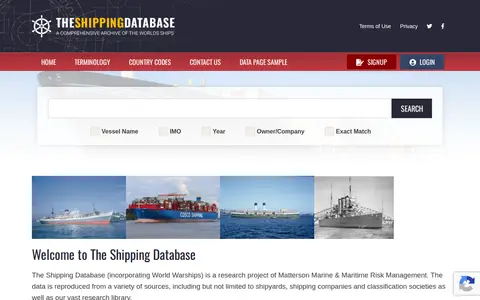
Shipping Database is a research project incorporating World Warships, run by Matterson Marine & Maritime Risk Management. It reproduces vessel data from shipyards, shipping companies, classification societies and a research library, covering barges and inland waterways vessels as well as other ships, with a terminology page explaining terms.
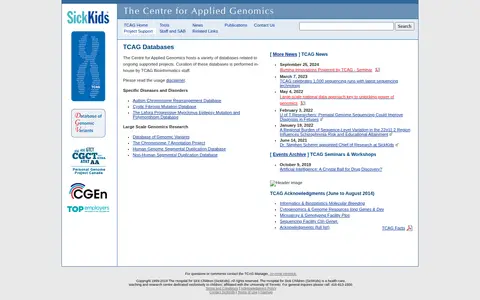
The Centre for Applied Genomics hosts databases related to its ongoing supported projects. Curation is performed in-house by TCAG Bioinformatics staff. The databases cover specific diseases and disorders, including autism and cystic fibrosis, as well as genomic research topics such as genomic variants, chromosome 7 annotation, and segmental duplications.
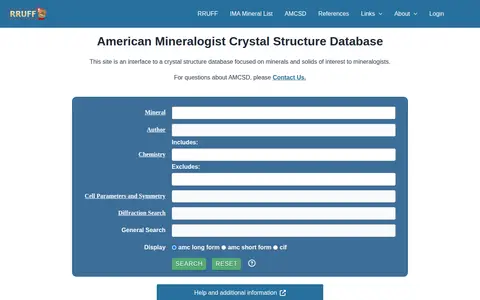
The American Mineralogist Crystal Structure Database (AMCSD) is an interface to a crystal structure database focused on minerals and solids of interest to mineralogists. Part of the RRUFF mineral data platform, it allows users to search for mineral data by chemistry, including filtering by element inclusion or exclusion, and access related mineral lists, references and supporting tools.
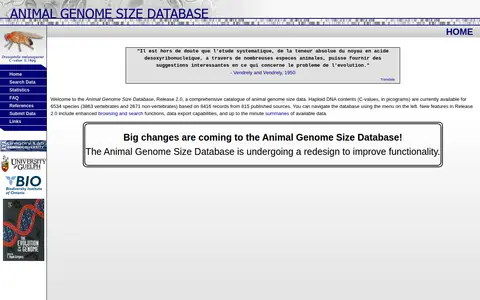
The Animal Genome Size Database is a catalogue of animal genome size data. It provides haploid DNA contents in picograms for 6534 species, with 8416 records drawn from 815 published sources. Release 2.0 adds enhanced browsing and search functions, data export capabilities, and summaries of available data. The database is for personal and academic use.
Bibliographic database for topics related to religion.
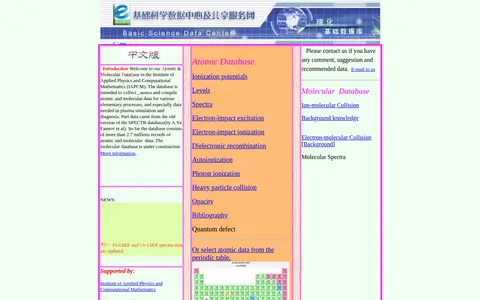
The Atomic & Molecular Database at the Institute of Applied Physics and Computational Mathematics collects, assesses and compiles atomic and molecular data for elementary processes, particularly data used in plasma simulation and diagnosis. It holds more than 2.7 million records and includes an ionization potentials and levels index and a periodic table selector. The molecular database is under construction.
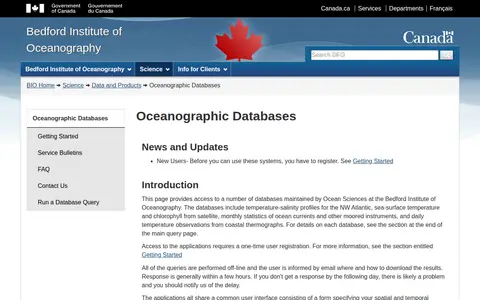
The Bedford Institute of Oceanography provides access to oceanographic databases maintained by Ocean Sciences. The databases cover temperature-salinity profiles for the NW Atlantic, satellite sea-surface temperature and chlorophyll, monthly statistics of ocean currents and moored instruments, and daily coastal thermograph observations. Access requires a one-time user registration, and queries run off-line with results sent by email.
The database of Biofilm-active antimicrobial peptides is described as the first database dedicated to antimicrobial peptides tested specifically against microbial biofilms. It aims to provide open-access resources on AMPs against biofilms for microbiologists, bioinformatics researchers and medical scientists working in the field.
The Brain Transcriptome Database (BrainTx) is an integrated platform for visualizing and analyzing original transcriptome data and publicly accessible transcriptome data related to the genetics underlying brain development, function, and dysfunction. Developed from the Cerebellar Development Transcriptome Database, it offers gene and keyword searches and spatiotemporal gene expression profiles.