
testphase.rechtsinformationen.bund.de
Browse public datasets, metadata and downloadable records in an open catalog.
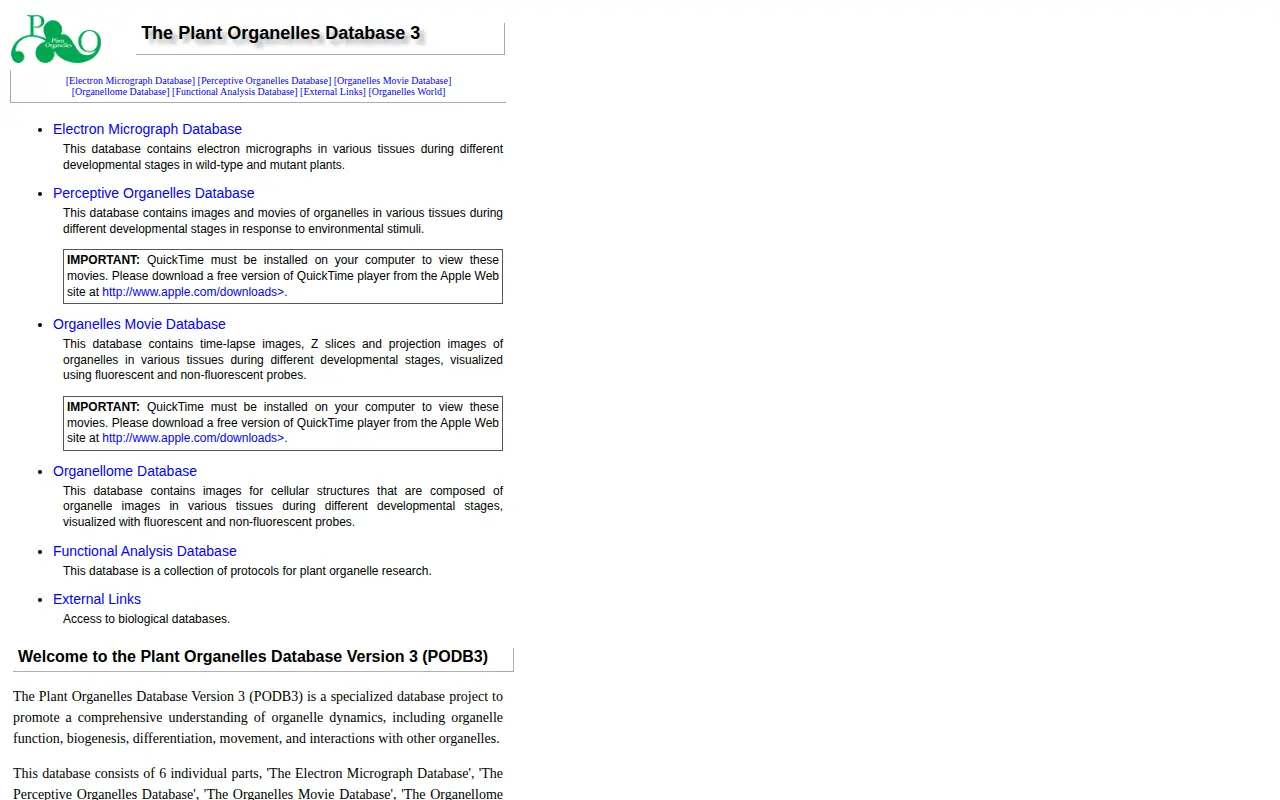
The Plant Organelles Database 3 (PODB3) is a specialized database project on organelle dynamics, function, biogenesis, differentiation, movement and interactions. It consists of six parts, including an Electron Micrograph Database, a Perceptive Organelles Database, an Organelles Movie Database, an Organellome Database, a Functional Analysis Database and external links. Data and protocols come from submissions by plant researchers. Data are free only to non-profit institutions, universities and colleges.
Browse public datasets, metadata and downloadable records in an open catalog.

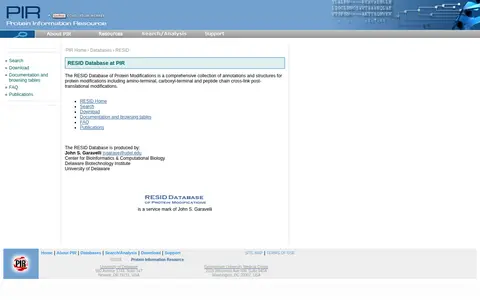
The RESID Database of Protein Modifications is a collection of annotations and structures for protein modifications, including amino-terminal, carboxyl-terminal and peptide chain cross-link post-translational modifications. It is produced by John S. Garavelli at the Center for Bioinformatics & Computational Biology, University of Delaware, and hosted by the Protein Information Resource.

The J. Craig Venter Institute is a research organization dedicated to advances in human health and the environment through genomic research. Its stated work includes genomic research, synthetic biology, tracking plastic pollution, and a center for innovative recycling and circular economy.

The Chesapeake Bay Data Hub provides access to monitoring and modeling data related to the Chesapeake Bay, past and present. Bay Program databases can be queried using user-defined inputs such as geographic region and date range, and each query returns a downloadable tab- or comma-delimited text file for import into programs such as SAS, Excel and Access.

The data.bris Research Data Repository is managed by the University of Bristol Research Data Service and builds on investment in the Research Data Storage Facility. It offers a means for Bristol's researchers to share research data openly with the world.

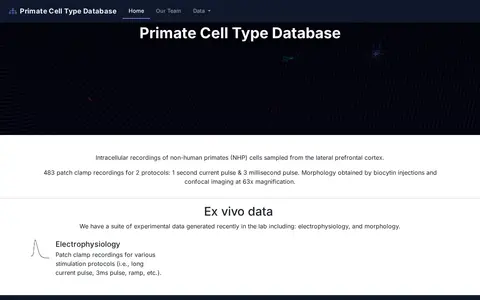
The Primate Cell Type Database provides ex vivo data from non-human primate cells sampled from the lateral prefrontal cortex. It includes intracellular patch clamp recordings for two protocols, a 1 second current pulse and a 3 millisecond pulse, and morphology obtained by biocytin injections and confocal imaging at 63x magnification.
Community notes
Be the first to share how this project worked for you.
Sign in with a verified account to leave a review or join the discussion.
Sign in to reviewKeep exploring
Browse public datasets, metadata and downloadable records in an open catalog.
The RESID Database of Protein Modifications is a collection of annotations and structures for protein modifications, including amino-terminal, carboxyl-terminal and peptide chain cross-link post-translational modifications. It is produced by John S. Garavelli at the Center for Bioinformatics & Computational Biology, University of Delaware, and hosted by the Protein Information Resource.
The J. Craig Venter Institute is a research organization dedicated to advances in human health and the environment through genomic research. Its stated work includes genomic research, synthetic biology, tracking plastic pollution, and a center for innovative recycling and circular economy.
The Chesapeake Bay Data Hub provides access to monitoring and modeling data related to the Chesapeake Bay, past and present. Bay Program databases can be queried using user-defined inputs such as geographic region and date range, and each query returns a downloadable tab- or comma-delimited text file for import into programs such as SAS, Excel and Access.
The data.bris Research Data Repository is managed by the University of Bristol Research Data Service and builds on investment in the Research Data Storage Facility. It offers a means for Bristol's researchers to share research data openly with the world.
The Primate Cell Type Database provides ex vivo data from non-human primate cells sampled from the lateral prefrontal cortex. It includes intracellular patch clamp recordings for two protocols, a 1 second current pulse and a 3 millisecond pulse, and morphology obtained by biocytin injections and confocal imaging at 63x magnification.