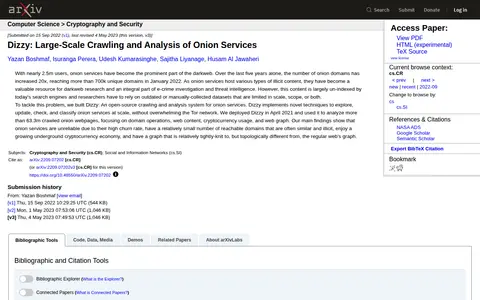

Dizzy is an open-source crawling and analysis system for onion services. It implements techniques to explore, update, check, and classify onion services at scale without overwhelming the Tor network. It was deployed in April 2021 and used to analyze more than 63.3 million crawled onion webpages, focusing on domain operations, web content, cryptocurrency usage, and web graph.
Directory
Search results
Published directory entries matching your search.
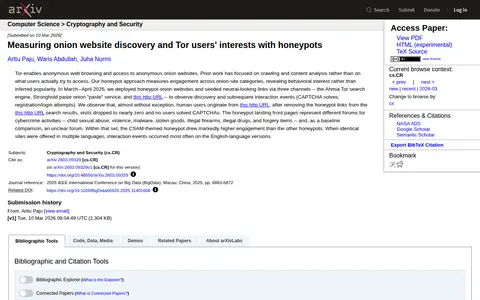
An arXiv paper measuring onion website discovery and Tor users' interests with honeypots. The authors deployed honeypot onion websites in March–April 2025 and seeded links via three channels to observe interaction events. They report that human users almost without exception originated from Ahmia.fi, and that the CSAM-themed honeypot drew markedly higher engagement than the others.

Security Onion Solutions, LLC is the creator and maintainer of Security Onion, a free and open platform for threat hunting, network security monitoring and log management. It bundles free and open tools including Suricata, Zeek and the Elastic Stack, and the company sells products and services that fund development.
Official guides for understanding, deploying and maintaining Tor onion services.
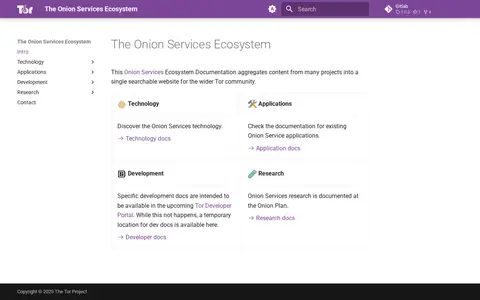
Tor Project documentation portal for onion-service applications, standards and operator tools.
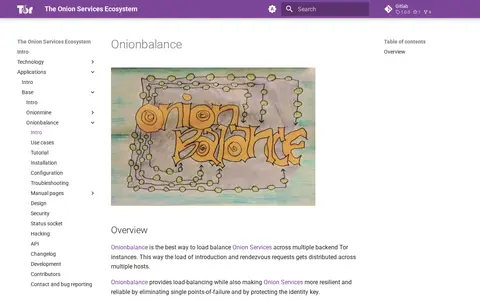
Load-balancing system for resilient Tor onion services, documented by the Tor onion-services team.
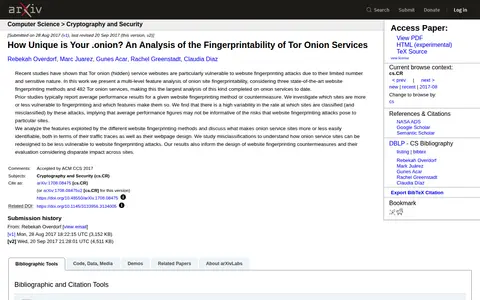
Study of whether website fingerprinting can distinguish and identify Tor onion-service traffic.
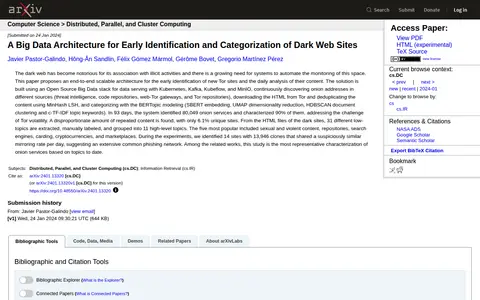
This arXiv paper proposes an end-to-end scalable architecture for early identification of new Tor sites and daily analysis of their content. It is built on an open source big data stack including Kubernetes, Kafka, Kubeflow and MinIO, discovering onion addresses across several sources, downloading HTML from Tor, deduplicating with MinHash LSH and categorizing with BERTopic modeling. In 93 days it identified 80,049 onion services and characterized 90% of them.
Historical visualization and research record mapping a sample of linked Tor onion services.
A working paper by John Schriner that focuses on how researchers monitor the Dark Web. It defines onion services and Tor and discusses tools for monitoring and securing onion services.
Open-source utility for gathering public metadata about onion services during authorized research.
Tor measurement project collecting performance data for public relays, bridges and onion services.
Tor Stack Exchange is a question-and-answer site for researchers, developers, and users of Tor. Questions cover topics such as onion services, exit relays, Tails, the Tor Browser Bundle, anonymity, and configuration.
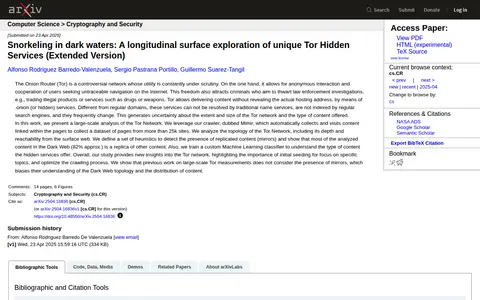
An arXiv paper presenting a large-scale analysis of the Tor network using a crawler called Mimir, which collects and visits linked content. The authors report a dataset of pages from more than 25k sites and examine network topology, replicated content and content types.
Open-source scanner for auditing onion-service metadata and operational security.
onionsearch is a Python script that scrapes URLs on different .onion search engines. It is distributed on PyPI as version 1.3, released on October 22, 2021, under the GNU General Public License v3. The package page states the author has not provided a project description.
Twisted-based Python library for controlling Tor and building onion-service applications.
Tor add-on that helps onion-service operators reduce guard-discovery and related attacks.
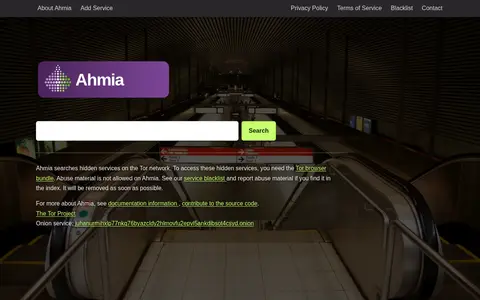
Ahmia is a search engine for services on the Tor network. It indexes hidden services, which require the Tor browser bundle to access, and states that abuse material is not allowed and is removed from the index. The project is developed as free and open source software, with a crawler, an index and a search website.
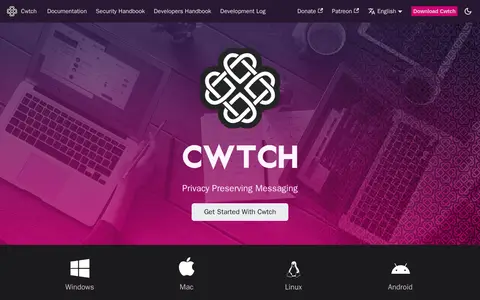
Cwtch is a decentralized, privacy-preserving, metadata resistant messaging app. Communication is end-to-end encrypted and takes place over Tor v3 onion services. Participants can host their own safe spaces or lend infrastructure to others. The protocol is open, and anyone is free to build bots, services and user interfaces.
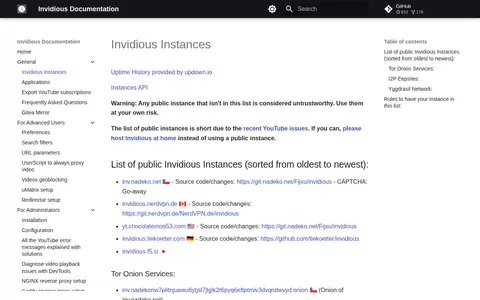
Official Invidious documentation page listing public Invidious instances, sorted from oldest to newest, with addresses for clearnet, Tor onion services, I2P eepsites and the Yggdrasil network. It states that public instances not in the list are considered untrustworthy and lists rules instances must meet to be included.
Orbot is a Tor VPN for Android and iOS that routes app traffic through the Tor network. It lets Android users choose which apps route through Tor and allows apps to connect to onion services. It offers access to Tor Bridges for restricted networks. The project is free and open source, with code that anyone may inspect.
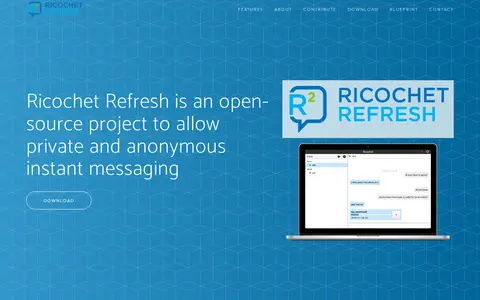
Ricochet Refresh is an open-source project to allow private and anonymous instant messaging. It is a peer-to-peer messenger app that uses Tor to connect clients, creating a Tor hidden service on the computer. The project updates the original Ricochet software and is compatible with Tor Onion Services v3.
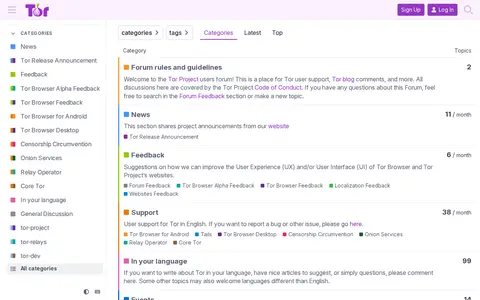
The Tor Project Forum is a discussion site for Tor users. It hosts user support, Tor blog comments, project announcements, feedback on Tor Browser and Tor Project websites, and discussions in languages other than English. It also covers events, general Tor ecosystem topics, read-only mirrors of Tor Project mailing lists, and development of Arti.