
A blog guide on FinetuneDB covering best practices for evaluating Large Language Model outputs. It explains what LLM output evaluation is, why it matters, and describes evaluation datasets, model-based judgments and human judgments as approaches for structuring the process.
Directory
Search results
Published directory entries matching your search.
Filters

huggingface.co
This is a Hugging Face Space created by AllenAI that hosts an interactive RewardBench leaderboard. Users can filter the leaderboard by model name pattern or model type to view scores for each model across RewardBench evaluation categories, and can download the full evaluation results.

This is a blog post from Confident AI that serves as a guide to LLM evaluation metrics. It covers retrieval-augmented generation (RAG) metrics such as faithfulness and answer relevancy, agent metrics, LLM-as-a-judge approaches, and includes working DeepEval code examples.

blogs.nvidia.com
The Guide to LLM Evaluation Deci provides machine-learning models, research, training resources, or evaluation tools.

github.com
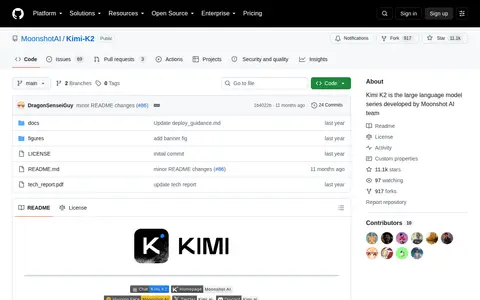
Kimi K2 is a large language model series developed by Moonshot AI. The repository includes model introductions, key features, model variants, summaries, and evaluation results. It is hosted on GitHub as an open-source project.

aimultiple.com
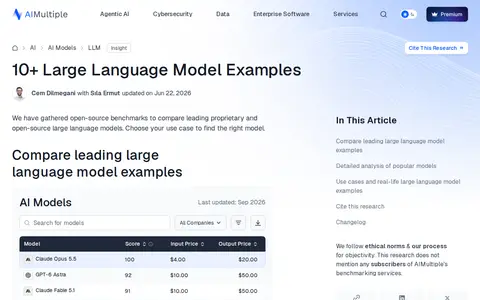
This webpage provides a curated list of large language model examples, alongside insights on business adoption, language model training, and influential models. It includes comparative analysis of leading LLMs such as OpenAI’s GPT-5, Claude 4.6, Gemini, DeepSeek-R1, Qwen, Llama 4, and xAI Grok-4 and Grok-4.1.

github.com
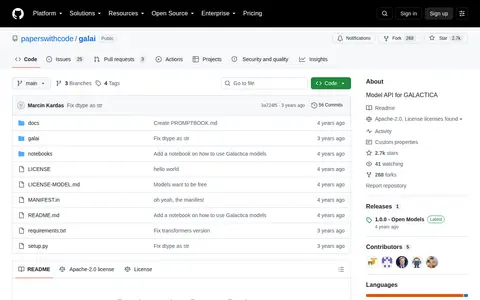
GALACTICA is a general-purpose scientific language model trained on scientific text and data. This repository provides a Model API for GALACTICA, installable from pip or the repository, with five model sizes. The models can be used with the transformers library. It is a stand-alone model that is not instruction tuned, so correct prompts are needed for good results.

github.com
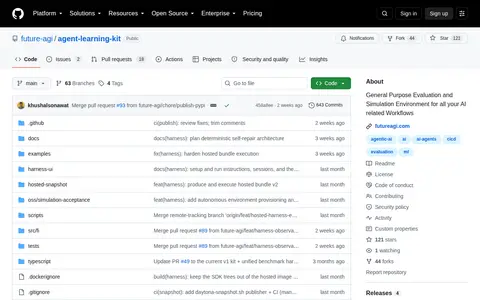
Open-source project that provides machine-learning models, research, training resources, or evaluation tools.

github.com
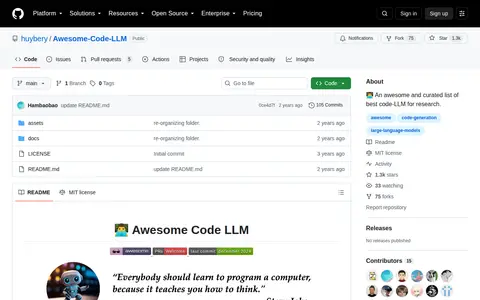
Awesome-Code-LLM is a curated list of code large language models for research, covering top code LLMs, evaluation toolkits, leaderboards and related papers. It also lists evaluation frameworks for autoregressive code generation models and a secure sandbox for judging generated code.

github.com
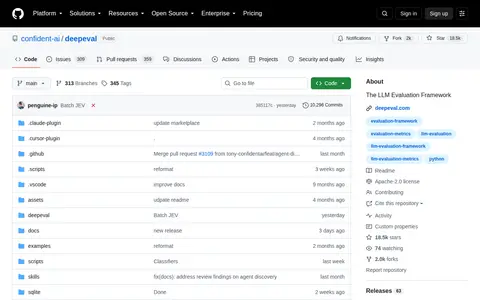
DeepEval is an open-source LLM evaluation framework, described as similar to Pytest but specialized for unit testing LLM apps. It provides evaluation metrics such as G-Eval, task completion, answer relevancy and hallucination, which use LLM-as-a-judge and other NLP models running locally. It can evaluate LLM apps end-to-end, complete agent trajectories, and individual agent steps.

llm-eval.github.io
Research on evaluation of LLMs conducted by Microsoft Research and other collaborated institutes. (Updated at: 2023/10).


airtrain.ai
No-code batch compute platform for LLM evaluation and tuning workloads.
docs.clarifai.com
Documentation for LLM Evaluation Clarifai Guide, covering setup, features, and practical usage.
github.com
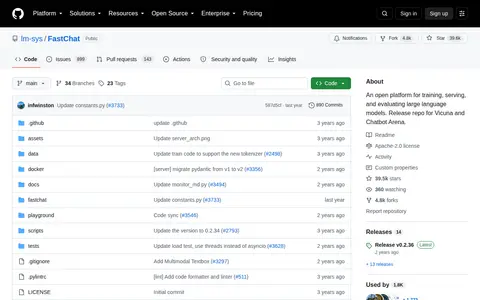
FastChat is an open platform for training, serving, and evaluating large language model based chatbots. Its core features include training and evaluation code for models such as Vicuna and MT-Bench, and a distributed multi-model serving system with a web UI and OpenAI-compatible RESTful APIs.

huggingface.co
The Open VLM Leaderboard is an interactive Hugging Face Space that displays the Open VLM main leaderboard and individual dataset leaderboards. Users can filter results by evaluation dimensions, model size, model type and other related criteria.

promptlayer.com
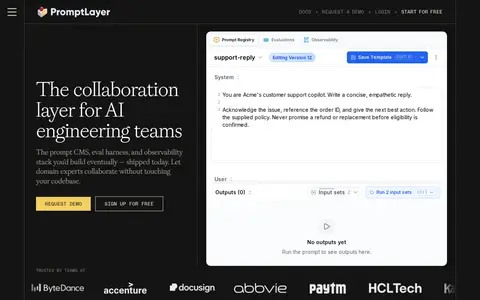
PromptLayer is a prompt management platform for AI engineering teams. It offers prompt versioning, large language model evaluation tools, and AI agent observability via tracing, logs, and regression sets, plus a visual editor for prompt iteration and collaboration.

huggingface.co
VBench is a Hugging Face Space created by Vchitect that hosts a leaderboard for AI video generation models. Users can upload a zip file with their model's evaluation JSON files and provide details such as model name, link, team, and contact email. The application extracts the metrics and updates the benchmark leaderboard accordingly.

ernie.baidu.com
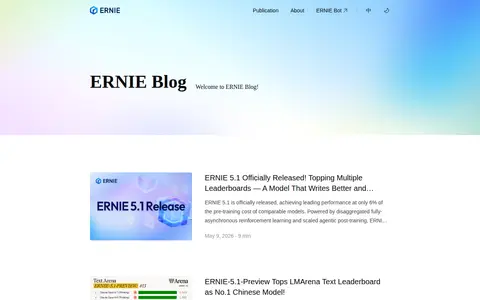
ERNIE is Baidu's blog covering its model releases. Posts describe ERNIE 5.1, a model trained with disaggregated fully-asynchronous reinforcement learning and scaled agentic post-training, and ERNIE 5.0, a 2.4 trillion-parameter unified multimodal model trained from scratch that integrates text, image, video and audio in a single autoregressive framework. ERNIE-Image is a text-to-image generation model built on a single-stream Diffusion Transformer.

github.com
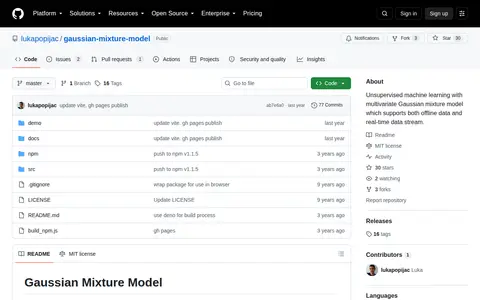
Gaussian Mixture Model is an unsupervised machine learning implementation using a multivariate Gaussian mixture model. It supports both offline data and real-time data streams. The repository provides installation instructions, a simple example, and a license. It is hosted on GitHub at https://github.com/lukapopijac/gaussian-mixture-model.

huggingface.co
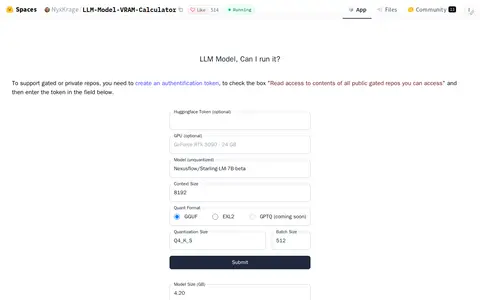
LLM Model VRAM Calculator is a Hugging Face Space created by NyxKrage. The tool allows users to input a Hugging Face model name, select a target GPU, set context length and quantization options, then calculates the model's required memory size and context buffer capacity to aid LLM deployment planning.

github.com
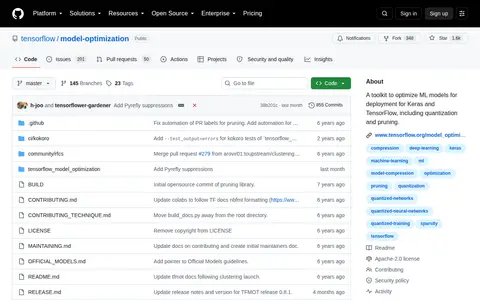
TensorFlow Model Optimization is a toolkit designed to optimize machine learning models for deployment for Keras and TensorFlow. It includes techniques such as quantization and pruning to reduce model size and improve inference performance.
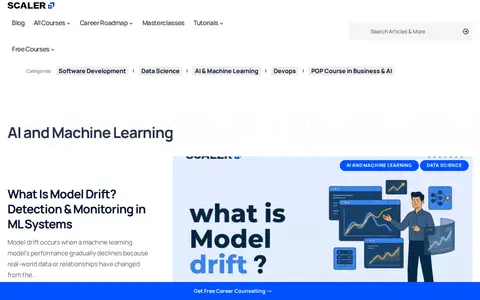

scaler.com
This is a Scaler blog category page collecting articles on artificial intelligence and machine learning. Posts listed include MLOps projects, becoming an AI research scientist, model drift detection and monitoring, and retrieval-augmented generation evaluation metrics. The page also links to categories such as software development and data science, and offers career counselling.
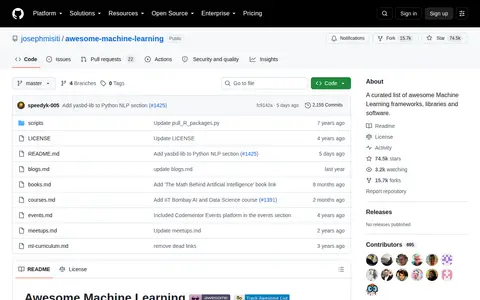

github.com
Open-source project that provides machine-learning models, research, training resources, or evaluation tools.
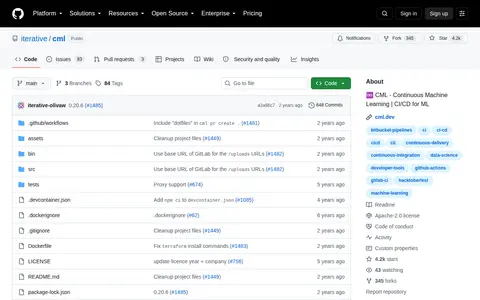

github.com
CML, or Continuous Machine Learning, is an open-source CLI tool for implementing CI/CD with a focus on MLOps. It is used to automate development workflows, including machine provisioning, model training and evaluation, comparing ML experiments across project history, and monitoring changing datasets. It can generate a visual report with results and metrics automatically on every pull request, using GitLab, GitHub, or Bitbucket.