This page describes an online car recognition tool that identifies vehicle information from an uploaded car picture, including brand, model, year and color. The page states that users upload a photo and click the "Car Model Recognition" button to use a machine learning model to identify the vehicle online. It is one of many tools listed on the ToolPie site.
Directory
Search results
Published directory entries matching your search.
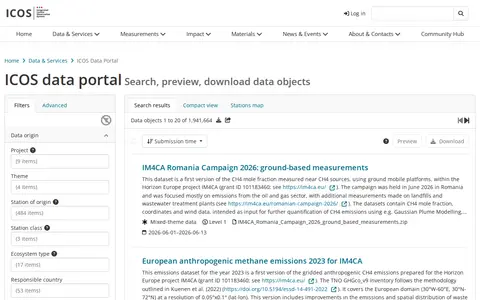
The ICOS Carbon Portal is the data access point for the Integrated Carbon Observation System (ICOS), a network measuring atmospheric, ecosystem, and ocean greenhouse gas data across European member countries. It provides access to raw and processed measurement datasets, along with tools including STILT atmospheric transport modeling, DOI minting, and SPARQL querying to support climate change and emissions research.
The Internet Game Cars Database is a reference site listing vehicles seen in video games, both playable and unplayable, with image captures and additional information. Visitors can search by video game, make or model. The site also provides pictures taken directly from games and allows members to contribute comments and images.
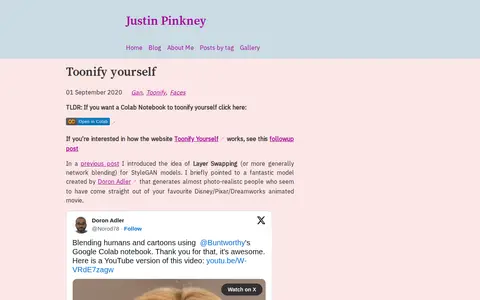
A blog post by Justin Pinkney explaining how to toonify yourself, making a photo-realistic cartoon model using StyleGAN model blending. It describes transfer learning by fine-tuning a faces model on animated film characters, then swapping layers so low resolution layers give a cartoon face structure while high resolution layers keep photo-realistic rendering.
The caret package provides a set of functions in R intended to streamline creating predictive models. Its tools cover data splitting, pre-processing, feature selection, model tuning using resampling and variable importance estimation, and it offers a uniform interface and standardized common tasks.
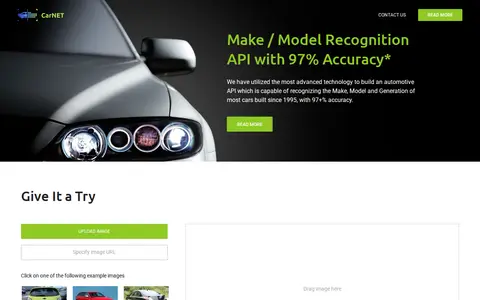
CarNet.AI is a car make and model recognition API. The service reports recognizing the make, model and generation of most cars built since 1995. API access is obtained by messaging the service through its contact form. The company states it has data on 300 car brands and 3100+ models.
Cartesia uses AI for speech, voice, transcription, music, or other audio workflows.
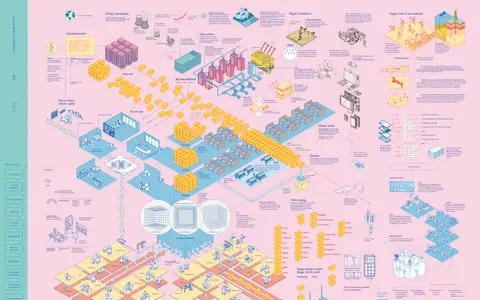
Cartography of generative AI is a project presenting a mapped account of generative AI in multiple languages. It discusses how tools automate writing and image generation through examples and statistical models trained on datasets, and examines the extraction of internet content for training datasets and related controversies.
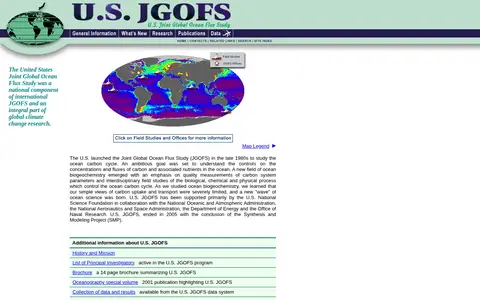
The U.S. Joint Global Ocean Flux Study (U.S. JGOFS) was a national component of international JGOFS, launched in the late 1980s to study the ocean carbon cycle. Its goal was to understand the controls on the concentrations and fluxes of carbon and associated nutrients in the ocean. The program ended in 2005 with the conclusion of the Synthesis and Modeling Project (SMP).
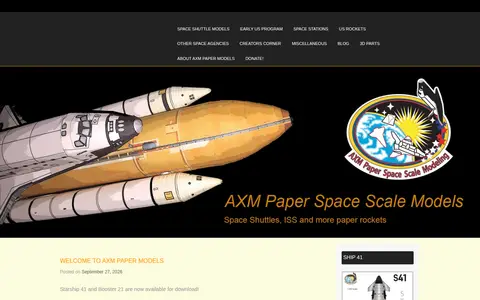
AXM Paper Space Scale Models is a paper model site featuring space shuttles, the ISS and paper rockets. The page announces that a Cargo Dragon CRS-35 model is available and notes a pending postflight model for S40, with featured model photos from followers.
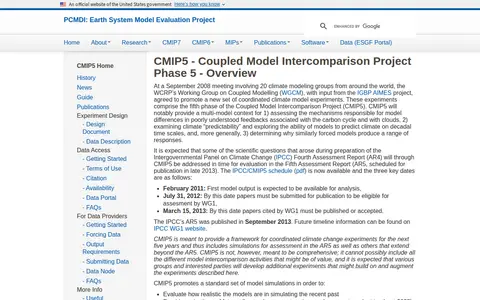
CMIP5 is the fifth phase of the Coupled Model Intercomparison Project, promoted by the WCRP Working Group on Coupled Modelling with input from IGBP AIMES. It provides a multi-model framework for coordinated climate model experiments, including assessment of carbon cycle and cloud feedbacks, climate predictability on decadal timescales, and differing responses of similarly forced models.
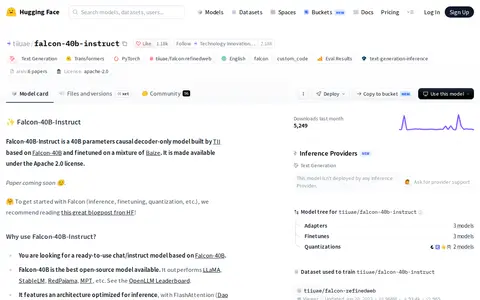
Falcon-40B-Instruct is a 40B parameter causal decoder-only model built by TII based on Falcon-40B and finetuned on a mixture of Baize, released under the Apache 2.0 license. It is intended as a ready-to-use chat and instruct model, and the card notes it may not be ideal for further finetuning. The model is trained mostly on English data, and users are advised to take precautions for production use.
This is a Scaler blog category page collecting articles on artificial intelligence and machine learning. Posts listed include MLOps projects, becoming an AI research scientist, model drift detection and monitoring, and retrieval-augmented generation evaluation metrics. The page also links to categories such as software development and data science, and offers career counselling.
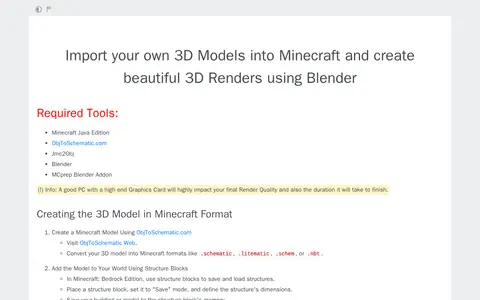
A guide by cweeper for importing custom 3D models into Minecraft and creating renders in Blender. It lists required tools including Minecraft Java Edition, ObjToSchematic.com, Jmc2Obj, Blender, and the MCprep Blender addon, and covers converting models to Minecraft formats, exporting worlds, and setting up Blender. It notes that a high-end graphics card affects render quality and duration.
MLOps Community is a global community for machine learning engineers focused on MLOps. It facilitates knowledge sharing, real-world problem solving, networking, and career advancement through in-person meetups and conferences, virtual tech talks, podcasts, workshops, and masterclasses. It reports membership of over 70,000 to 90,000 ML practitioners.
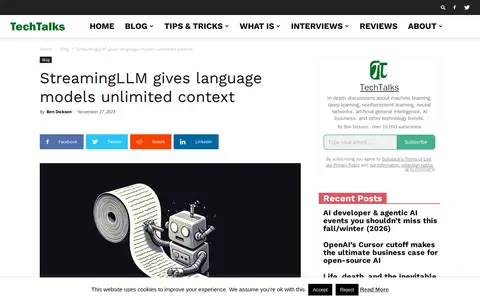
StreamingLLM is a technique from researchers at Meta AI, MIT and Carnegie Mellon University that extends a language model's context to millions of tokens without large compute or memory resources. The article describes it as addressing the fixed context length of models such as Llama-2, which has a context of approximately 4,000 tokens.
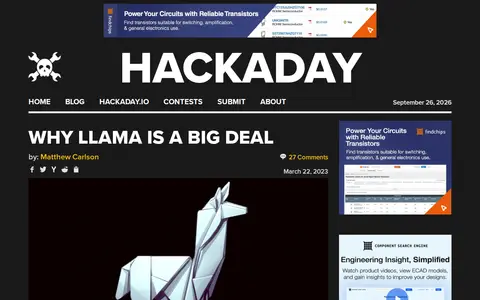
A Hackaday article by Matthew Carlson explaining why LLaMa matters. It describes LLaMa as a transformer language model from Facebook/Meta research spanning 7 billion to 65 billion parameters, and notes that llama.cpp runs inference with 4-bit quantization.
AGENTS.inc provides autonomous AI agents for enterprise marketing, sales and market intelligence, offered as Agents-as-a-Service. Two deployment models are offered: agents hosted and maintained by the company, or deployed into the customer's own infrastructure. The company states its agents are grounded in customer systems of record and that outputs carry source provenance.
An overview of the current attack techniques on LLMs by Marcello Carboni.
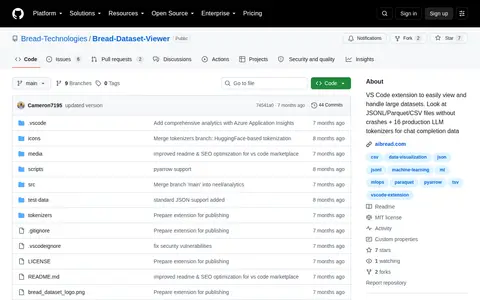
Bread Dataset Viewer is a VS Code extension for viewing and handling large datasets. It opens JSONL, Parquet, CSV, TSV, JSON, and Arrow/Feather files by streaming and lazy-loading data, and provides Cards, Table, and Raw views. It includes 16 production LLM tokenizers from GPT, Claude, Llama, and Qwen for chat completion data.
CancerData is a website promoting free and open-source resource sharing for cancer care. It offers a collection of resources including a brain radiotherapy atlas and contouring instructions, and highlights a deep learning model for contouring guidelines for organs at risk in neuro-oncology.
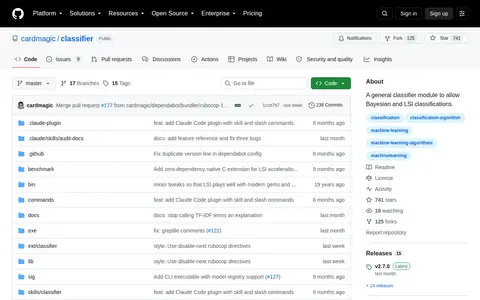
A general classifier module to allow Bayesian and other types of classifications.
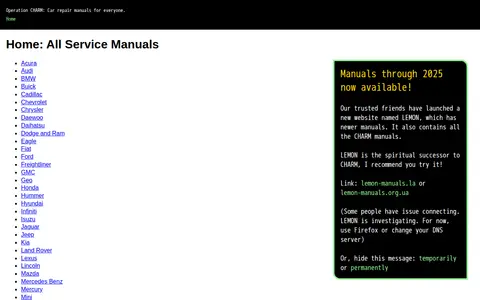
Operation CHARM is an online repository of free car and truck service manuals, described as spanning many makes and models from 1982 through 2013. The site states that the data will be available free of charge permanently. The project also releases the database and code powering the site publicly so that an equivalent site could be set up.
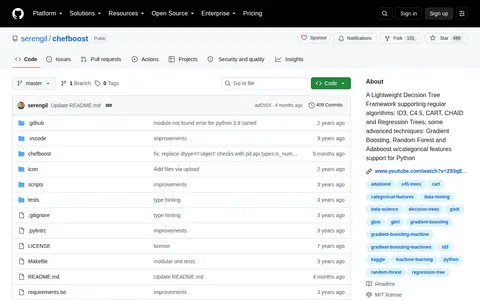
ChefBoost is a lightweight decision tree framework for Python. It supports standard algorithms including ID3, C4.5, CART, CHAID and regression trees, as well as advanced techniques such as gradient boosting, random forest and Adaboost, with support for categorical features.