
arxiv.org
Open-access repository for preprints in physics, math, computer science, AI, and related fields.
Directory
Published directory entries matching your search.
Open-access repository for preprints in physics, math, computer science, AI, and related fields.

An arXiv paper on digging deeper into hidden web databases limited by the top-k output constraint. It presents the GetNext meta-algorithm, which retrieves the next ranked tuple through a restrictive interface without prior knowledge of the ranking function, and algorithms that generate and execute multiple reformulated queries. Theoretical analysis and experiments over synthetic and real-world databases are reported.

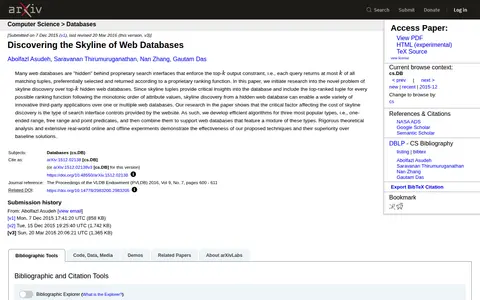
An arXiv paper on discovering skylines over hidden web databases whose search interfaces enforce a top-k output constraint. It examines how search interface controls affect discovery cost and develops algorithms for one-ended range, free range and point predicates, combined for mixed interfaces. Experiments over real-world online and offline databases are reported.

This arXiv paper by Dirk Lewandowski and Philipp Mayr provides a critical review of Bergman's 2001 study on the Deep Web. It introduces the concept of the Academic Invisible Web, defined as databases and collections relevant to academia but not searchable by general-purpose internet search engines, and reviews approaches for indexing it. The authors question Bergman's size estimate and suggest collaboration.

Public-health research measuring harmful-content availability and searches on the Tor network.

An arXiv paper presenting a longitudinal analysis of the dark web cybercrime ecosystem. The authors analyze 25,065 websites using 11,403,638 HTML snapshots collected over six years, applying a topic-modeling framework with domain-specific embeddings, density-based clustering and temporal aggregation. The analysis identifies 55 thematic clusters and measures topic prevalence and lifecycle at the website level.

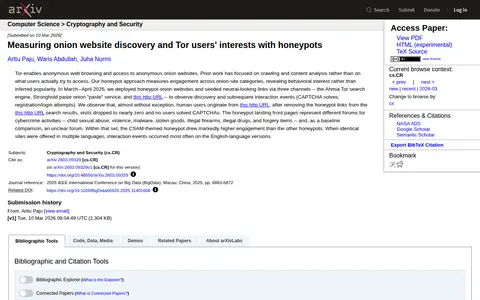
An arXiv paper measuring onion website discovery and Tor users' interests with honeypots. The authors deployed honeypot onion websites in March–April 2025 and seeded links via three channels to observe interaction events. They report that human users almost without exception originated from Ahmia.fi, and that the CSAM-themed honeypot drew markedly higher engagement than the others.

Study of whether website fingerprinting can distinguish and identify Tor onion-service traffic.

An arXiv paper presenting a large-scale analysis of the Tor network using a crawler called Mimir, which collects and visits linked content. The authors report a dataset of pages from more than 25k sites and examine network topology, replicated content and content types.

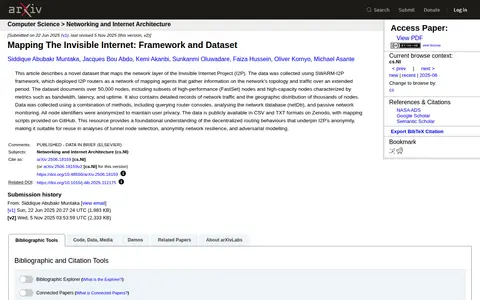
This dataset maps the network layer of the Invisible Internet Project (I2P), collected using the SWARM-I2P framework, which deployed I2P routers as mapping agents. It documents over 50,000 nodes with metrics such as bandwidth, latency, and uptime, plus network traffic records and geographic distribution. Node identifiers were anonymized. Data is available in CSV and TXT formats on Zenodo, with mapping scripts on GitHub.

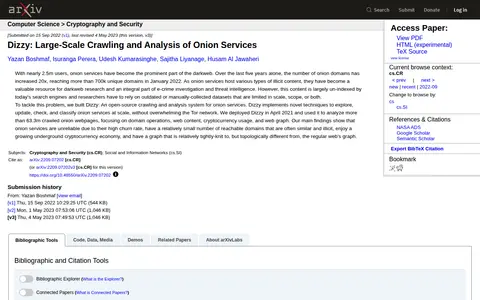
Dizzy is an open-source crawling and analysis system for onion services. It implements techniques to explore, update, check, and classify onion services at scale without overwhelming the Tor network. It was deployed in April 2021 and used to analyze more than 63.3 million crawled onion webpages, focusing on domain operations, web content, cryptocurrency usage, and web graph.

This arXiv paper proposes an end-to-end scalable architecture for early identification of new Tor sites and daily analysis of their content. It is built on an open source big data stack including Kubernetes, Kafka, Kubeflow and MinIO, discovering onion addresses across several sources, downloading HTML from Tor, deduplicating with MinHash LSH and categorizing with BERTopic modeling. In 93 days it identified 80,049 onion services and characterized 90% of them.

CRATOR is a proposed dark web crawler described in an arXiv paper. It is designed to extract pages that handle security protocols such as captchas, using seed URL lists, link analysis and scanning to discover content, with user-agent rotation and proxy usage for anonymity. The authors report evaluation using coverage, performance and robustness metrics, and suggest threat intelligence, cybersecurity and online investigation applications.
This arXiv paper presents the first large-scale study of the Nostr social network, focusing on relays and post replication strategies. The authors find Nostr achieves superior decentralization compared to traditional Fediverse applications, while relay availability remains a challenge and replication introduces overhead. They propose two improvements.
FEDSTR is a proposed approach on the NOSTR protocol for a decentralized marketplace for federated learning and LLM training. Customers provide a dataset for training an AI model; service providers receive parts of the dataset, train the model, and return the optimized model in exchange for payment. A proof-of-concept implementation over public NOSTR relays is presented.