
prashantbarahi.com.np
algorithms provides educational videos, lessons, tutorials, or self-learning resources.
Directory
Published directory entries matching your search.
algorithms provides educational videos, lessons, tutorials, or self-learning resources.

Algorithms Books presents three textbooks by Mykel J. Kochenderfer and coauthors, published by the MIT Press. The books are Algorithms for Optimization, Algorithms for Decision Making, and Algorithms for Validation. Full PDFs are available free.
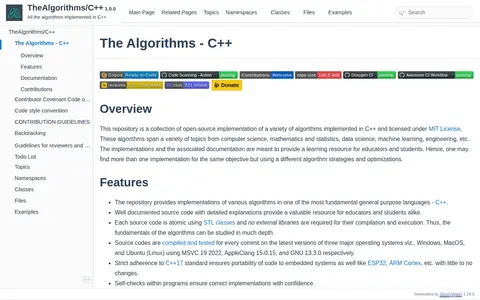
The Algorithms - C++ is a repository of open-source implementations of various algorithms in C++, released under the MIT License. It covers topics including computer science, mathematics, statistics, data science, machine learning and engineering, and is intended as a learning resource for educators and students. The documentation is generated from the source code.

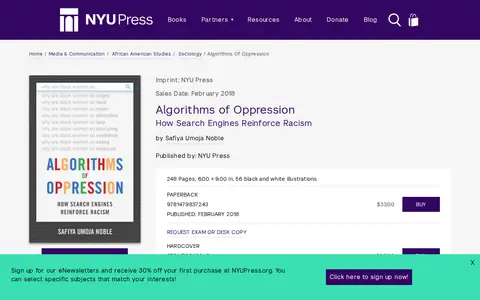
Algorithms of Oppression by Safiya Umoja Noble is a book published by NYU Press in February 2018 under the title How Search Engines Reinforce Racism. It examines how negative biases against women of color are embedded in search engine results and algorithms.

Algorithms-Cheatsheet-Resources is a GitHub repository or organization with source code, releases, documentation, or project resources.

CP-Algorithms is a developer resource for coding, documentation, communities, security research, or software tools.
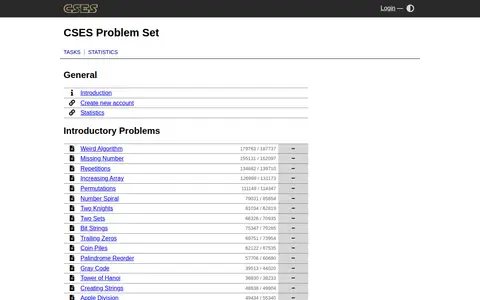
CSES Problem Set is a collection of programming tasks organized into categories including introductory problems, sorting and searching, dynamic programming, graph algorithms, range queries, tree algorithms, mathematics and string algorithms. The page lists tasks with solved and attempt counts and offers account creation and login.
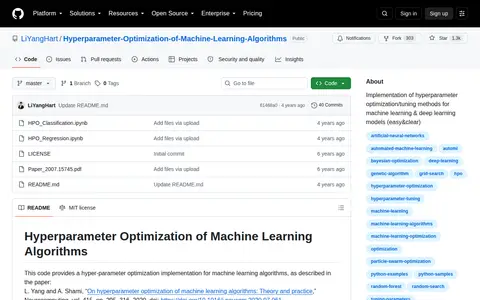
This repository provides a hyperparameter optimization implementation for machine learning algorithms, accompanying a paper on hyperparameter optimization theory and practice. It includes sample code for regression and classification problems using the Boston-Housing and MNIST datasets, covering algorithms such as random forest, SVM, KNN and artificial neural networks.

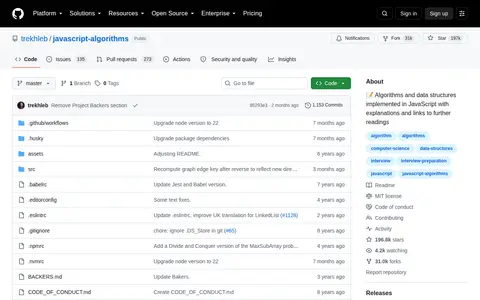
JavaScript Algorithms is a GitHub repository or organization with source code, releases, documentation, or project resources.
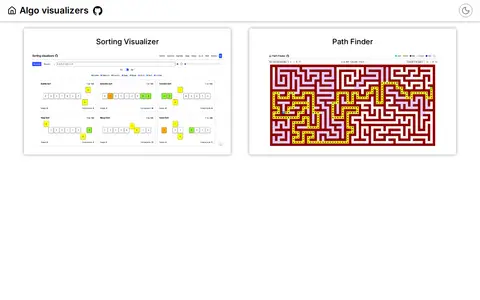
Sorting Algorithms Visualizer provides educational videos, lessons, tutorials, or self-learning resources.

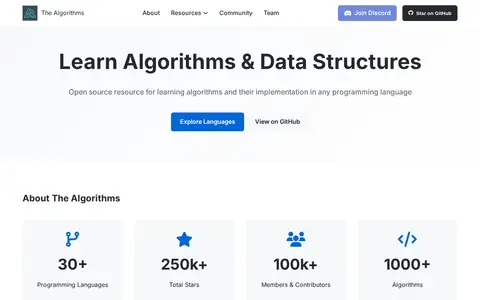
The Algorithms is a GitHub repository or organization with source code, releases, documentation, or project resources.

An open-source resource for learning data structures and algorithms through implementations in various programming languages. The site covers programming languages including Python, Java, JavaScript, Go, Rust, and C++, and organizes algorithms into categories such as sorting, searching, and graph algorithms. It also provides guidance on contributing implementations.

Advances in Evolutionary Algorithms. Edited by: Witold Kosinski. ISBN 978-953-7619-11-4, PDF ISBN 978-953-51-5796-0, Published 2008-11-01.
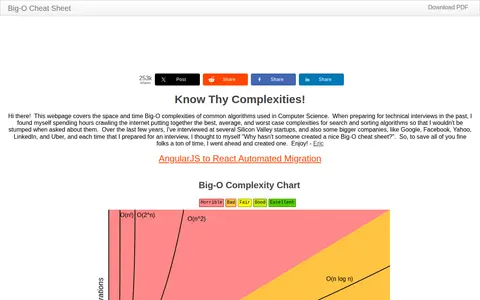
Big-O Cheatsheet is a webpage presenting space and time Big-O complexities of common computer science algorithms. It includes a Big-O complexity chart, common data structure operations with average and worst case time complexity and space complexity, and array sorting algorithms with best, average and worst case time complexity. A downloadable PDF version is offered.

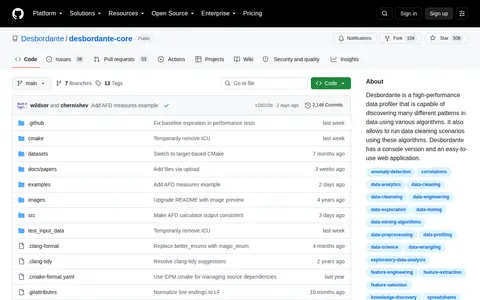
Desbordante is a high-performance open-source data profiler. It uses a variety of algorithms to discover different patterns in data and supports running data cleaning scenarios using these algorithms. The tool is available as a console version and an easy-to-use web application.

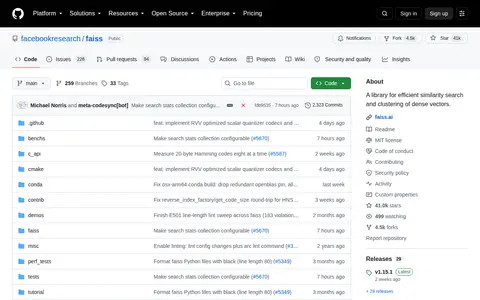
Faiss is a library for efficient similarity search and clustering of dense vectors, containing algorithms that search sets of vectors of any size. It is written in C++ with complete wrappers for Python/numpy, with some algorithms implemented on the GPU, and is developed primarily at Meta's Fundamental AI Research group.

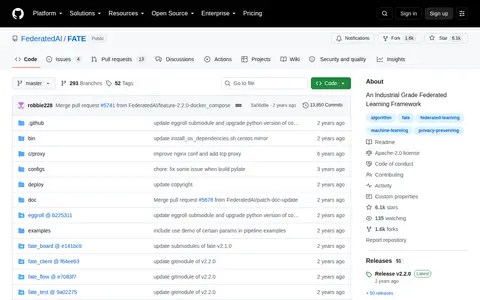
FATE (Federated AI Technology Enabler) is an industrial grade federated learning open source framework that enables enterprises and institutions to collaborate on data while protecting data security and privacy. It implements secure computation protocols based on homomorphic encryption and multi-party computation, and provides federated learning algorithms including logistic regression, tree-based algorithms, deep learning and transfer learning.

Gephi is free, open-source software for network visualization and analysis. It is available as a desktop application and as Gephi Lite in the browser. It includes algorithms for community detection, centrality measures and clustering, multiple layout algorithms, appearance customization and image exports. The source code is released under the GPL license.

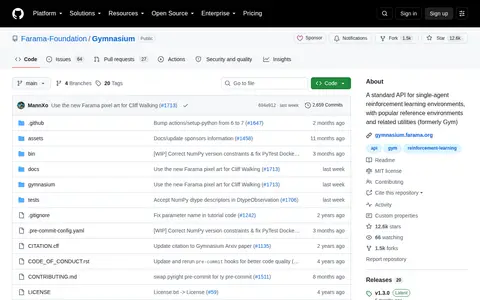
Gymnasium is an open source Python library for developing and comparing reinforcement learning algorithms. It provides a standard API between learning algorithms and environments, plus reference environments including Classic Control, Box2D, Toy Text, MuJoCo and Atari. It is a fork of OpenAI's Gym library maintained by its maintainers.
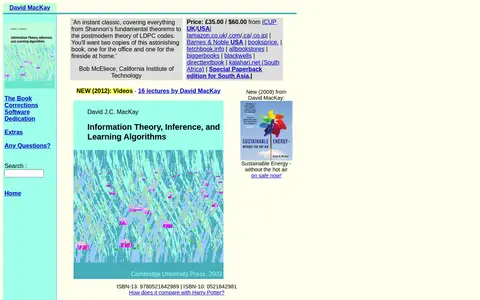
A 2003 book by David J.C. MacKay published by Cambridge University Press, covering information theory, inference, and learning algorithms. The site offers corrections, software, and downloadable figures. It lists a price of £35.00 or $60.00.

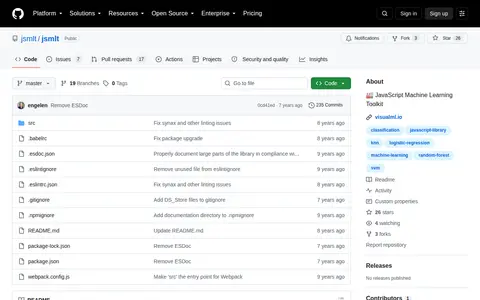
JSMLT is an open source JavaScript library for education in machine learning. It implements supervised learning algorithms, including SVM, random forest, decision tree, perceptron, neural networks, k-nearest neighbors and logistic regression, and provides visualization examples for exploring how the algorithms work.

LightFM is a Python implementation of recommendation algorithms for implicit and explicit feedback. It allows item and user metadata to be incorporated into matrix factorization algorithms, representing users and items as sums of latent feature representations. Installation is available from PyPI, and a Docker setup is provided for running examples and tests.

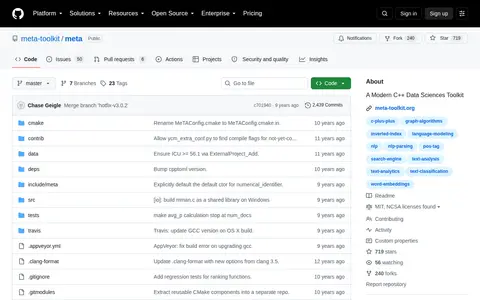
MeTA is a modern C++ data sciences toolkit. It provides text tokenization including deep semantic features like parse trees, inverted and forward indexes with compression and caching strategies, ranking functions for searching indexes, topic models, classification algorithms, graph algorithms, language models, a CRF implementation for POS-tagging and shallow parsing, and wrappers for liblinear and libsvm.

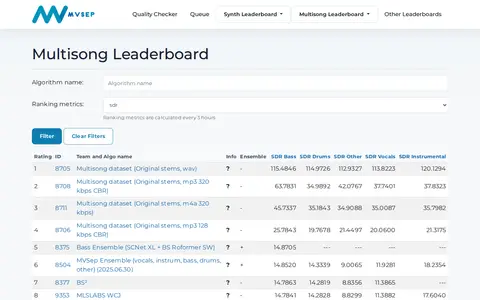
MultiSong Leaderboard is a ranking page on the MVSEP music and voice separation platform. It evaluates multisong audio separation algorithms using metrics including SDR, SI-SDR, L1 frequency, log WMSE, aura STFT, aura MRSTFT, bleedless, and fullness, with rankings updated every three hours. The page lists top-performing algorithms and their scores for separation tasks such as bass, drums, other stems, vocals, and instrumentals.