
onuniverse.com
Universe is a developer resource for coding, documentation, communities, security research, or software tools.
Directory
Published directory entries matching your search.
Universe is a developer resource for coding, documentation, communities, security research, or software tools.
An interactive map showing about 200,000 galaxies with their actual position and color, from the Milky Way to the edge of the observable Universe. It was created from 15 years of Sloan Digital Sky Survey data by B. Ménard and N. Shtarkman at Johns Hopkins University. The visualization shows a thin slice of the Universe about 10 degrees thick.

Pearson's AP Universe provides educational videos, lessons, tutorials, or self-learning resources.

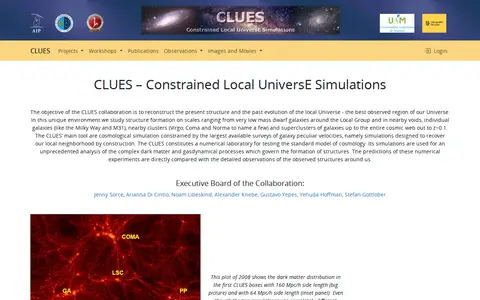
CLUES, the Constrained Local UniversE Simulations collaboration, works to reconstruct the present structure and past evolution of the local Universe. Its main tool is cosmological simulations constrained by surveys of galaxy peculiar velocities, used to analyze dark matter and gasdynamical processes in structure formation and compare predictions with observations of nearby structures.

Scale of the Universe is an educational resource for documentaries, courses, books, reference material, or self-learning.
Universe Atlas is an educational resource for documentaries, courses, books, reference material, or self-learning.

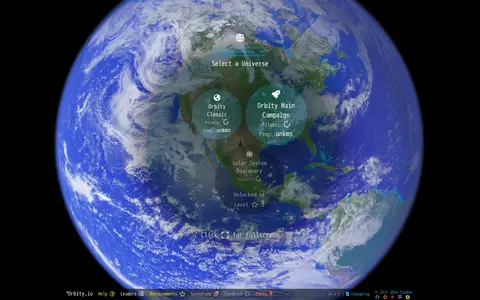
Orbity.io is an online multiplayer 2D space orbiting browser game. It offers a Classic universe with scoreboards, a main Campaign with missions and ship upgrades, and an experimental Solar System universe. A full mouse-and-keyboard PC experience is recommended.

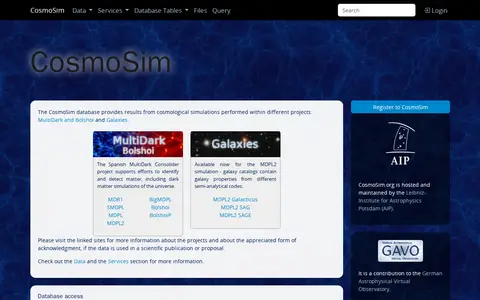
CosmoSim is a database providing results from cosmological simulations performed within the MultiDark and Bolshoi projects and Galaxies. It reports dark matter simulations of the universe and galaxy catalogs for the MDPL2 simulation. The database can be queried by entering SQL statements directly into a query interface or through scripted access; registration provides full access.
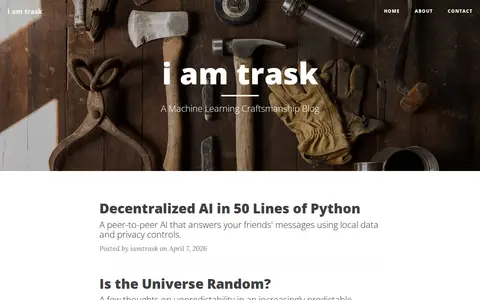
I am trask is a machine learning craftsmanship blog. Posts listed include Decentralized AI in 50 Lines of Python, Is the Universe Random?, Safe Crime Detection, Deep Learning without Backpropagation and Building Safe A.I.

In-The-Sky.org provides astronomy news and interactive guides to the night sky. The site offers a planetarium, sky guide, weather forecast, object search and catalogs, an orrery and 3D universe views. It also lists events such as oppositions, occultations and meteor showers, with rise and set times shown for a selected location.
MAD Magazine's site announces current issues, including an art-themed issue and a late night issue, sold at comic stores. It promotes subscription, the magazine on DC Universe Infinite, and a Spy vs. Spy omnibus collected edition. It also features video content and a fold-in.
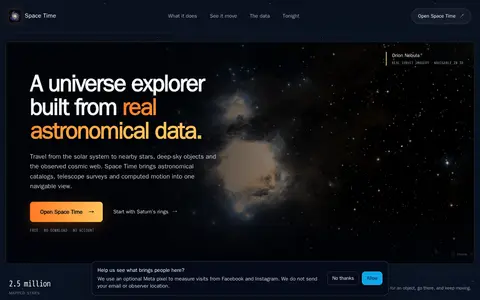
Space Time is a browser-based 3D universe explorer built from astronomical catalogs, telescope surveys and computed motion. It covers the solar system, stars, deep-sky objects and the observed cosmic web in one continuous view, with no account required. It is free and requires no download.

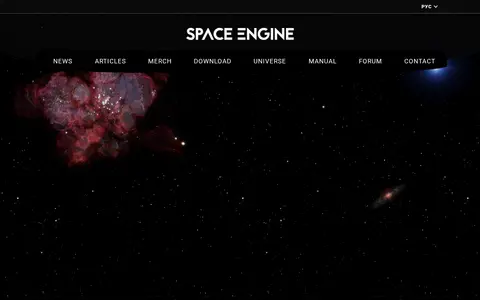
SpaceEngine is a virtual universe simulator for computers. Users can travel from star to star and galaxy to galaxy, landing on planets, moons and asteroids, and can alter the speed of time. Real celestial objects appear alongside procedurally generated regions based on scientific knowledge.

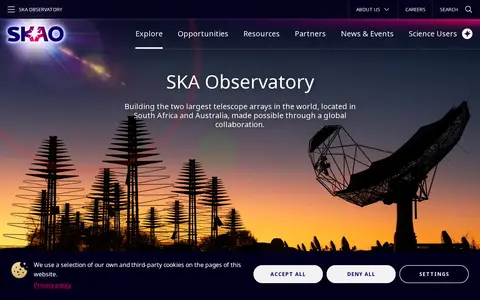
The SKA Observatory is an intergovernmental organisation building two large telescope arrays in South Africa and Australia through global collaboration. Its stated science goals concern exploring the Universe, and the project covers handling large volumes of data.

Across The Multiverse is an in-browser, freely explorable 3D game spanning infinite procedurally generated universes. It includes a four-chapter story mode described as a solo narrative story with an exclusive ending, and a multiplayer Discovery Mode for metaverse free exploration.

Research platform of the University of Basel, Switzerland.

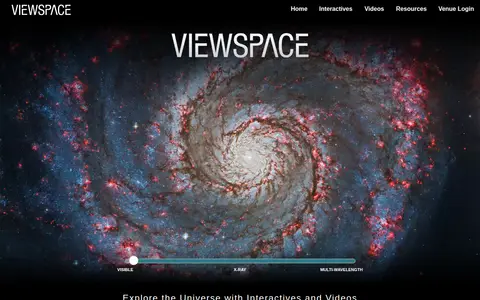
ViewSpace is a free, web-based collection of astronomy and Earth science videos and interactives. It offers image tours, image sliders, and a video library that let users explore the planet, solar system, galaxy, and universe. The project is developed by the Space Telescope Science Institute with NASA support and has been exhibited in museums, planetariums, and science centers since 2000.