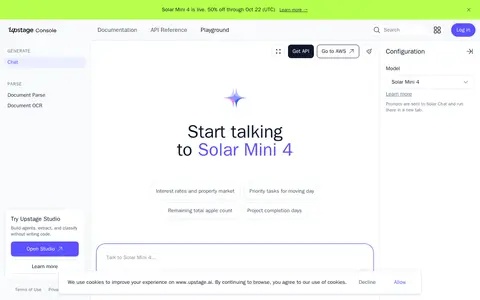
Solar is a browser-based playground from Upstage Console that lets users test Solar LLM and Document AI tools. It supports features including AI chat, document parsing, OCR, and question answering over user-uploaded files.
Directory
Search results
Published directory entries matching your search.
Solar is a storage, design, or frontend resource for mockups, assets, UI tools, or web search.
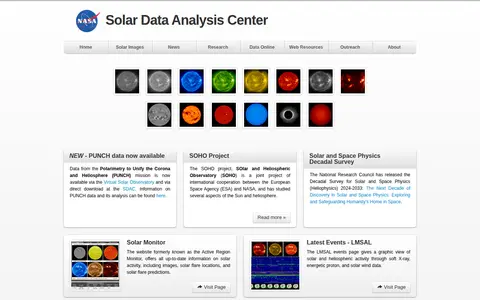
The Solar Data Analysis Center (SDAC) at NASA Goddard Space Flight Center serves solar images, solar news, solar data, and solar research. It develops and maintains scientific research infrastructure supporting NASA's Heliophysics Science Division. Data from the PUNCH mission is available via the Virtual Solar Observatory and direct download, and the site links to the SOHO project and Solar Monitor.
Solar System Scope is an online 3D simulation of the Solar System and night sky in real time, showing the Sun, planets, dwarf planets, comets, stars and constellations. It also offers a free model of the Solar System and night sky with accurate positions of objects. A desktop version and an Android app are available.
The UK Solar System Data Centre provides a central archive and data centre facility for Solar System science in the UK, jointly funded by STFC and NERC. Its facilities include the World Data Centre for Solar-Terrestrial Physics, Chilton, and the Cluster Ground-Based Data Centre. It supports data archives encompassing solar, inter-planetary, magnetospheric, ionospheric and geomagnetic science.
Block explorer for U2U Solaris Mainnet, showing transactions, blocks, addresses, tokens, and network activity.
The World Data Center for Solar-Terrestrial Physics, Moscow, a division of the Geophysical Center of the Russian Academy of Sciences, has existed since 1956. It collects, stores and disseminates data on solar-terrestrial physics disciplines, with online data and data search. Its data can be used freely for scientific research and educational purposes.

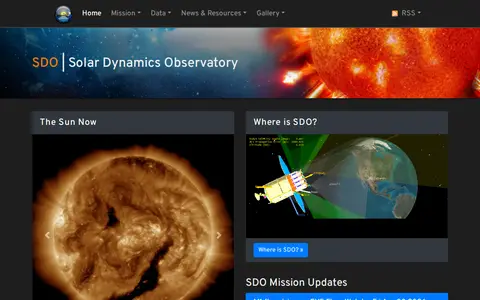
Solar Dynamics Observatory (SDO) is a NASA mission designed to study the solar atmosphere at fine space and time scales across multiple wavelengths to understand the Sun’s influence on Earth and near-Earth space. Its associated portal provides access to mission data, spacecraft specifications, instrument details, scientific publications, observation event information, and outreach resources.
Solar System is an educational resource for documentaries, courses, books, reference material, or self-learning.
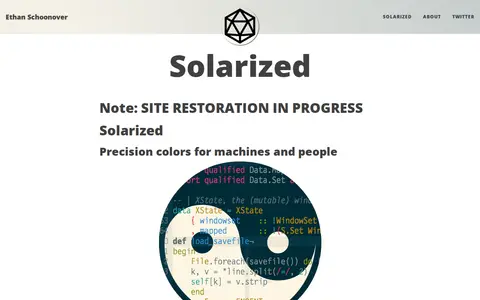
Solarized is a sixteen color palette consisting of eight monotones and eight accent colors, designed for terminal and GUI applications. The colorscheme uses CIELAB lightness relationships and hues based on fixed color wheel relationships. Formats are available for editors and IDEs, terminal emulators, and other applications, along with palettes. The site notes that restoration is in progress.
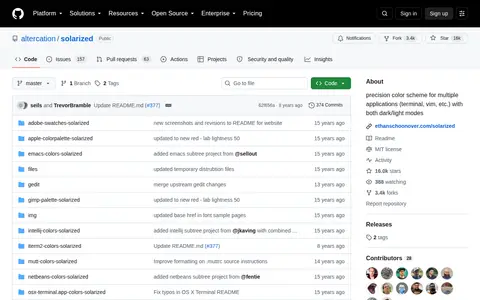
Solarized is a sixteen color palette consisting of eight monotones and eight accent colors, designed for terminal and GUI applications. It includes dark and light modes and is available in formats for editors, IDEs, terminal emulators and other applications such as Vim, Emacs, IntelliJ, iTerm2 and Mutt.
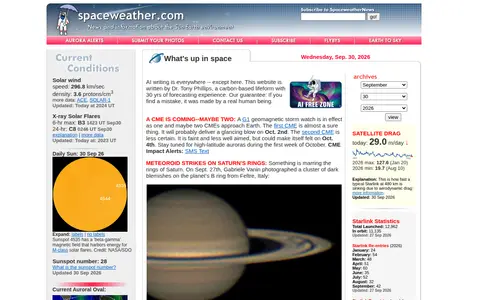
SpaceWeather.com presents news and information about solar flares, geomagnetic storms, auroras, meteor showers, and near-Earth asteroids. The page displays current solar wind speed and density, X-ray solar flare levels, the daily Sun image, sunspot number, auroral oval, planetary K-index, and interplanetary magnetic field data.
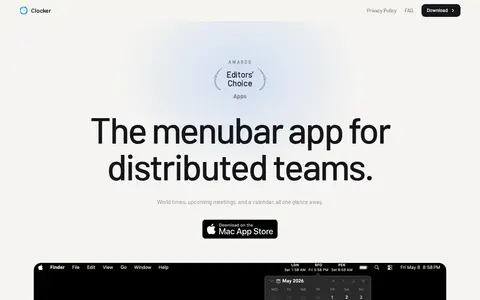
Clocker is a menubar app for distributed teams, written in Swift and AppKit. It shows world clocks for multiple cities with custom labels and reordering, and includes upcoming meetings and a calendar in the menubar. Four themes are offered: Light, Dark, Solarized Light and Solarized Dark.
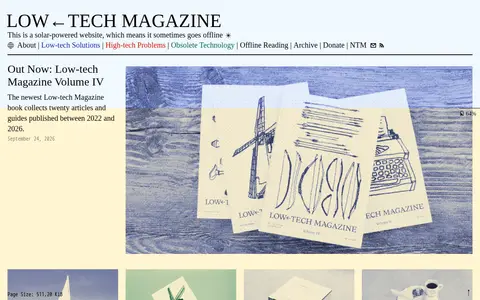
Low-tech Magazine covers past and forgotten technologies and how they can inform sustainable energy practices. Its website is solar-powered and self-hosted, designed to reduce the energy use associated with accessing its content, and it notes that it sometimes goes offline. Articles and guides include building solar-powered devices and domestic low-tech projects.
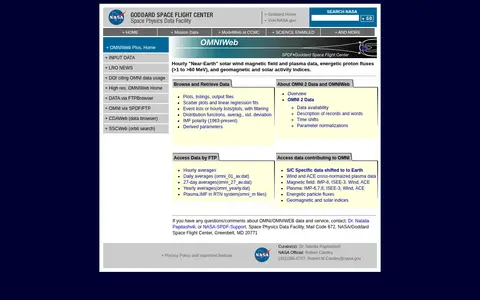
OMNIWeb is a NASA Space Physics Data Facility service providing hourly near-Earth solar wind magnetic field and plasma data, energetic proton fluxes above 1 to 60 MeV, and geomagnetic and solar activity indices. It offers plots, listings, output files, scatter plots with linear regression fits, and event or hourly lists with filtering.
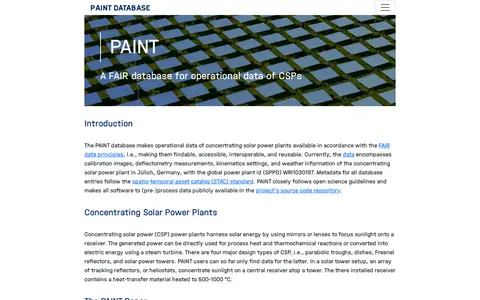
PAINT is a database making operational data of concentrating solar power plants available under FAIR data principles: findable, accessible, interoperable, and reusable. Its current data covers calibration images, deflectometry measurements, kinematics settings, and weather information from the solar tower plant in Jülich, Germany. Metadata follows the STAC standard, and software for data processing is publicly available in the project's source code repository.
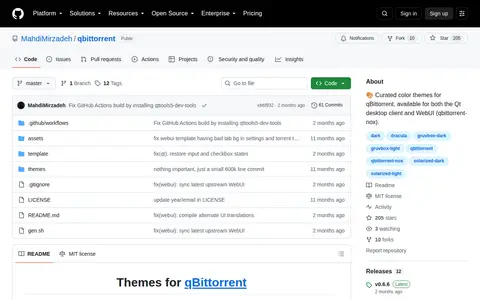
A collection of curated color themes for qBittorrent, offered for the Qt desktop client and the WebUI (qbittorrent-nox). Themes such as Dark, Dracula, Gruvbox Dark, Solarized Dark, Gruvbox Light and Solarized Light are provided. Each theme ships in two formats: a .qbtheme bundle for the Qt desktop client and a .tar.gz or .zip archive for the WebUI.
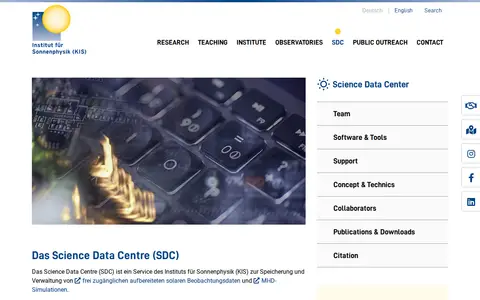
The Science Data Centre (SDC) of the Leibniz-Institute for Solarphysics is a service for storing and managing openly accessible processed solar observation data and MHD simulations. It focuses on curation, archiving and distribution of ground-based solar data from telescopes at the El Teide Observatory on Tenerife, and on developing pipelines and analysis tools. An online archive is available.
Solaris is a magazine publishing features, commentary and specialist editorial coverage in Canada.
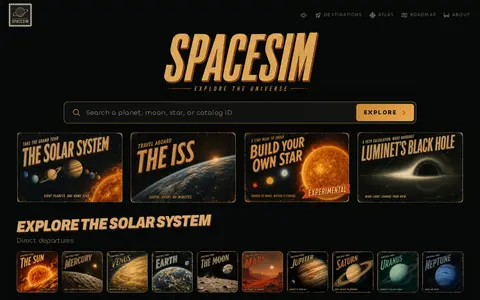
SpaceSim is a free 3D space simulator that runs in a browser. It offers travel across the Solar System, time changes, source-backed worlds and postcards, along with journeys such as a grand tour of the Solar System, an ISS trajectory view and a procedural stellar laboratory for known stellar objects.
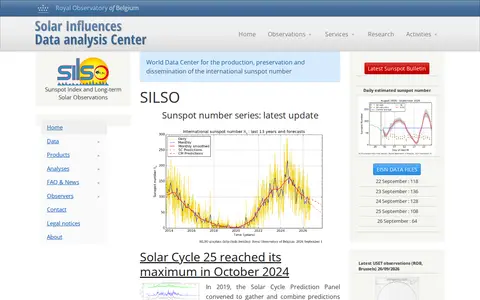
SILSO is the World Data Center for the production, preservation and dissemination of the international sunspot number. The site provides sunspot number series and updates, and notes that Solar Cycle 25 reached its maximum in October 2024.
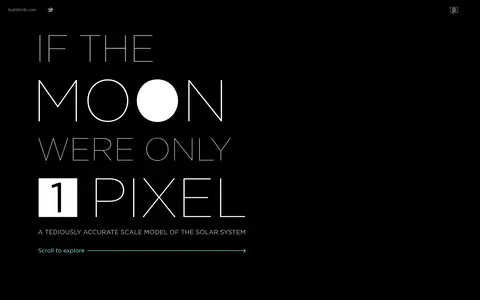
A web page that maps the solar system to scale with the Moon at one pixel. It presents the Sun, planets and some moons in sequence across a long scroll, with notes on the large distances between them. It states that distances shown are averages and depend on orbital positions.
Appalachian State University is a university in Boone, North Carolina, in the North Carolina mountains. The site invites prospective students to apply and presents university news, including enrollment figures, research partnerships and a solar racing team victory.
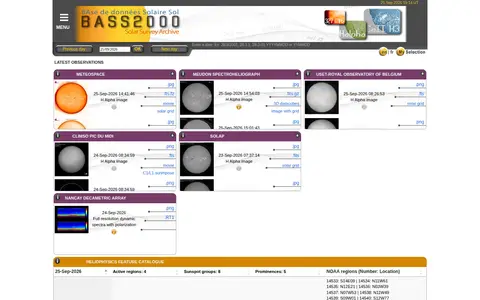
BASS2000 is a solar survey archive presented as a database of images. It offers a menu of latest observations and a date entry field, and links to resources including MeteoSpace, the Nançay Decametric Array, the Meudon Spectroheliograph, Climso Pic du Midi, and the Heliophysics Feature Catalogue.