
developer.mozilla.org
Observatory is a developer resource for coding, documentation, communities, security research, or software tools.
Directory
Published directory entries matching your search.
Observatory is a developer resource for coding, documentation, communities, security research, or software tools.

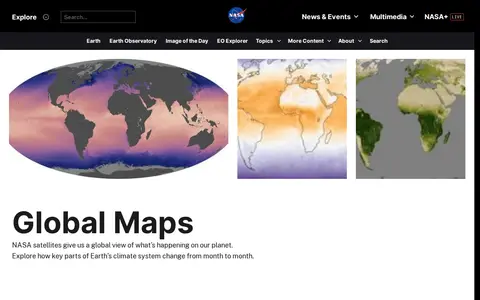
Earth Observatory is a miscellaneous web resource for discovery, directories, archives, web culture, or useful tools.
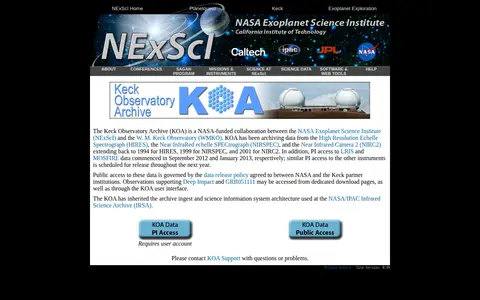
The Keck Observatory Archive is a NASA-funded collaboration between the NASA Exoplanet Science Institute and the W. M. Keck Observatory. It archives data from the HIRES, NIRSPEC and NIRC2 instruments, with records extending back to 1994 for HIRES. PI access to LRIS and MOSFIRE data began in September 2012 and January 2013. A user account is required.

The World Data Centre for Geomagnetism, Copenhagen, distributes the definitive PCN index derived from the geomagnetic observatory Qaanaaq and Kp-index data products derived at the geomagnetic observatory Niemegk via an FTP server. It also holds extensive archives of magnetograms and other geomagnetic observatory data products that predate digital data recording, in analogue form such as film or microfiche. It was established in 1957.

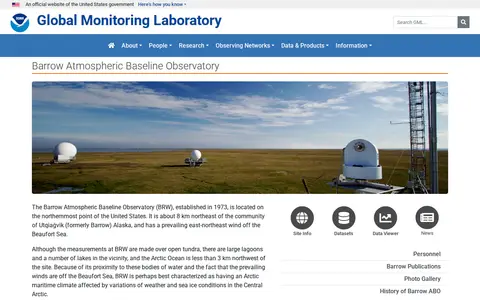
The Barrow Atmospheric Baseline Observatory is a NOAA Global Monitoring Laboratory site on the northernmost point of the United States, about 8 km northeast of Utqiaġvik, Alaska. Established in 1973, it is staffed year round by two engineers and scientists who perform routine inspections and maintenance of instruments, and it hosts cooperative research projects.
The Chesapeake Bay Environmental Observatory is a project providing a portal where users can search and download CBEO data. It also offers materials such as test bed data, documentation, publications and presentations. The project was funded through a National Science Foundation program for cyberinfrastructure for environmental observatories.
The Global Health Observatory data repository is the World Health Organization's gateway to health-related statistics for its 194 Member States, providing access to over 1000 health topic indicators through indicators, countries, a data API and a map gallery. COVID-19 data is not currently provided by the GHO APIs.

HEASARC is NASA's multi-mission archive for high-energy astronomy, holding data in extreme ultraviolet, X-ray and gamma-ray wavelengths plus cosmic microwave background datasets. It provides archival data, multi-mission software and analysis tools, and information on current and past observatory missions, available freely. Data discovery uses an interactive web portal, with API access through Xamin, astroquery and Virtual Observatory protocols.

Infectious Diseases Data Observatory (IDDO) is an organisation that enables reuse of infectious disease data to support disease control efforts. It pools and standardises data, applies strict privacy controls to pseudo-anonymise data, shares data responsibly and maintains gold standard data repositories for a range of infectious diseases including malaria, COVID-19, Ebola and antimicrobial resistance. It also provides data access guidelines and related resources for users.
NEPTUNE Canada is an ocean observatory operated by Ocean Networks Canada, a University of Victoria initiative. It is part of the NEPTUNE and VENUS cabled ocean observatory systems located in the northeast Pacific Ocean and the Salish Sea, supporting ocean data collection for scientific research and sustainability efforts.

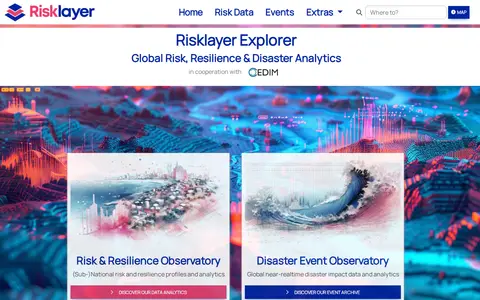
Risklayer Explorer presents global risk, resilience and disaster analytics in cooperation with the Risk & Resilience Observatory. It offers sub-national and national risk and resilience profiles and analytics, and a Disaster Event Observatory providing near-realtime disaster impact data and analytics alongside an event archive.
SOAP (Subaru Observatory Astronomical Projects) is a data download server providing public access to astronomical datasets from the Subaru Observatory, including the Subaru Deep Field (SDF) and Subaru XMM-Newton Deep Survey (SXDS).
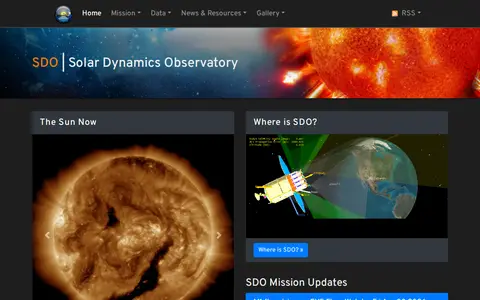
Solar Dynamics Observatory (SDO) is a NASA mission designed to study the solar atmosphere at fine space and time scales across multiple wavelengths to understand the Sun’s influence on Earth and near-Earth space. Its associated portal provides access to mission data, spacecraft specifications, instrument details, scientific publications, observation event information, and outreach resources.

TERN is Australia's Terrestrial Ecosystem Research Network. It provides model-ready terrestrial ecosystem data for research and describes itself as Australia's Ecosystem Observatory. Its Data Discovery Portal supports discovery, access and reuse of datasets from TERN observatory measurements, including site surveys, remote sensing, model-derived and in-situ sensor data. Data infrastructure includes a cloud-based virtual desktop and tools for data submission and landscape-scale dataset analysis.
Find and access agriculture, forestry and veterinary medicine research data, with indexed datasets.

Arctic Data Centre provides quick access to datasets and news, listing datasets including marine observatory nutrient data from Kongsfjorden, InSAR-derived landfast sea ice extent, soil properties from Storholmen, and airborne hyperspectral point cloud data from a HySpex VNIR-1800 spectrometer. It also posts news, such as an issue with URLs after a thredds.met.no upgrade.
The Astronomical Data Archives Center is part of the National Astronomical Observatory of Japan and provides services including an online catalog service and a VizieR catalogue service mirror. The information it provides is intended only for academic research and educational activities, and use for commercial products, services, or activities is prohibited.
Digital library portal for researchers in astronomy and physics, operated by the Smithsonian Astrophysical Observatory.

Birmingham City Council publishes a range of data that can be downloaded and reused under the Open Government Licence. The City Observatory is an open data-sharing platform intended to provide a single source of information about Birmingham and to support collaboration on data. The page also links to data on roads and parking, local land authority and housing stock, and boundaries.
The Bureau Central de Magnétisme Terrestre provides ground-based geomagnetic observations and data products. It operates the French National Magnetic Observatory at Chambon-la-Forêt, a network of 18 overseas observatories and 11 repeat stations in metropolitan France. The site offers collected raw magnetic measurements and derived data products, with Digital Object Identifiers for variation and definitive data.

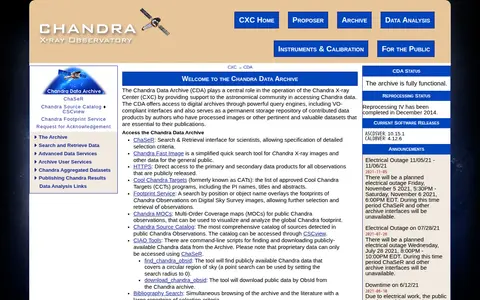
The Chandra Data Archive is the official repository for data from the Chandra X-ray Observatory. It provides tools to search and retrieve public and proprietary observational data, alongside services including the Chandra Source Catalog, event visualisation tools and dataset identifier assignment.
CLARIN-ERIC is a European research infrastructure offering sustainable access to a wide range of language data and tools to support research in humanities and social sciences. It coordinates national consortia, knowledge centres, and projects. It provides resources including a federated data search engine, the Virtual Language Observatory, and the Language Resource Switchboard. It also offers training, education, and outreach activities.

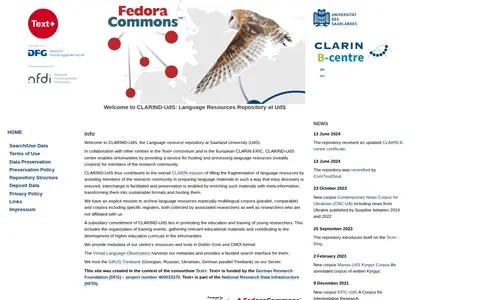
CLARIND-UdS is the language resource repository at Saarland University, run in collaboration with Text+ and CLARIN ERIC. It hosts and processes language resources, especially multilingual corpora, supplying metadata in Dublin Core and CMDI formats for harvesting by the Virtual Language Observatory. It also hosts the GRUG Treebank and supports training for young researchers.
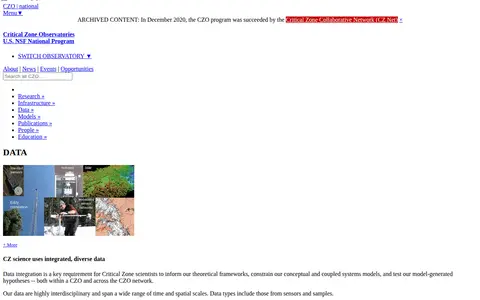
An archived national data page for the U.S. Critical Zone Observatories program, which ended in December 2020 and was succeeded by the Critical Zone Collaborative Network. It provides dataset listings, other data access routes, data policies, and cyberinfrastructure information, with a metadata catalog spanning over 400 datasets across the observatory network.