
yoav-lavi.github.io
Melody helps developers write, search, review, test, or manage code and projects.
Directory
Published directory entries matching your search.
Melody helps developers write, search, review, test, or manage code and projects.

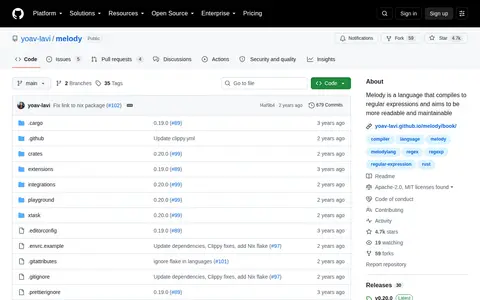
Melody is a language that compiles to ECMAScript regular expressions, with the goal of being more readable and maintainable. It can be installed via Cargo or from source, and a playground allows trying it in the browser.

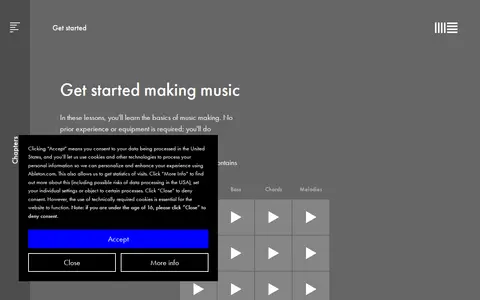
An interactive website from Ableton for exploring music fundamentals. Users experiment with beats, melody, harmony, basslines, and song structure in a web browser. The lessons cover music-making basics and require no prior experience or equipment.
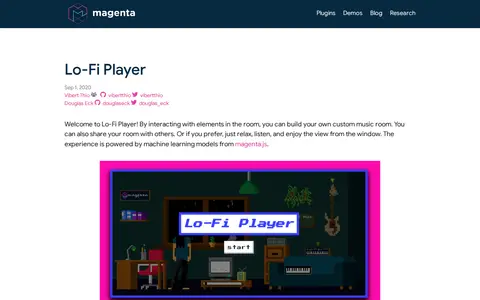
Lo-Fi Player is an interactive lofi beat player built as a virtual room. Interacting with elements in the room builds a custom music stream, with controls for melody, bass, chords, background sounds and drums. It was built by Vibert Thio, an intern on the Google Brain team, and is powered by Magenta. The page recommends a desktop window wider than 700px.

Lo-Fi Player is a virtual room in a browser where interacting with objects changes music in real time. It is powered by machine learning models from magenta.js, including MusicVAE for creating melodies and MelodyRNN for generating melodies via the radio. Users can build a custom music room and share it with others.

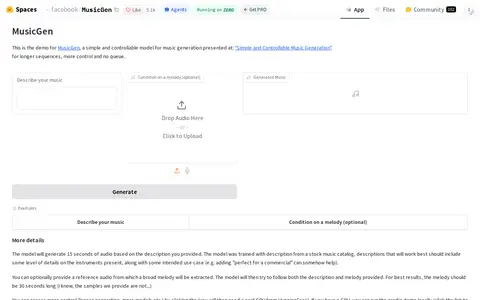
MusicGen is a Hugging Face Space by facebook that generates music audio from a text description. Users can optionally upload a short melody to guide it and set parameters such as length; the app then creates a music audio file.

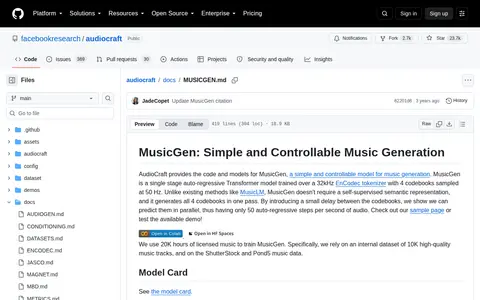
MusicGen is a single-stage auto-regressive Transformer model for music generation trained over a 32kHz EnCodec tokenizer with four codebooks, part of the AudioCraft library. It supports text-to-music and text-plus-melody-to-music models ranging from 300M to 3.3B parameters. Running it locally requires a GPU, with at least 16 GB of memory recommended for medium-sized models.
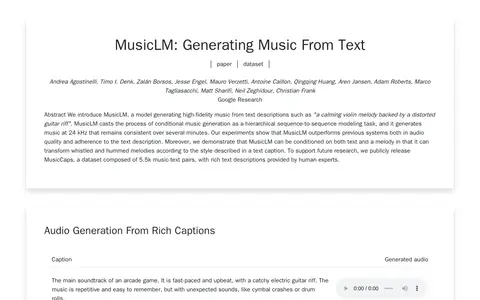
MusicLM is a model that generates high-fidelity music from text descriptions. It frames conditional music generation as hierarchical sequence-to-sequence modeling and produces audio at 24 kHz consistent over several minutes. It can also be conditioned on text and a melody, transforming whistled or hummed melodies according to a text caption. The project released MusicCaps, a dataset of 5.5k music-text pairs with descriptions by human experts.

ScoreCloud music notation software instantly turns your songs into sheet music. Users write and arrange music by playing into notation using Audio or MIDI. The Songwriter version is designed to turn recordings of voice and instruments into lead sheets with melody, lyrics and chords.