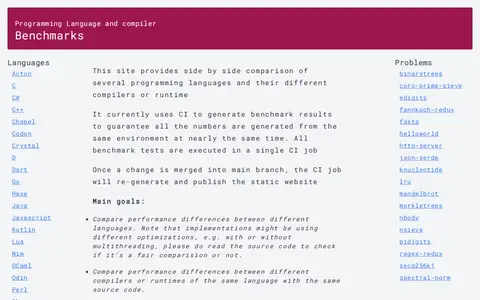

A site offering side-by-side comparisons of programming languages and their compilers or runtimes. Benchmark tests are executed in a single CI job, and the static website is regenerated once a change is merged into the main branch. It aims to compare performance differences between languages and between compilers or runtimes of the same language.
Directory
Search results
Published directory entries matching your search.
Kaggle Benchmarks is a Kaggle feature that allows the AI research community to build, run, and share benchmarks for evaluating artificial intelligence models and agents. All benchmarks are crowdsourced by the global AI research community.
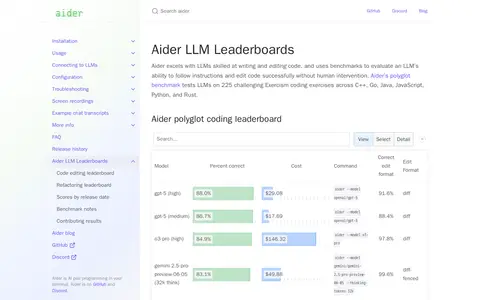
Aider LLM Leaderboards presents quantitative benchmarks of LLM code editing skill. The polyglot benchmark tests LLMs on 225 Exercism coding exercises in C++, Go, Java, JavaScript, Python and Rust, and benchmarks evaluate an LLM's ability to follow instructions and edit code without human intervention.
CodSpeed provides continuous performance testing for CI. It runs benchmarks in the CI pipeline, reports regressions in pull requests, and offers autonomous performance optimization. A documentation quickstart describes connecting a repository and setting up benchmarks, either through an automated wizard or manual configuration, including plugins for languages such as Python and C++.
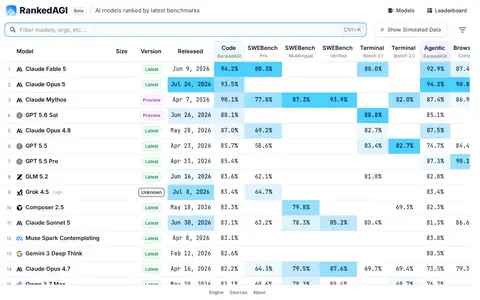
RankedAGI is a website that compares benchmarks across different AI models. It features benchmarks such as SWE Bench Verified, Codeforces, LMSYS and LiveBench, and presents a ranked table of models with size, version, release date, context length, cutoff knowledge, license and organization.
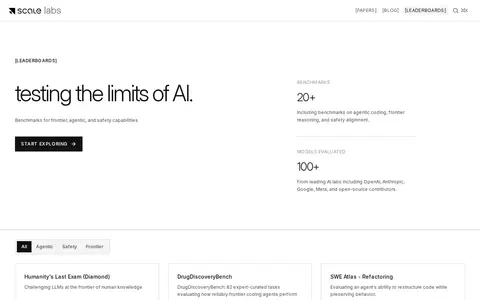
The SEAL LLM Leaderboard is a resource from Scale Labs that provides expert-driven benchmarks and updated rankings for large language models. It evaluates capabilities including agentic coding, frontier reasoning, and safety alignment, with over 20 benchmarks and assessments of more than 100 models from leading AI labs and open-source contributors.
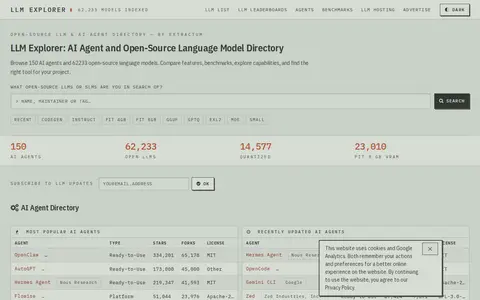
LLM Explorer is a directory of open-source language models and AI agents. It lists 150 AI agents and 64,811 open-source large and small language models, grouped into categories with benchmarks and analytics.
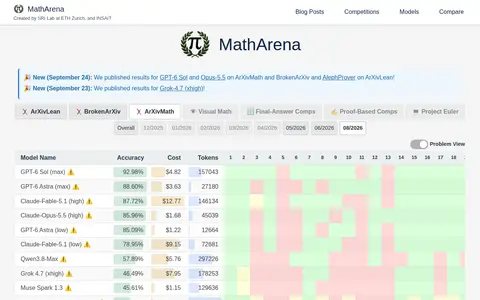
MathArena evaluates large language models on uncontaminated math benchmarks. It presents model analysis across competitions such as ArXivLean, BrokenArXiv, ArXivMath, Visual Math, Final-Answer Comps, Proof-Based Comps and Project Euler. A competition is selected to load tables and a leaderboard, and clicking a cell shows the raw model output.
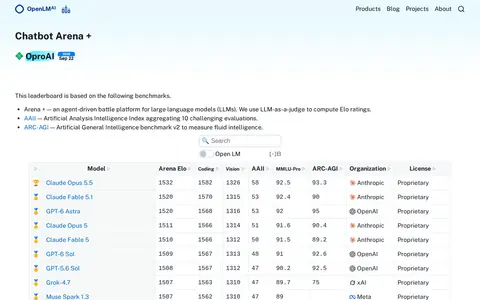
OpenLM Arena is a leaderboard site that ranks large language models. It bases rankings on three benchmarks: an agent-driven battle platform with Bradley-Terry Elo ratings from LLM-as-a-judge votes, a Model Intelligence Index, and the ARC-AGI-2 general intelligence benchmark. The page lists models with Elo, coding, vision, MII and ARC-AGI figures alongside organization and license.
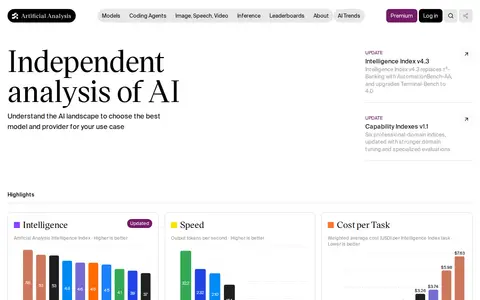
Artificial Analysis provides comparison and analysis of AI models and API hosting providers. It offers independent benchmarks across performance metrics including quality, price, output speed and latency, along with an intelligence index and cost-per-task measures.
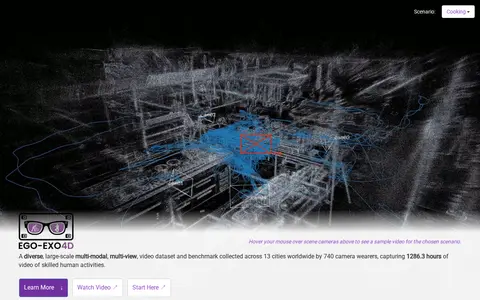
Ego-Exo4D is a large-scale multi-modal, multi-view video dataset and benchmark of simultaneously captured ego-centric and exo-centric video of skilled human activities such as sports, music, dance, and bike repair. It includes natural language datasets, multi-view capture with Aria glasses and GoPros, and benchmarks including Keystep Recognition and Proficiency Estimation.
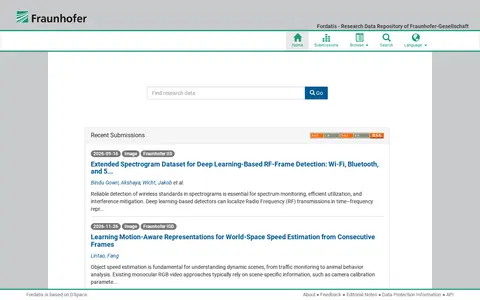
Fordatis is the research data repository of the Fraunhofer-Gesellschaft. It hosts research publications and datasets from Fraunhofer institutes and Fraunhofer associations, with content searchable by institute, document type, publication date, author, title, and language, and available in German and English. Recent publications include works on RF spectrogram datasets for deep learning, motion-aware speed estimation, and 3D instance segmentation benchmarks.
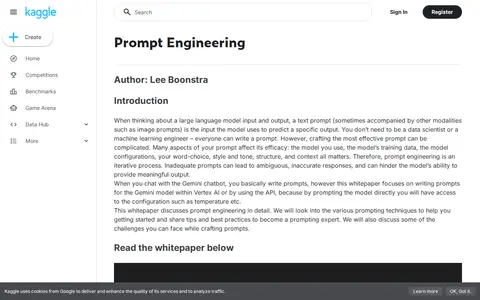
This is a Kaggle page for a Google prompt engineering whitepaper. It invites users to join a community of builders, researchers and labs evaluating AI agents, models and frontier technology through crowdsourced benchmarks, competitions and hackathons.
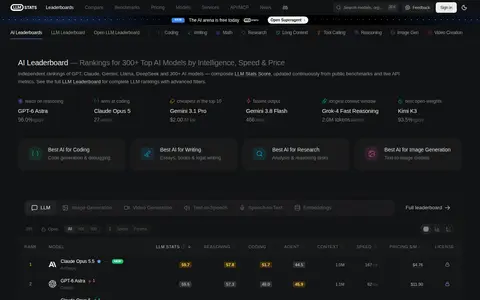
LLM Stats is an AI leaderboard that ranks GPT, Claude, Gemini, Llama, DeepSeek and more than 300 AI models by intelligence, speed and price. Scores are computed from public benchmarks and live API metrics.
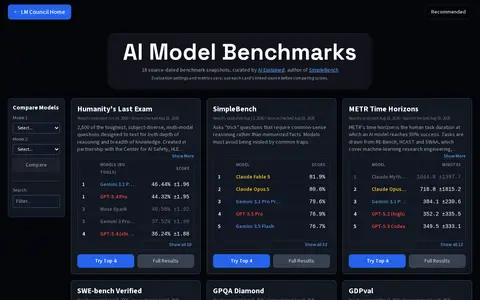
LM Council presents source-dated benchmark snapshots for AI models. It covers GPT, Claude, Gemini and other frontier models across benchmarks including Humanity's Last Exam, FrontierMath, GPQA and SWE-bench, with a comparison tool selecting two models. Each snapshot links its source and checked date, and evaluation settings and metrics vary.
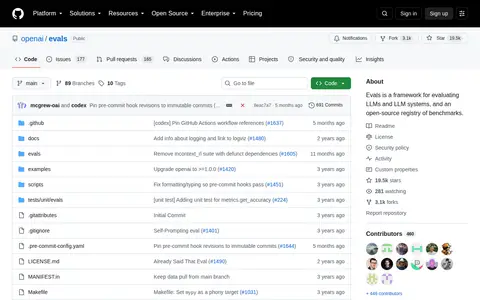
Evals is a framework for evaluating large language models and systems built using LLMs. It offers an existing registry of evals to test different dimensions of OpenAI models and the ability to write custom evals. It is available as an open-source registry of benchmarks. Evals require an OpenAI API key.
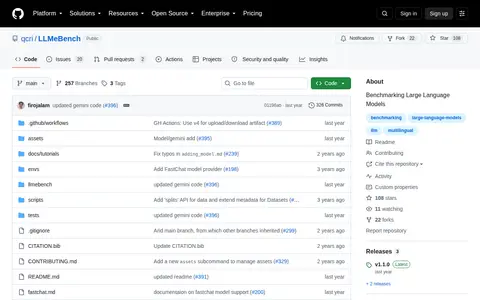
LLMeBench is a flexible framework for accelerating the benchmarking of large language models. It provides tools to run benchmarks and evaluate model performance. The project is hosted on GitHub under the qcri organization.
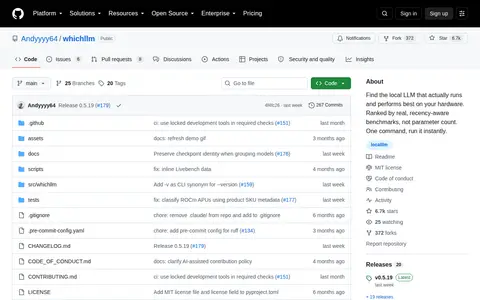
WhichLLM is a tool that identifies local large language models that run effectively and perform best on a user's hardware. It ranks models by real, recency-aware benchmarks rather than parameter count, and can be run instantly with a single command.