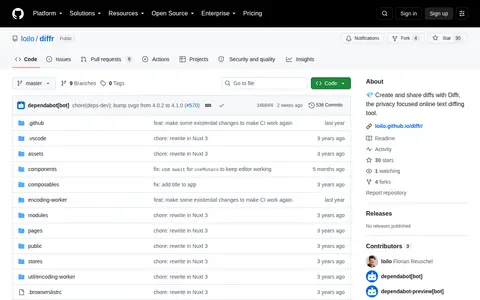

Diffr is a privacy-focused online text diffing tool for creating and sharing diffs. Its source code is published on GitHub, and the app is available at loilo.github.io/diffr. The project uses the Monaco Editor for the editing and diffing area.
Directory
Search results
Published directory entries matching your search.
Diffr is a web-based text comparison tool that displays content in a split-view editor. It offers options to ignore whitespace, trim whitespace, share comparison results, swap editor panels, clear entered content, and view information about the tool. The editor may take a short time to load on a user's first visit to the site.
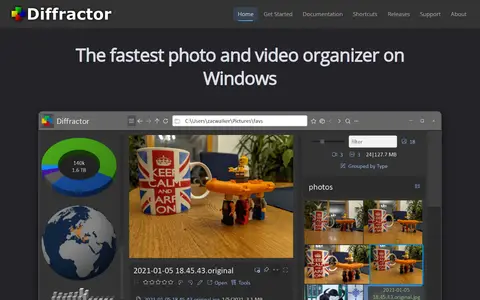
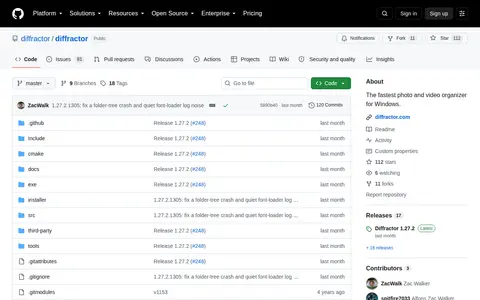
Diffractor is a free, open-source Windows application for browsing, organizing, searching and comparing local photo and video collections. It indexes chosen folders, supports metadata search and editing, duplicate detection, RAW viewing and synchronization with network storage. It is built in C++ and Direct3D by Zac Walker, previously called ImageWalker.
Diffractor is a code repository or project page with source code, releases, documentation, or setup notes.
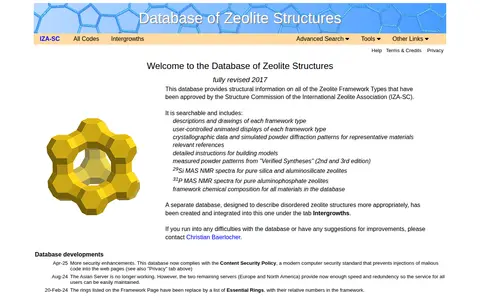
The Database of Zeolite Structures provides structural information on Zeolite Framework Types approved by the Structure Commission of the International Zeolite Association. It is searchable and includes framework descriptions and drawings, crystallographic data, simulated powder diffraction patterns, references and framework chemical compositions. A separate database describing disordered zeolite structures is integrated under the Intergrowths tab.
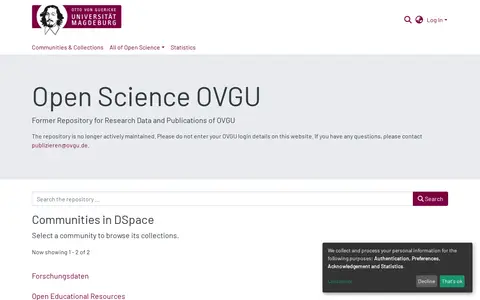
Open Science OVGU is the former open access repository for research data and publications of Otto-von-Guericke University Magdeburg (OVGU). It is no longer actively maintained, and users are advised not to enter OVGU login details on the site. The repository hosts communities for research data and open educational resources, and includes recent submissions such as the 2024 TapCorder Data Set, which explores classification of oily or cream-like substances using smartphone-captured diffraction data.
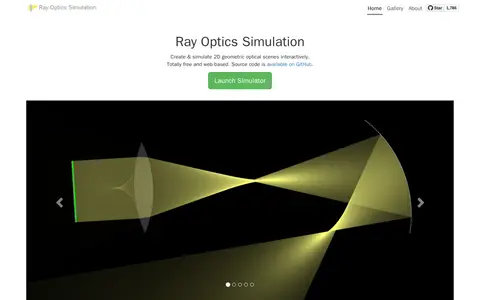
Ray Optics Simulation is a web-based tool for creating and simulating 2D geometric optical scenes interactively. It provides components such as single rays, beams, mirrors, glass, ideal lenses, diffraction gratings, detectors and a ruler, with views for rays, extended rays, images and colors. Source code is available on GitHub.
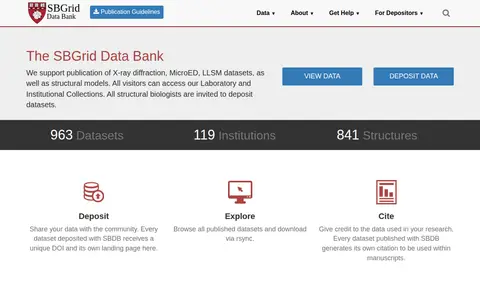
The SBGrid Data Bank is a repository for publishing X-ray diffraction, MicroED, LLSM datasets and structural models. Structural biologists can deposit datasets, and each deposited dataset receives a unique DOI and landing page. Visitors can access Laboratory and Institutional Collections and browse published datasets. Datasets can be downloaded via rsync, and each published dataset generates its own citation.
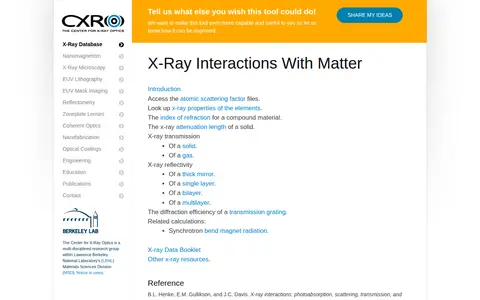
The X-Ray Database is a reference from the Center for X-Ray Optics at Lawrence Berkeley National Laboratory. It provides access to atomic scattering factor files and lookups of x-ray properties of the elements, plus calculations for index of refraction, attenuation length, transmission, reflectivity and diffraction efficiency. It cites X-ray interaction data covering E=50-30000 eV for Z=1-92.