
github.com
AI Generation is a GitHub repository or organization with source code, releases, documentation, or project resources.
Directory
Published directory entries matching your search.
AI Generation is a GitHub repository or organization with source code, releases, documentation, or project resources.

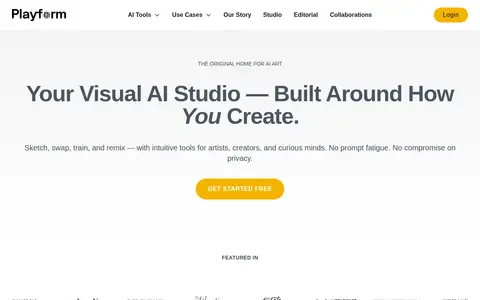
Playform is an AI art generation platform for creative people, offering free AI image generation with specialized AI tools. It includes text-to-image, sketch stylization, face swapping, prompt-free generation, model training and upscaling. Paid plans add unlimited generation, watermark removal, bulk downloading and storage.

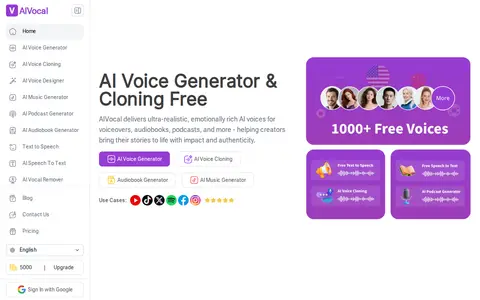
AIVocal is an AI-powered voice assistant platform. It provides tools for AI voice generation, voice cloning, text-to-speech, speech-to-text, vocal removal, audiobook generation, podcast generation and audio transcription, serving creators and professionals for voice-related work.

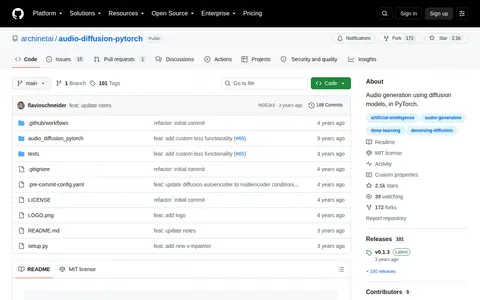
Audio diffusion library for PyTorch that includes models for unconditional audio generation, text-conditional audio generation, diffusion autoencoding, upsampling, and vocoding. The models are waveform-based, and the U-Net, DiffusionModel, diffusion method, and samplers are customizable for other formats. No pre-trained models are provided.
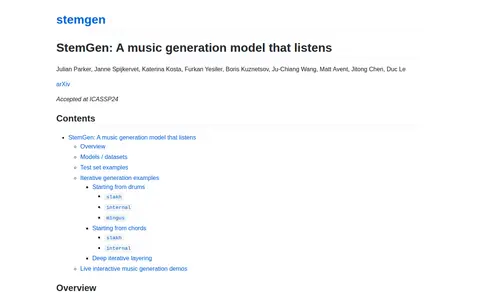
StemGen is an end-to-end music generation model trained to listen to musical context and respond appropriately. It is built on a non-autoregressive language-model type architecture similar to SoundStorm and VampNet, and is presented as examples for an ICASSP2024 paper.
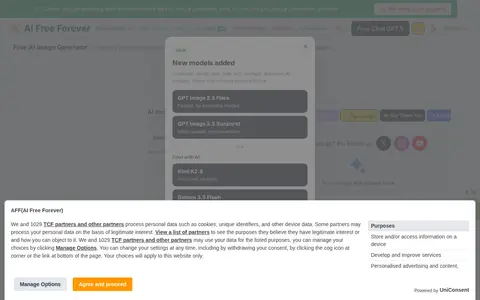
AIFreeForever is a free online text-to-image generation tool that does not require user sign-up or login. It offers unlimited image generation without watermarks, and provides access to over 20 top AI image models including Nano Banana 2, Imagen 4, Flux 2 Pro, and other leading models. Users can generate images from text prompts, adjust output size, select models, and upscale results.

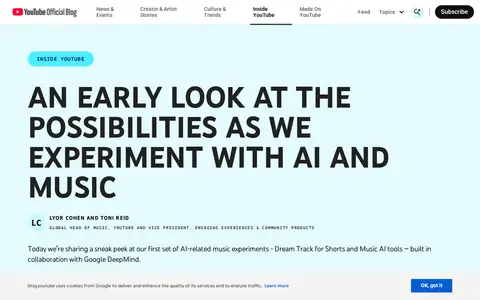
A YouTube Blog post announcing an early look at the company's first AI-related music experiments: Dream Track for Shorts and Music AI tools, built in collaboration with Google DeepMind. Dream Track is powered by the Lyria music generation model and initially lets a small group of select US creators create soundtracks of up to 30 seconds for Shorts.

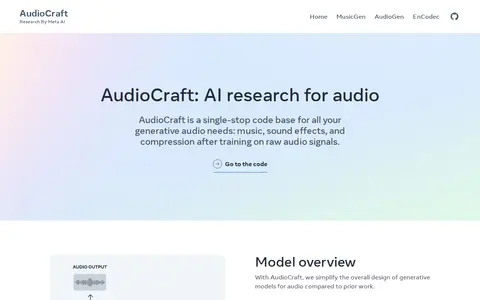
AudioCraft is a code base for generative audio tasks including music, sound effects, and compression, trained on raw audio signals. MusicGen produces music samples from text inputs, and AudioGen produces audio from environmental sounds via text-to-sound generation. The models use the EnCodec neural audio codec to learn discrete audio tokens from waveforms.

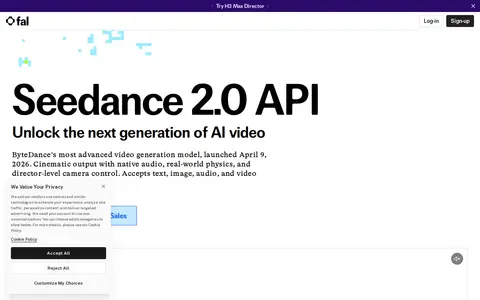
FAL.ai (Seedance 2.0) is ByteDance's Seedance 2.0 video generation API hosted on the fal serverless platform, launched April 9, 2026. It produces cinematic video with native audio, real-world physics, and director-level camera control, accepting text, image, audio, and video inputs. The service offers fast and standard API tiers for text-to-video, image-to-video, and reference-to-video generation, supporting 480p and 720p output.

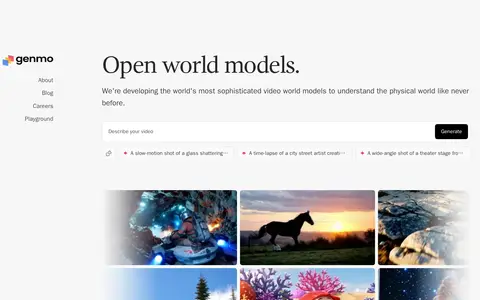
Genmo is a research lab that develops open models for video generation. Its Mochi 1 model is an open-source text-to-video model, available through an open-source repository or ComfyUI and an interactive playground. The playground creates AI-generated videos, and FAQ materials describe MP4 output, text-to-video generation, and Free, Lite, Standard, and Pro plans.

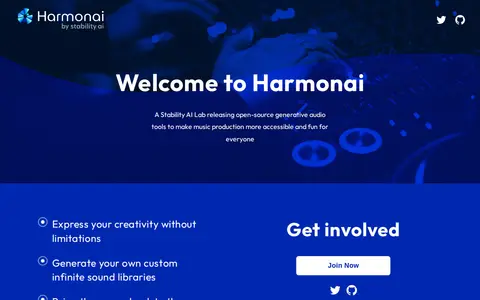
Harmonai is a Stability AI lab that releases open-source generative audio tools for music production. Its stated goal is to make music creation more accessible and enjoyable for all users, with tools that support custom infinite sound library generation to expand creative possibilities for musicians.

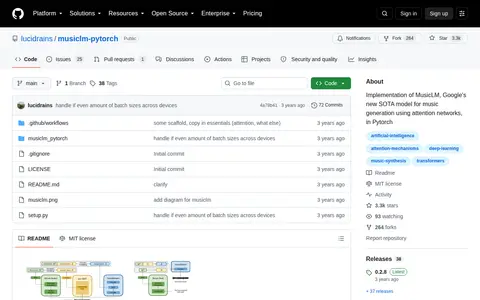
Implementation of MusicLM, Google's new SOTA model for music generation using attention networks, in Pytorch.

Lyria by Google DeepMind is a music generation model developed by Google DeepMind, positioned as the organization's most advanced system for AI-powered music creation. It is designed to support creative music production alongside related AI experiments, as part of Google DeepMind's broader portfolio of specialized AI models for generating high-fidelity music and audio.

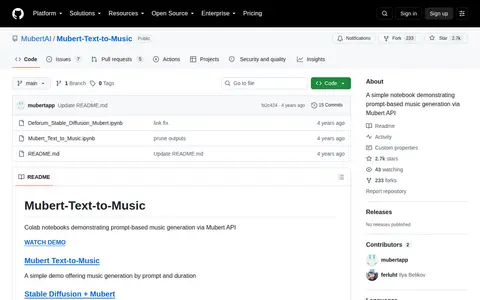
MubertAI/Mubert-Text-to-Music is a GitHub repository maintained by MubertAI. It hosts a simple notebook that demonstrates prompt-based music generation via the Mubert API, providing a reference implementation for users looking to generate music from text prompts using the service.

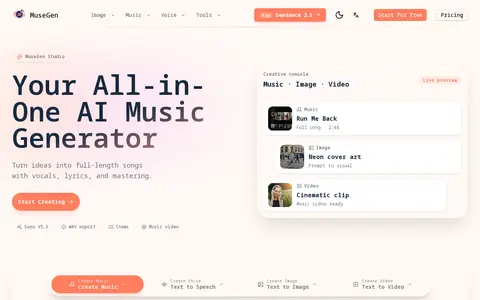
MuseGen is an AI music generation studio that turns text prompts into songs. It composes melodies, lyrics and vocals, offers multi-genre styles, and allows editing and export in MP3, WAV or MIDI. It also separates tracks into stems and can turn songs into MIDI or music videos. A paid subscription gives monthly credits for generating videos, images and songs.

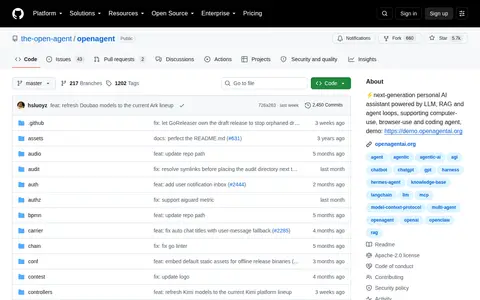
OpenAgent is a next-generation personal AI assistant powered by large language models, retrieval-augmented generation and agent loops. It supports computer-use, browser-use and coding agent functionalities, and integrates with over 30 model providers. A public demo is available at https://demo.openagentai.org.
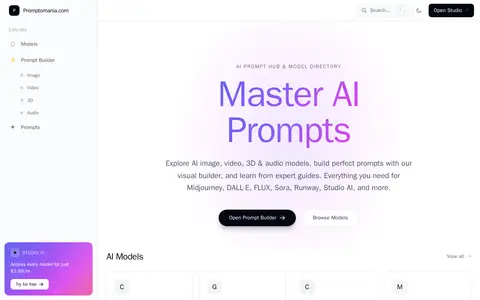
promptoMANIA is an AI prompt hub, model directory, and toolset for AI image generation. It offers a visual prompt builder, expert guides, and resources for models including Midjourney, DALL·E, Stable Diffusion, FLUX, Ideogram, and Leonardo AI. The platform also provides specialized prompt guides for use cases such as logo design, portrait photography, landscape generation, product mockups, pattern creation, and typography.

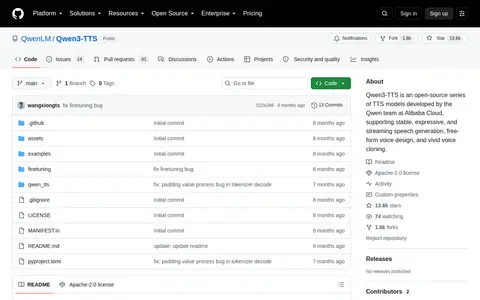
Qwen3-TTS is an open-source series of text-to-speech models developed by the Qwen team at Alibaba Cloud. It supports speech generation, streaming output, free-form voice design and voice cloning, and covers ten major languages with dialectal voice profiles. The release includes models of 0.6B and 1.7B parameters.

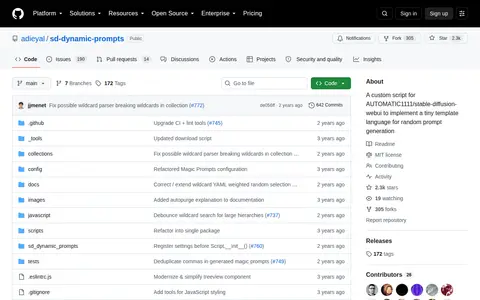
SD Dynamic Prompts is a custom script built for the AUTOMATIC1111 stable-diffusion-webui. It implements a small template language that enables random generation of prompts for use with Stable Diffusion image generation workflows.

Snapgen AI is a free, unlimited AI video generation platform. It uses Veo 3.1 to let users create videos, speech, and images via its advanced AI tools, and is intended for content creators' generation needs.

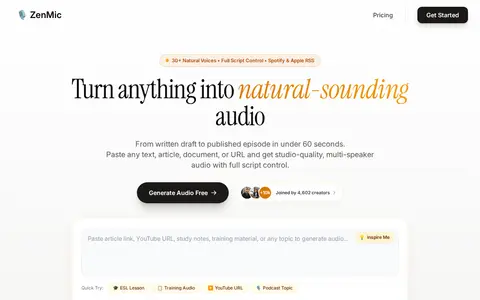
Zenmic.com is an AI audio generation tool that converts text, documents, URLs or topics into natural-sounding audio. It is targeted at ESL teachers, learning and development teams, and podcast creators, and offers features including full script control, over 30 voices, MP3 export, support for 125 languages, up to six speaker tracks, and voice cloning. Users can start using the tool for free without a credit card.

AIFreeVideo is an online AI video generator that creates videos from text or images. The site states it is free to use, requires no subscription, places no watermarks, and offers HD downloads and unlimited generations, with an average generation time of five minutes. It lists text-to-video and image-to-video as its main features.

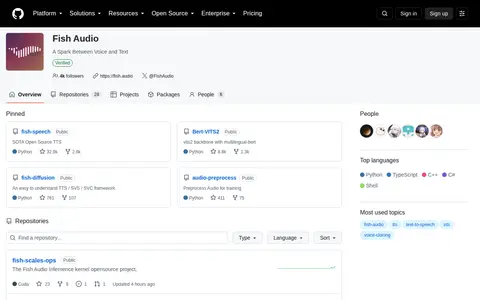
Fish Audio is an AI platform for voice generation, voice cloning, and audio storytelling, and its GitHub organization hosts open source repositories. Public repositories include fish-speech, described as SOTA open source TTS, Bert-VITS2, a vits2 backbone with multilingual-bert, and fish-diffusion, a TTS / SVS / SVC framework.

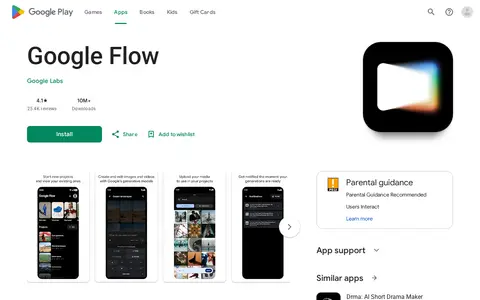
Google Flow is a Google Labs Android app for creating and refining images and videos with generative AI. It supports photo uploads and a project library shared with the desktop experience.