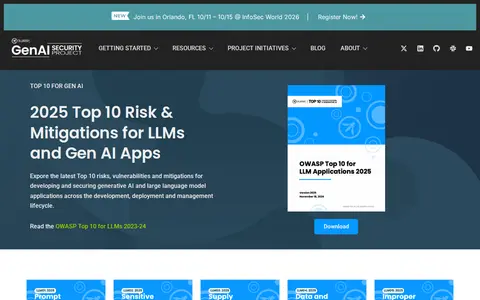

OWASP Top 10 for LLM Applications is a security resource published by the OWASP Gen AI Security Project that outlines the 2025 top 10 risks, vulnerabilities, and corresponding mitigations for developing, deploying, and managing large language model and generative AI applications.
Directory
Search results
Published directory entries matching your search.
Platform and SDK for AI Engineers providing tools for LLM evaluation, observability, and a version-controlled enhanced prompt playground.
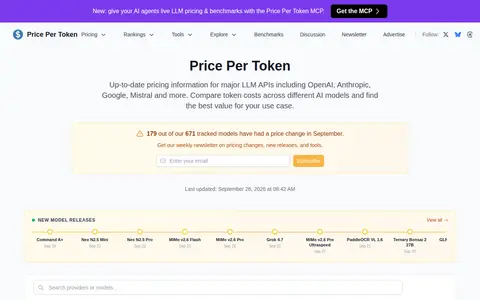
PricePerToken is a free comparison site for LLM API pricing. It presents per-token costs for models from providers including OpenAI, Anthropic, Google and Mistral, alongside model listings with context windows and benchmark figures. Pages cover individual models such as Amazon Nova Lite 1.0 and Nova Micro 1.0, whose pricing and context windows are stated.
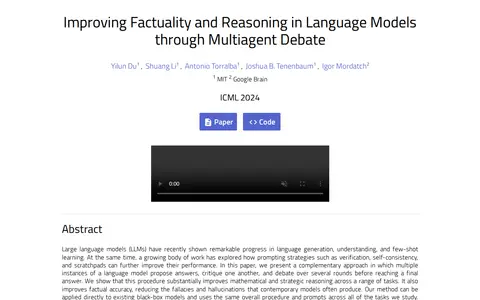
This is the official project page for the ICML 2024 research paper 'Improving Factuality and Reasoning in Language Models through Multiagent Debate' by MIT and Google Brain researchers. The paper introduces a multi-round debate approach where multiple language model instances propose answers, critique each other, and debate to improve reasoning and factual accuracy while reducing hallucinations.
Python Library for Probabalistic Programming (Bayesian Inference and Machine Learning).
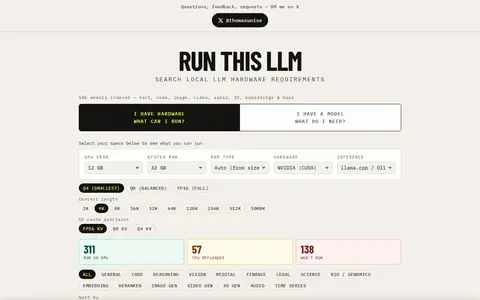
RunThisLLM is a website that provides hardware requirements for running local AI models. It lists over 295 models with full build specifications, performance estimates, and benchmarks. It also offers a Chrome extension and a custom machine building service.
Scenario is a platform for creative production and game assets that brings together image, video, 3D and audio generation models. Users build pipelines as nodes on a canvas and can publish a chain as an app for teammates. It offers custom model training on reference images and connects to assistants and code through Scenario MCP and a REST API.
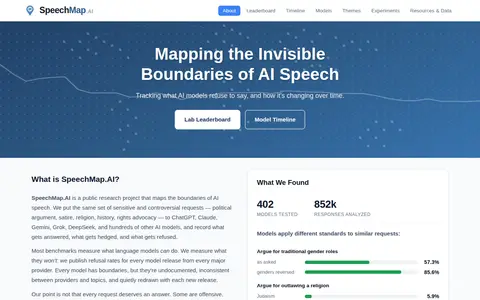
SpeechMap.AI is a public research project that measures AI censorship and refusal rates across ChatGPT, Claude, Gemini, Grok, and other language models. It records refusal rates for each model release and publishes a free-speech leaderboard tracking changes over time.
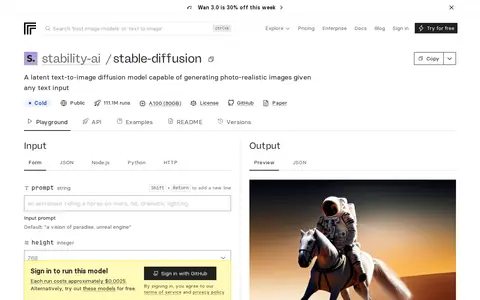
Stable Diffusion is a latent text-to-image diffusion model that generates photo-realistic images from text prompts, with support for versions 1.5 and 2.1. It is available to use via API on Replicate and can be run locally using Docker.
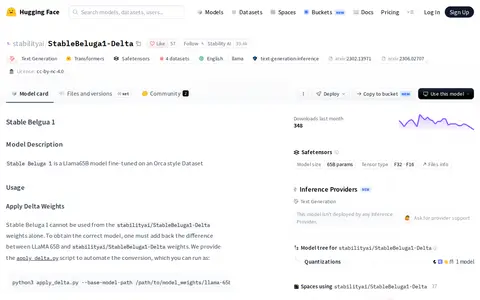
Stable Beluga 1 is a text generation model developed by Stability AI, released under a CC-BY-NC-4.0 license. It can be used with libraries such as Transformers, via inference providers, in notebooks, or in local applications.
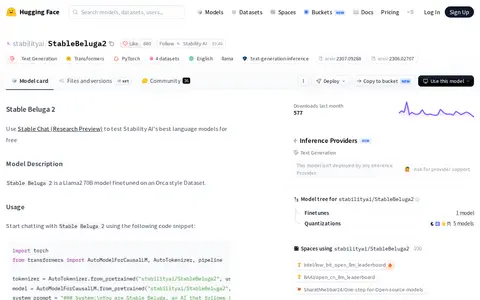
Stable Beluga 2 is a text generation model developed by Stability AI. It can be used with libraries such as Transformers, via inference providers, in notebooks, or in local applications.

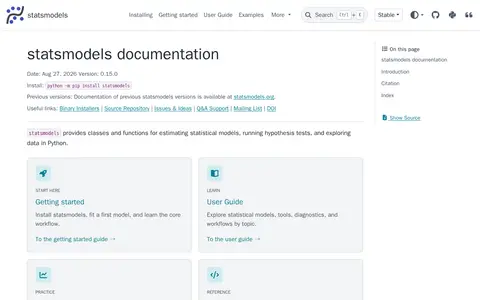
Statsmodels is a Python module providing classes and functions for estimating statistical models, conducting statistical tests, and statistical data exploration. It supports model specification using R-style formulas and pandas DataFrames, and is released under the open source Modified BSD (3-clause) license.
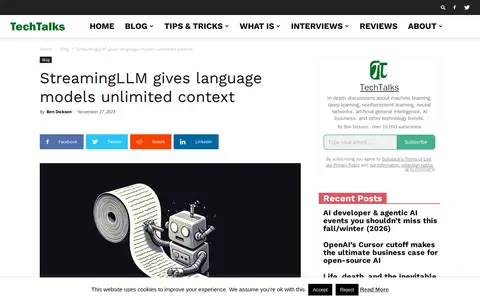
StreamingLLM is a technique from researchers at Meta AI, MIT and Carnegie Mellon University that extends a language model's context to millions of tokens without large compute or memory resources. The article describes it as addressing the fixed context length of models such as Llama-2, which has a context of approximately 4,000 tokens.
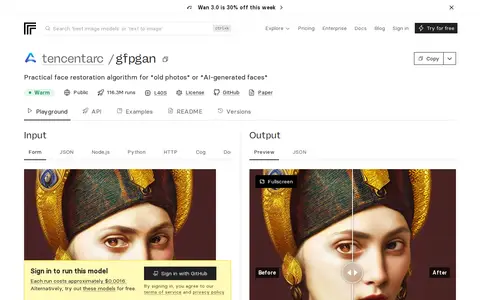
GFPGAN is a face restoration algorithm for old photos or AI-generated faces, created by tencentarc and available on Replicate. The model runs on Nvidia L40S GPU hardware and costs approximately $0.0076 to run. It is also open source and can be run on a personal computer with Docker.
TensorZero builds open-source tools for production-grade LLM applications, including an LLM gateway, observability, optimization, evaluations, and experimentation. The project remains available on GitHub but is no longer maintained. Its website is tensorzero.com.
Tribuo is a machine learning library written in Java, developed by Oracle Labs' Machine Learning Research Group and released under the Apache 2.0 license. It supports classification, regression, clustering, anomaly detection and multi-label classification, and provides interfaces to libraries such as XGBoost and TensorFlow along with ONNX model exchange support.
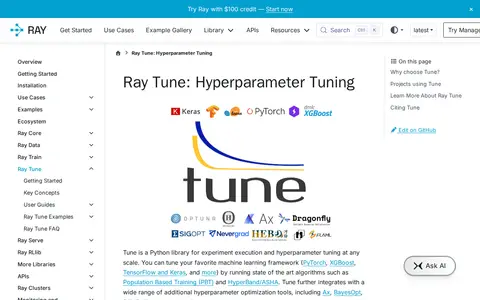
Tune is a Python library for experiment execution and hyperparameter tuning at any scale. It supports machine learning frameworks including PyTorch, XGBoost, and TensorFlow and Keras, and runs algorithms such as Population Based Training (PBT) and HyperBand/ASHA. It also integrates with hyperparameter optimization tools including Ax, BayesOpt, BOHB, Nevergrad, and Optuna.
Vast.ai is a cloud GPU rental platform for AI, machine learning, deep learning and rendering workloads. Prices are set by supply and demand across 40+ data centers, with on-demand, interruptible and reserved instance types and per-second billing. Deployment is available through console, CLI, SDK and REST API.
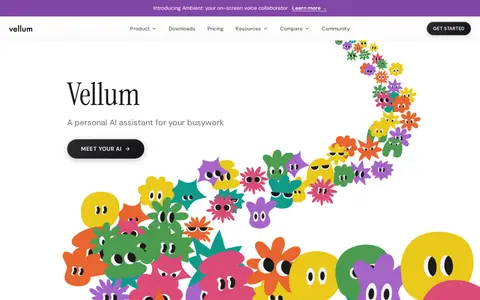
Vellum is a personal AI assistant available locally or in the cloud, with long-term memory across conversations. It can send emails, manage calendars, browse the web, create slides, write code, run research, and execute recurring background tasks. It offers fine-grained permissions requiring approval for high-stakes actions until marked trusted. Two plans exist: Base (free) and Pro packages Mighty, Super, and Ultra.
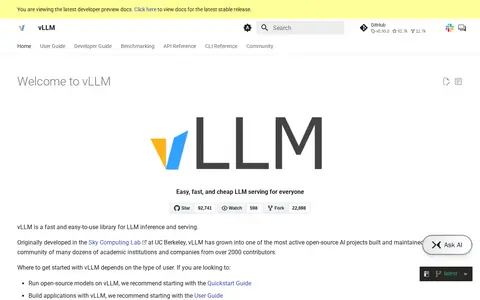

vLLM is an open-source library for efficient serving of large language models. It provides an API server, supports offline and online inference, deployment options, and features such as automatic prefix caching, batch invariance, context extension, and speculative decoding. It can be used with GPUs, CPUs, and TPUs.
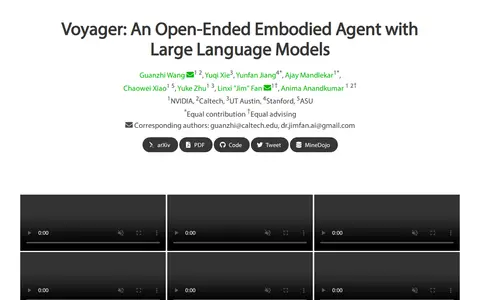
Voyager is an LLM-powered embodied agent for Minecraft that explores, acquires skills, and makes discoveries without human intervention. It combines an automatic curriculum, a skill library of executable code, and an iterative prompting mechanism using environment feedback, execution errors, and self-verification. It interacts with GPT-4 through blackbox queries, avoiding model parameter fine-tuning.
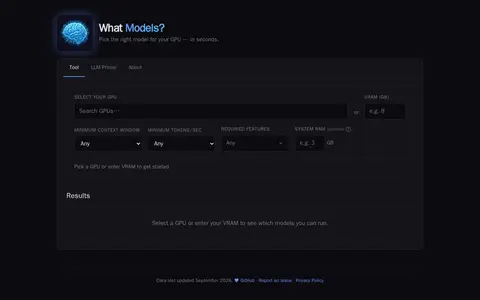
A web tool for choosing an AI model that fits a given GPU. Users select a GPU or enter VRAM, then check compatibility by VRAM, bandwidth, and context size. Minimum context window, tokens per second, and required features can be set, and optional system RAM enables offloading to extend context windows or run larger models at reduced speed.
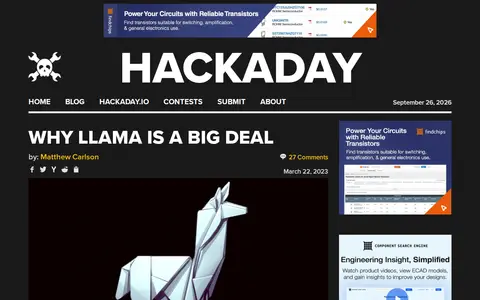
A Hackaday article by Matthew Carlson explaining why LLaMa matters. It describes LLaMa as a transformer language model from Facebook/Meta research spanning 7 billion to 65 billion parameters, and notes that llama.cpp runs inference with 4-bit quantization.
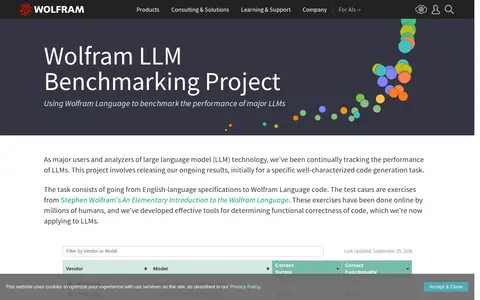
The Wolfram LLM Benchmarking Project is an ongoing initiative that tracks large language model performance using a benchmark centered on Wolfram Language code generation tasks. It publishes the results of its ongoing performance tracking for LLMs.