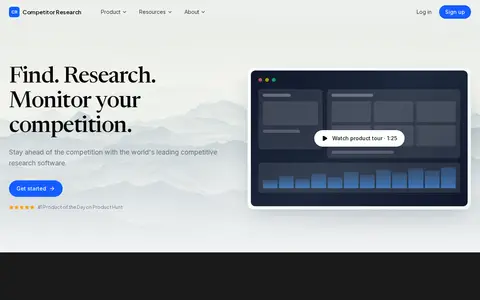
Competitor Research is a competitive research tool. It takes a website URL and produces a ranked list of competitors, which users can curate into watchlists. It provides profiles covering positioning, pricing, launches, and other data, and sends weekly signals about competitor changes. Some features, including real-time change alerts and SEO and keyword movement, are listed as coming soon.

Directory
Search results
Published directory entries matching your search.
Cosmos generates 30-second video essays from a typed idea, with sourced facts, archive pictures, a voiceover and original music. Films can be made free up to three a day, with a watermark, and a clean 1080p MP4 can be bought for $9. No credit card is required to start and there is no subscription.
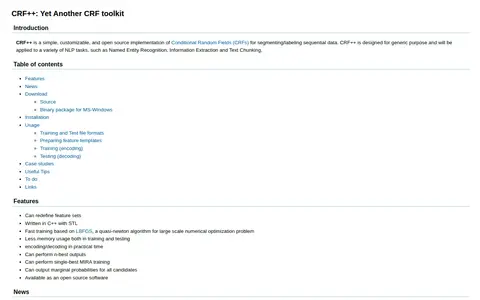
CRF++ is an open source implementation of Conditional Random Fields for segmenting and labeling sequential data. It is designed for general purposes and can be applied to NLP tasks such as named entity recognition, information extraction and text chunking. Feature sets can be redefined, and it is written in C++ with STL.
An open-source JavaScript visualization library that streamlines the creation of beautiful and accessible SVG data visualizations.
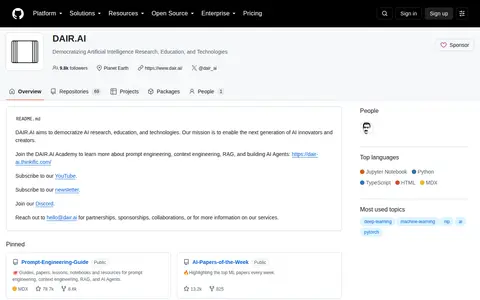
DAIR.AI is a GitHub organization that states it aims to democratize AI research, education, and technologies. Its repositories include a prompt engineering guide covering guides, papers, lessons, notebooks and resources for prompt engineering, context engineering, RAG, and AI Agents, and AI-Papers-of-the-Week, which highlights top machine learning papers each week.
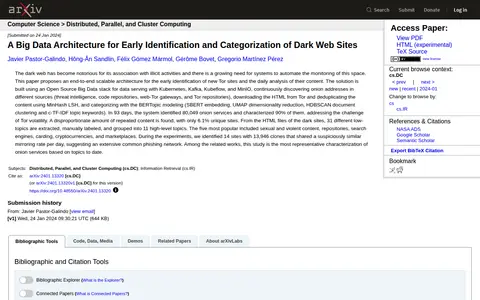
This arXiv paper proposes an end-to-end scalable architecture for early identification of new Tor sites and daily analysis of their content. It is built on an open source big data stack including Kubernetes, Kafka, Kubeflow and MinIO, discovering onion addresses across several sources, downloading HTML from Tor, deduplicating with MinHash LSH and categorizing with BERTopic modeling. In 93 days it identified 80,049 onion services and characterized 90% of them.
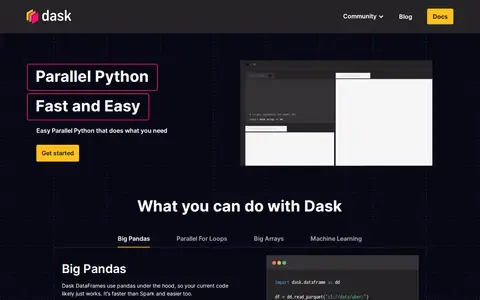
Dask is an open-source Python library for parallel computing maintained by contributors across dozens of companies. The site describes uses including Dask DataFrames for pandas, parallel for loops, large arrays with NumPy and Xarray, and machine learning. It can run on a laptop or be deployed on resource managers such as Kubernetes or cloud.
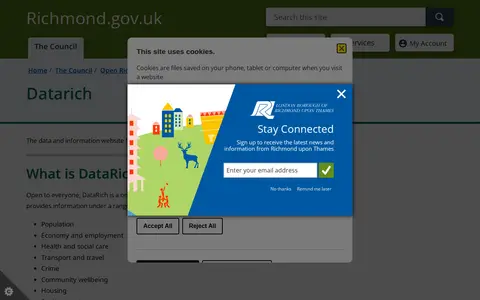
DataRich is the data and information website for Richmond upon Thames, open to everyone. It provides statistics and analysis for the borough under themes including population, economy and employment, health and social care, transport and travel, crime, community wellbeing, housing and environment. It contains 2011 Census data and a profile of key facts, drawing on sources such as the Office for National Statistics, NOMIS, DCLG and Neighbourhood Statistics.
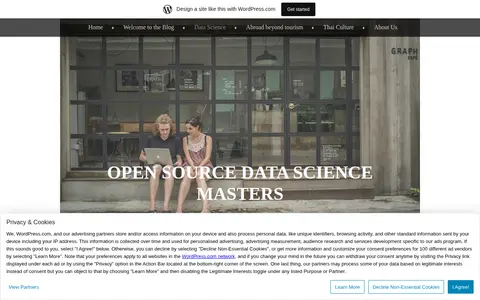
A blog documenting a self-designed open source data science master's program. Posts cover a six-month plan to become a data scientist, study examples after one month, MOOCs versus classroom learning, and a final project using the D3.js library to present what was learned.
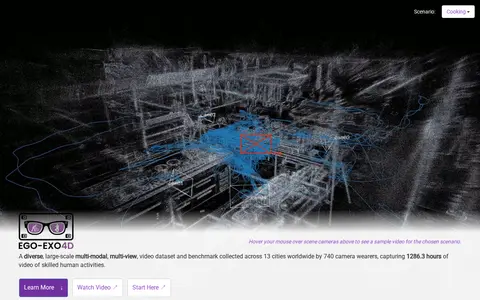
Ego-Exo4D is a large-scale multi-modal, multi-view video dataset and benchmark of simultaneously captured ego-centric and exo-centric video of skilled human activities such as sports, music, dance, and bike repair. It includes natural language datasets, multi-view capture with Aria glasses and GoPros, and benchmarks including Keystep Recognition and Proficiency Estimation.

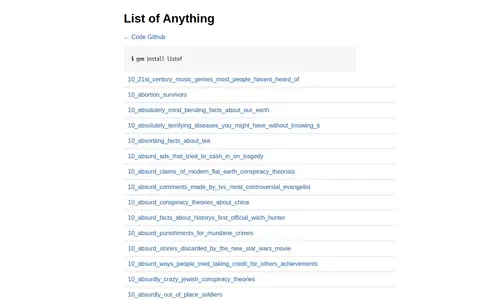
Listof - Community based data collection, packed in gem. Get list of pretty much anything (stop words, countries, non words) in txt, JSON or hash.
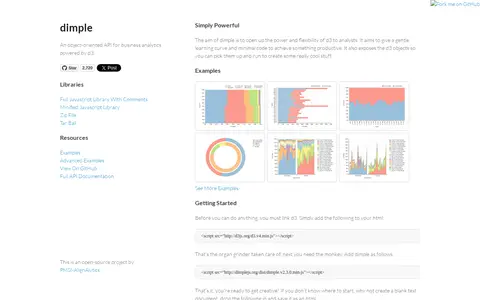
Dimple is an open-source charting API for d3 aimed at business analytics, letting users create and combine bar, line, area and scatter charts. It exposes underlying d3 objects so analysts can build on them, and requires linking d3 before adding dimple to a page.
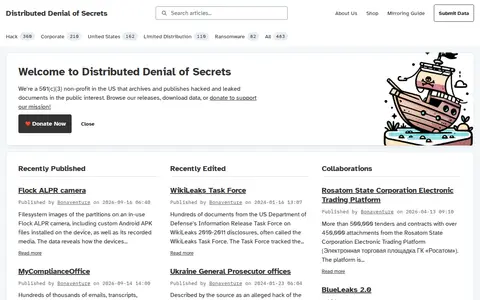
A US 501(c)(3) non-profit that archives and publishes hacked and leaked documents in the public interest. Its site lists released datasets by category and offers downloads. The group also publishes analysis and protects sources, according to its about page.
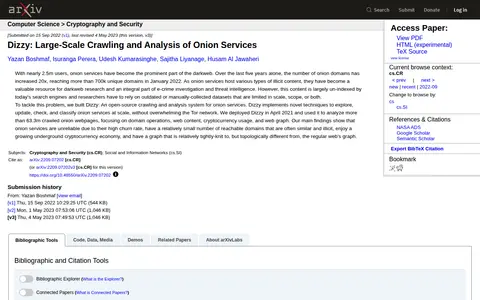
Dizzy is an open-source crawling and analysis system for onion services. It implements techniques to explore, update, check, and classify onion services at scale without overwhelming the Tor network. It was deployed in April 2021 and used to analyze more than 63.3 million crawled onion webpages, focusing on domain operations, web content, cryptocurrency usage, and web graph.
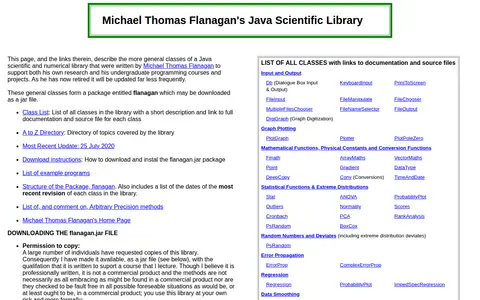
A Java scientific and numerical library written by Michael Thomas Flanagan to support his research and undergraduate programming courses. It is distributed as the flanagan.jar package and includes general classes, example programs and arbitrary precision methods. The author has retired and states it will be updated less frequently. Commercial use, public listing of source codes and redistribution are not permitted.
DrivenData hosts online machine learning competitions with social impact and works with mission-driven organizations on data science and engineering projects. It also maintains open-source projects for the data science community and shares prize-winning solutions from past competitions on GitHub. Areas of work include public health, conservation and international development.
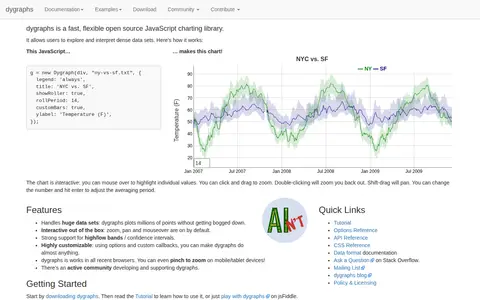
dygraphs is a fast, flexible open source JavaScript charting library that allows users to explore and interpret dense data sets. Charts are interactive, with zoom, pan and mouseover available by default, and the library handles very large data sets. It works in all recent browsers.
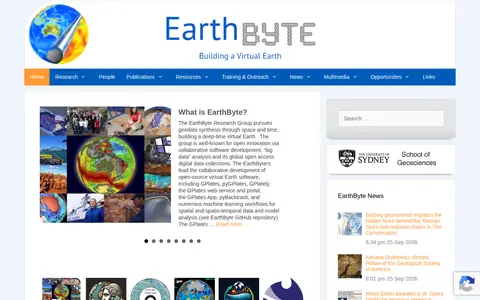
EarthByte is a research group at the University of Sydney's School of Geosciences. It pursues geodata synthesis through space and time, building a deep-time virtual Earth, and is known for collaborative software development, big data analysis and open access digital data collections. It leads development of open-source virtual Earth software including GPlates and pyGPlates.
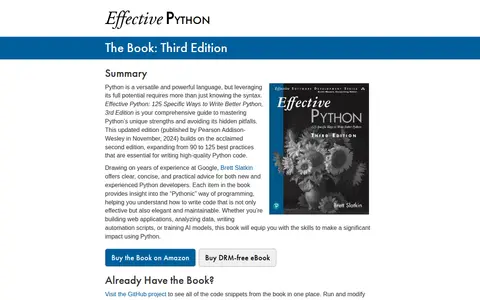
Effective Python: 125 Specific Ways to Write Better Python, 3rd Edition is a book by Brett Slatkin, published by Pearson Addison-Wesley in November 2024. It expands on the second edition from 90 to 125 best practices for writing Python code, adds new chapters on robustness and performance, and covers the language through Python version 3.13.
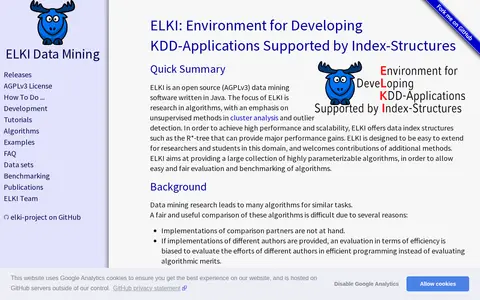
ELKI is an open source data mining software written in Java. It focuses on research in algorithms, emphasizing unsupervised methods in cluster analysis and outlier detection, and offers data index structures for performance and scalability. It is designed for researchers and students to extend.
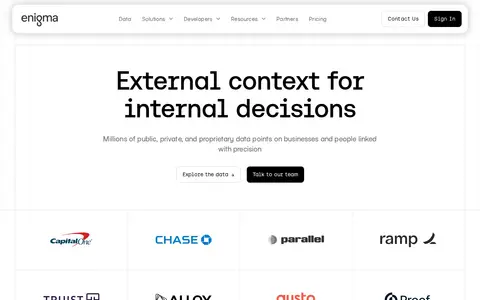
Enigma is a business data platform that provides access to millions of public, private and proprietary data points on businesses and people, supporting workflows including know-your-business verification, customer onboarding, go-to-market operations, payment risk assessment and customer screening.
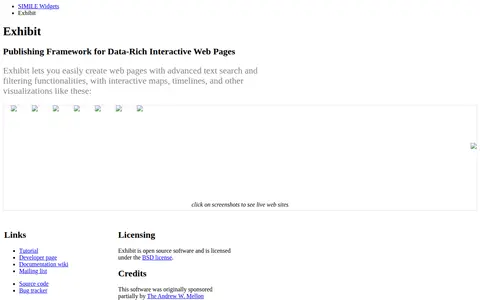
Exhibit is an open source publishing framework for creating data-rich interactive web pages. It provides advanced text search and filtering, along with interactive maps, timelines and other visualizations. The software is licensed under the BSD license and was originally sponsored partially by The Andrew W. Mellon Foundation as part of the SIMILE project.
Explainpaper is a tool for reading research papers. Users highlight confusing text to get explanations, and can ask follow-up questions. It offers plans from a free tier to paid Pro and Teams options, with Pro including advanced AI models and clickable explanations for graphs, figures and equations.
Helps find, analyze or synthesize information for research and knowledge discovery.