github.com
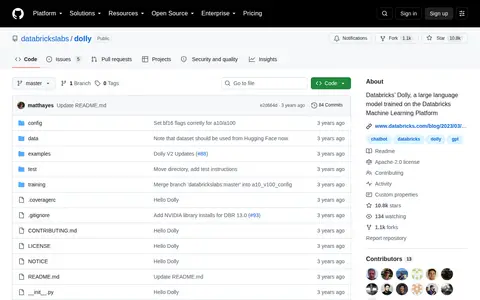
Databricks’ Dolly, a large language model trained on the Databricks Machine Learning Platform.
Directory
Published directory entries matching your search.
Databricks’ Dolly, a large language model trained on the Databricks Machine Learning Platform.

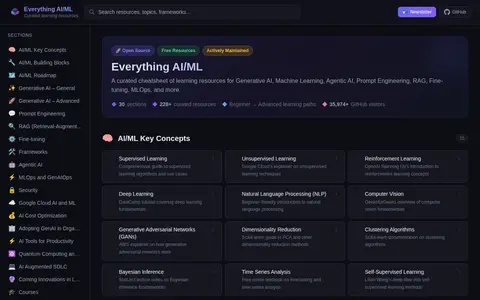
Everything AI/ML is a curated cheatsheet of learning resources covering topics such as generative AI, machine learning, agentic AI, prompt engineering, RAG, fine-tuning and MLOps. It organizes resources into sections, key concepts, interactive visualizations, building blocks and a roadmap from beginner to advanced, with links to external courses, tutorials and documentation.

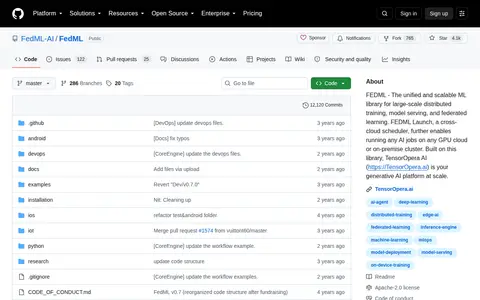
FedML is a unified and scalable open-source machine learning library for large-scale distributed training, model serving, and federated learning. It includes FEDML Launch, a cross-cloud scheduler for running AI workloads on GPU clouds or on-premise clusters, and forms the foundation of the TensorOpera AI generative AI platform.

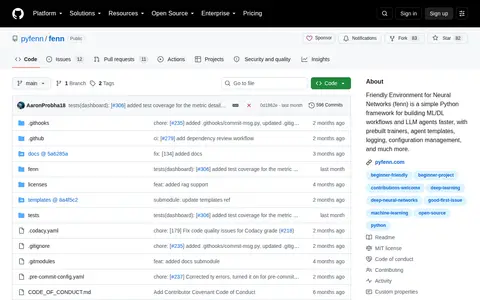
fenn is a Python framework for building machine learning and deep learning workflows and LLM agents. It provides prebuilt trainers, agent templates, logging, and configuration management, with YAML configuration parsed and injected into the entrypoint with CLI override support. It is released under the MIT license.
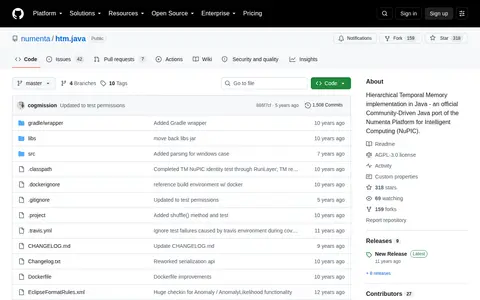
General Machine Learning library using Numenta’s Cortical Learning Algorithm.
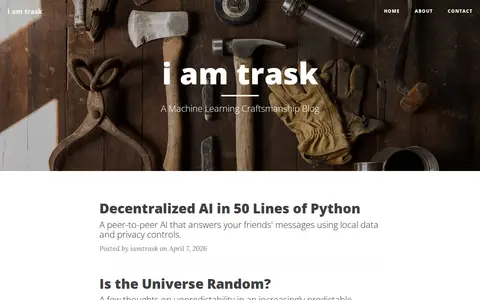
I am trask is a machine learning craftsmanship blog. Posts listed include Decentralized AI in 50 Lines of Python, Is the Universe Random?, Safe Crime Detection, Deep Learning without Backpropagation and Building Safe A.I.
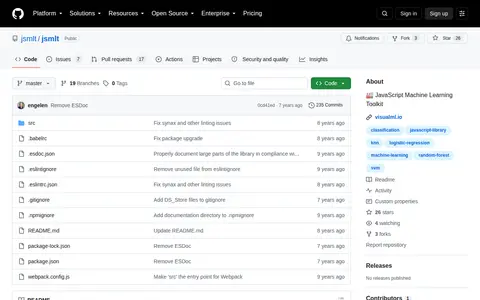
JSMLT is an open source JavaScript library for education in machine learning. It implements supervised learning algorithms, including SVM, random forest, decision tree, perceptron, neural networks, k-nearest neighbors and logistic regression, and provides visualization examples for exploring how the algorithms work.

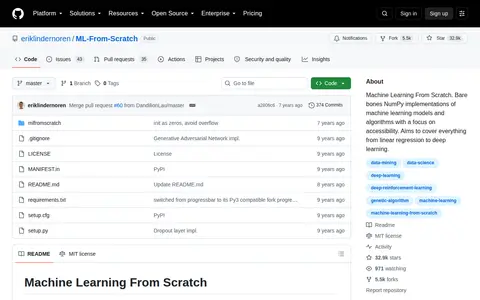
ML-From-Scratch is a GitHub repository that provides bare bones NumPy implementations of machine learning models and algorithms with a focus on accessibility, aiming to cover methods from linear regression to deep learning.

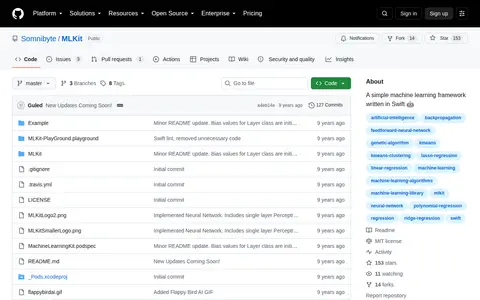
MLKit is a simple machine learning framework written in Swift. Currently it features algorithms dealing with regression, with planned expansion to classification, clustering, recommender systems and deep learning. The project is under active development and is not ready for use in commercial or personal projects, and can be installed via CocoaPods as MachineLearningKit.
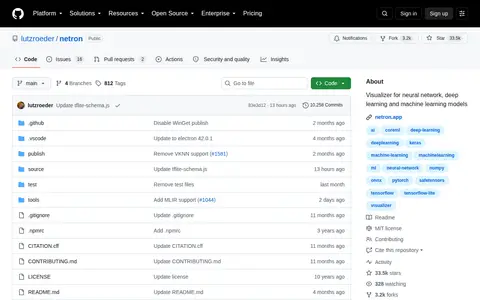
Netron is a visualizer for neural network, deep learning, and machine learning models. It allows users to view model architectures and graphs. The tool is available as a web application at netron.app.

Netron is a viewer for neural network, deep learning and machine learning models. It supports formats including ONNX, TensorFlow Lite, PyTorch, TensorFlow, Core ML, OpenVINO, Keras, Caffe, Darknet, Safetensors and NumPy. It is available as a browser version and installers for macOS, Linux and Windows, plus a Python package. Experimental support exists for MLIR, JAX, GGUF and other formats.

A Scientific American article discussing a new machine learning training method that aims to improve AI generalization abilities similar to human learning. The article suggests that adjusting training approaches, rather than solely increasing training data volume, may lead to more flexible and less error-prone AI systems.

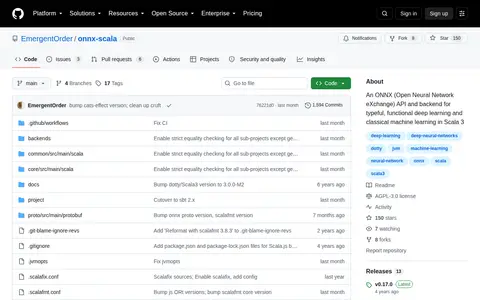
ONNX-Scala is an ONNX (Open Neural Network eXchange) API and backend built for typeful, functional deep learning and classical machine learning use cases in Scala 3. It is hosted as a public repository under the EmergentOrder GitHub organization.

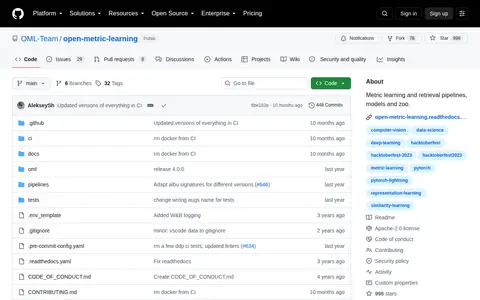
OpenMetricLearning is a repository that provides metric learning and retrieval pipelines, pre-trained models, and a model zoo for related machine learning tasks. It includes documentation, installation guides, and example implementations for users.

Apache SINGA is an Apache Top Level Project focused on distributed training of deep learning and machine learning models. It supports data parallel training across multiple GPUs on a single node or across different nodes, automatic gradient calculation, and loading and saving ONNX format models. Models trained with SINGA can be queried as stored procedures in an RDBMS.

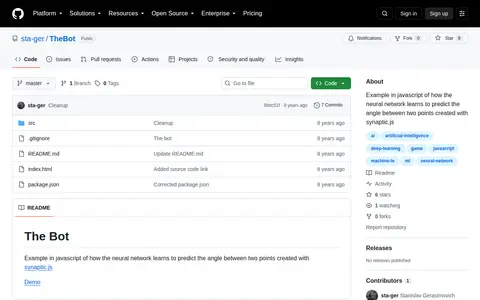
The Bot is a public JavaScript repository that provides an example of a neural network learning to predict the angle between two points. It is built using the synaptic.js library and demonstrates this machine learning functionality in code.

Vast.ai is a cloud GPU rental platform for AI, machine learning, deep learning and rendering workloads. Prices are set by supply and demand across 40+ data centers, with on-demand, interruptible and reserved instance types and per-second billing. Deployment is available through console, CLI, SDK and REST API.

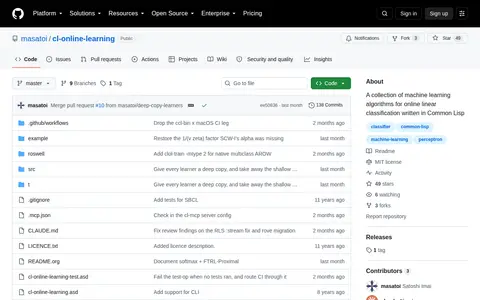
cl-online-learning is a Common Lisp library collecting machine learning algorithms for online linear classification. It implements binary classifiers including Perceptron, AROW, SCW-I, logistic regression with SGD or ADAM, and FTRL-Proximal, plus multiclass approaches such as one-vs-rest, one-vs-one, multiclass AROW and softmax with FTRL-Proximal. Command line tools are provided as a roswell script, and the package is available from Quicklisp.
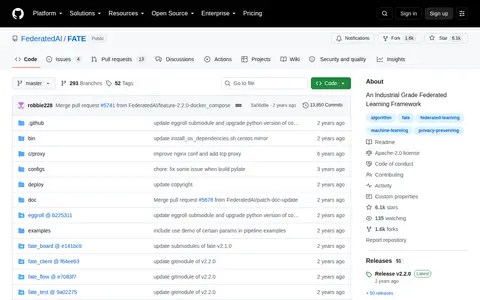
FATE (Federated AI Technology Enabler) is an industrial grade federated learning open source framework that enables enterprises and institutions to collaborate on data while protecting data security and privacy. It implements secure computation protocols based on homomorphic encryption and multi-party computation, and provides federated learning algorithms including logistic regression, tree-based algorithms, deep learning and transfer learning.

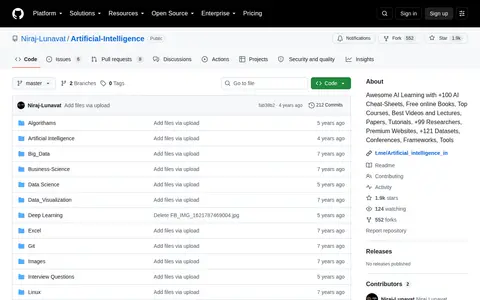
A GitHub repository collecting AI learning resources, including over 100 cheat-sheets, free online books, courses, videos and lectures, papers, tutorials, researchers, websites, datasets, conferences, frameworks and tools. Topics include machine learning, deep learning, big data, data science and Python.

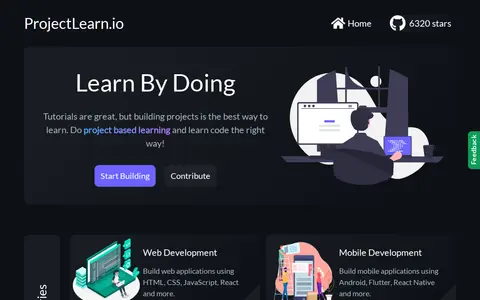
A project-based learning resource for coding across web development, mobile development, game development, machine learning and artificial intelligence. It presents the approach of learning by doing and building projects rather than only following tutorials.

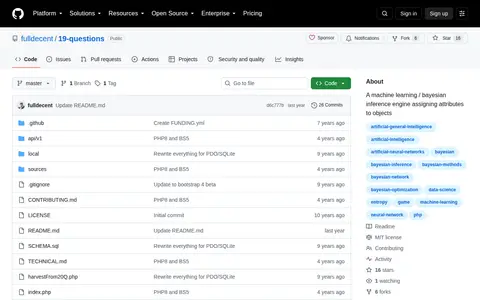
19 Questions is an open source machine learning and Bayesian inference engine designed to assign attributes to objects. Its source code is hosted in a public GitHub repository under the fulldecent organization, and contributions to the project are accepted from the public.

A simple guide to fine-tuning Llama 2 Brev docs provides machine-learning models, research, training resources, or evaluation tools.

Ability AI provides machine-learning models, research, training resources, or evaluation tools.