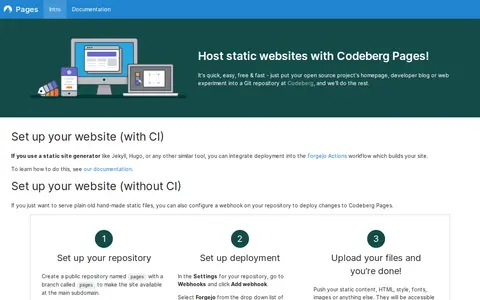

Codeberg Pages hosts static websites from Git repositories at Codeberg. A public repository named pages, or a pages branch in a public repository, makes the site available at the main subdomain. Site generators such as Jekyll and Hugo can deploy through Forgejo Actions, and deployment can also be configured with a webhook. Custom domains are supported through DNS records.
Directory
Search results
Published directory entries matching your search.
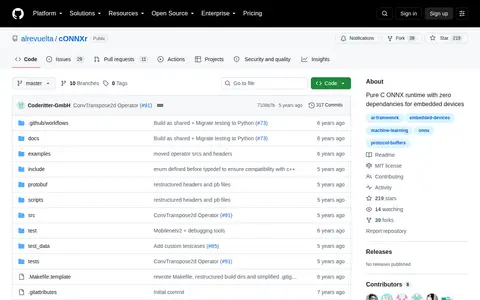
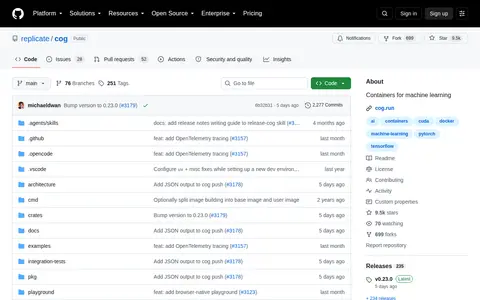
Cog is an open-source tool that packages machine learning models in standard, production-ready containers. Users define the environment in a configuration file, and it generates a Docker image with Nvidia base images and dependency caching. Model inputs and outputs are defined in Python, from which Cog generates an OpenAPI schema and an HTTP inference server. Models can be deployed to own infrastructure or Replicate.
Open-source project that provides machine-learning models, research, training resources, or evaluation tools.
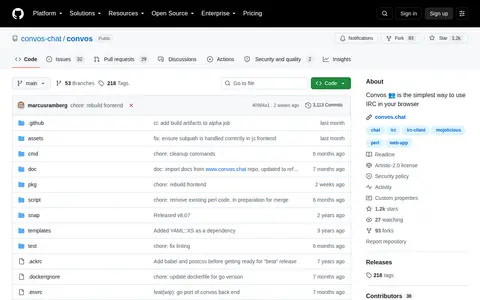
Convos is an open-source multiuser chat application hosted in the convos-chat/convos GitHub repository. It is designed as a simple option for using IRC directly in a web browser. The repository includes documentation for quick start, local installation, Docker deployment, and release creation.
The Coronavirus Government Response Tracker, formally the Oxford Covid-19 Government Response Tracker (OxCGRT), is a project run by the University of Oxford Blavatnik School of Government. It tracked and compared COVID-19 policy responses across the globe consistently over 2020, 2021, and 2022, and released the collected policy data for free public use. The project team continues to research the impacts and determinants of pandemic policy, and collaborates with partners to develop fast-deployment data collection methods for use in future pandemics.
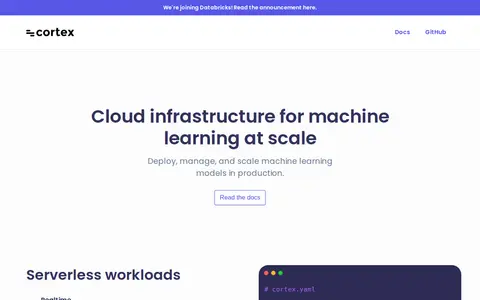
Cortex is cloud infrastructure for machine learning at scale, used to deploy, manage and scale machine learning models in production. It supports realtime, async and batch serverless workloads, along with automated cluster management including cluster autoscaling and spot instances with on-demand backups. Environments, provisioning and CI/CD and observability integrations are also listed. A notice states the project is joining Databricks.
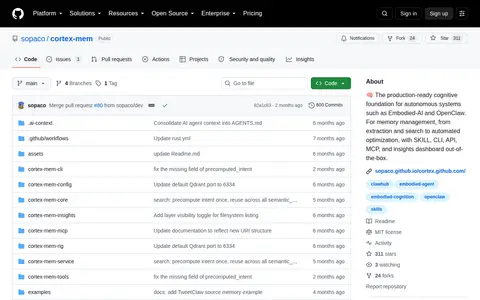
Cortex Memory is a production-ready cognitive foundation for autonomous systems such as Embodied-AI and OpenClaw. It provides memory management functionality including extraction, search, and automated optimization, and includes SKILL, CLI, API, MCP, and an insights dashboard out-of-the-box.
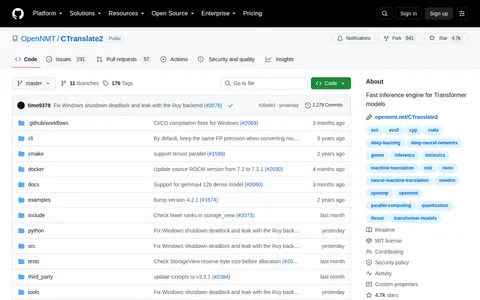
Fast inference engine for Transformer models in C++.
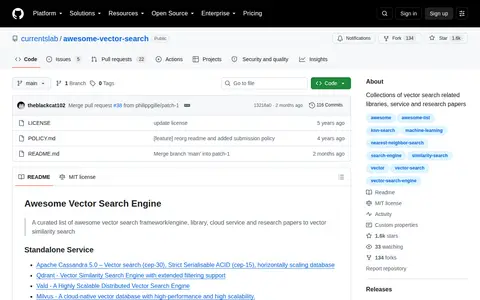
Curated list of awesome vector search framework/engine, library, cloud service and research papers to vector similarity search.
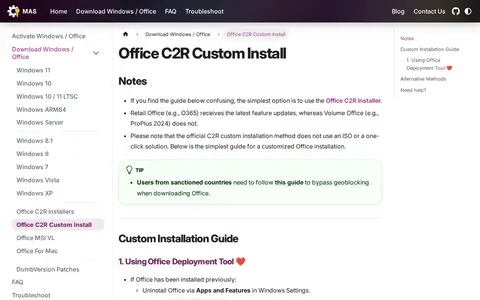
A guide for performing a customized Office install using the Office Deployment Tool, with a configuration file exported from config.office.com and commands run in an elevated Command Prompt. It notes that the official method uses neither an ISO nor a one-click solution, and mentions an advanced alternative method, YAOCTRI.
Enjoy unlimited API calls with Serverless AI Workers/LLMs for just $25 per month. No rate or concurrency limits.
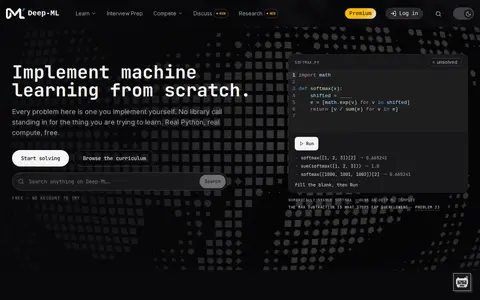
Deep ML supports machine learning models, deployment, inspection, datasets, or AI development workflows.
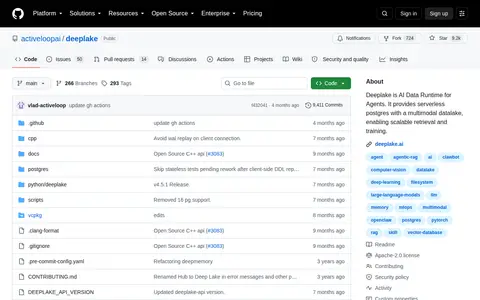
Open-source project that supports deploying, serving, monitoring, or operating AI and machine-learning systems.
DeepSeek provides machine-learning models, research, training resources, or evaluation tools.
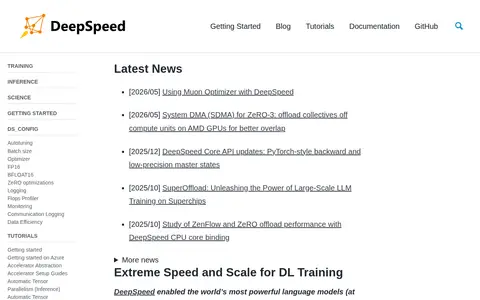
DeepSpeed is a deep learning optimization library intended to make distributed training easy, efficient and effective. It offers system innovations including ZeRO, 3D-Parallelism, DeepSpeed-MoE and ZeRO-Infinity, and has been integrated with several open-source deep learning frameworks.
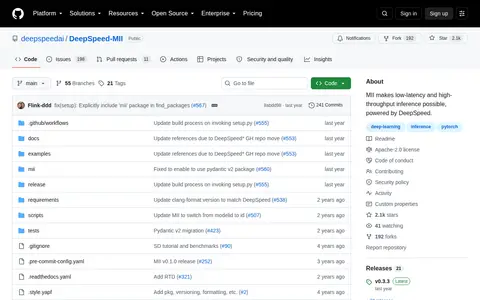
MII makes low-latency and high-throughput inference possible, powered by DeepSpeed.
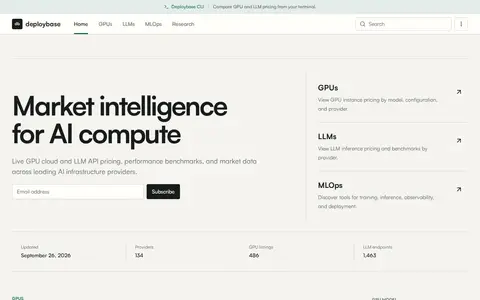
A market intelligence site for AI compute that tracks live GPU cloud and LLM API pricing, performance benchmarks and market data across AI infrastructure providers. It publishes comparisons of GPU cloud pricing by provider and of LLM performance versus cost, including articles on Azure, AWS, Google Cloud, CoreWeave and Lambda GPU offerings.
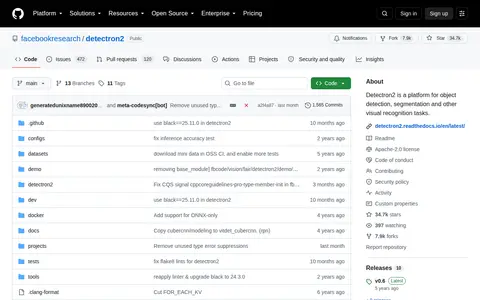
Detectron2 is Facebook AI Research's next generation library providing detection and segmentation algorithms, succeeding Detectron and maskrcnn-benchmark. It supports computer vision research projects and production applications at Facebook and includes capabilities such as panoptic segmentation, Densepose, Cascade R-CNN, rotated bounding boxes, PointRend, DeepLab, ViTDet and MViTv2. Models can be exported to TorchScript or Caffe2 format for deployment.
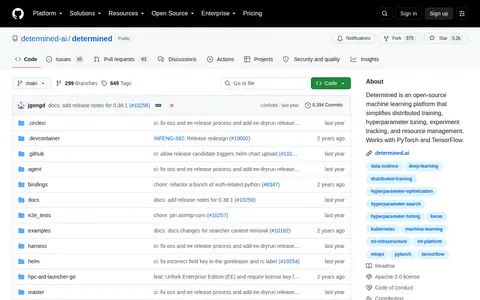
Determined is an open-source machine learning platform that simplifies distributed training, hyperparameter tuning, experiment tracking, and resource management. It works with PyTorch and TensorFlow, offering a Python library, command line interface, and web UI for managing machine learning workflows.
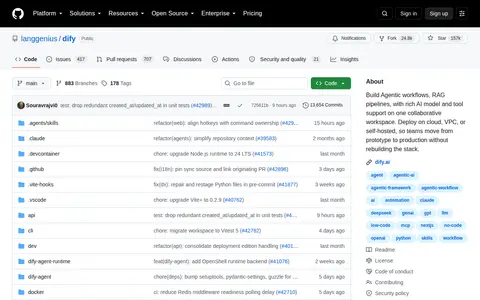
Dify is an open-source LLM app development platform with a visual canvas for AI workflows and RAG pipelines, plus model management and observability. It can be deployed on cloud, VPC, or self-hosted, and integrates with proprietary and open-source LLMs.
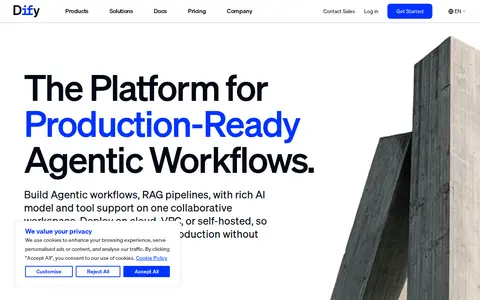
Dify is a platform for building agentic workflows on one canvas, covering agents, knowledge pipelines, models and tools. Deployments include Dify Cloud, a VPC or self-hosted setup, and a source-available Community Edition. The platform also supports RAG pipelines with AI model and tool support.
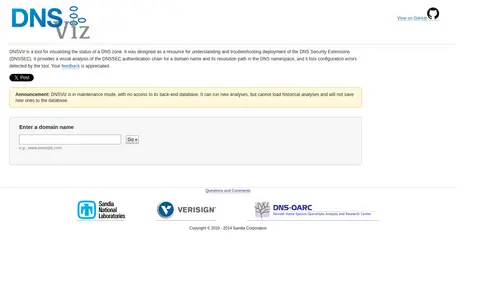
DNSViz is a tool for visualizing the status of a DNS zone. It was designed to help understand and troubleshoot deployment of the DNS Security Extensions, providing a visual analysis of the DNSSEC authentication chain and resolution path and listing configuration errors it detects.
Dominodatalab supports deploying, serving, monitoring, or operating AI and machine-learning systems.
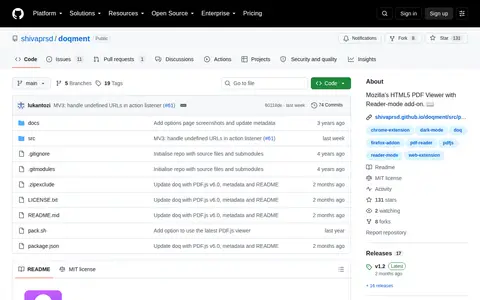
A custom deployment of Mozilla's PDF.js generic viewer packaged as a Web Extension, adding a reader mode that changes PDF colors plus features such as Auto-track Document Outline, Smart Zoom text and a Show/Hide toolbar. In Firefox it replaces the built-in PDF.js viewer; in Chromium browsers it coexists with the native viewer and opens PDFs via a context menu or toolbar button.