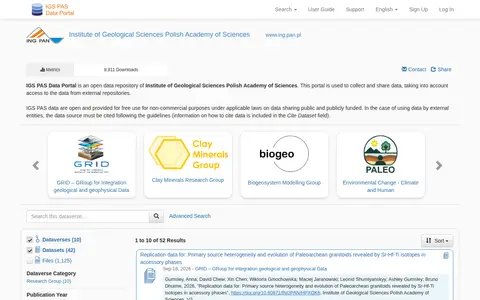

IGS PAS Data Portal is an open data repository of the Institute of Geological Sciences of the Polish Academy of Sciences. It collects and shares data, also considering access from external repositories. The data are freely available for non-commercial use, with citation required.
Directory
Search results
Published directory entries matching your search.
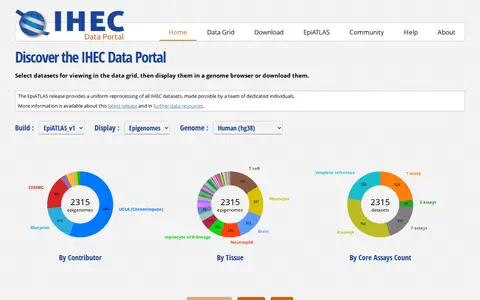
The IHEC Data Portal lets users select datasets for viewing in a data grid, display them in a genome browser, or download them. It offers a download section for direct dataset access and a UCSC Genome Browser mirror with a preloaded track hub. Searches use key = "value" phrases that may be combined in boolean fashion. Raw sequencing read files are stored at controlled access repositories.
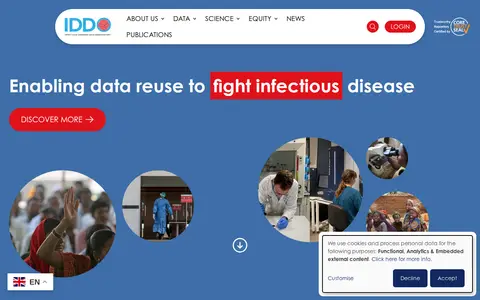
Infectious Diseases Data Observatory (IDDO) is an organisation that enables reuse of infectious disease data to support disease control efforts. It pools and standardises data, applies strict privacy controls to pseudo-anonymise data, shares data responsibly and maintains gold standard data repositories for a range of infectious diseases including malaria, COVID-19, Ebola and antimicrobial resistance. It also provides data access guidelines and related resources for users.
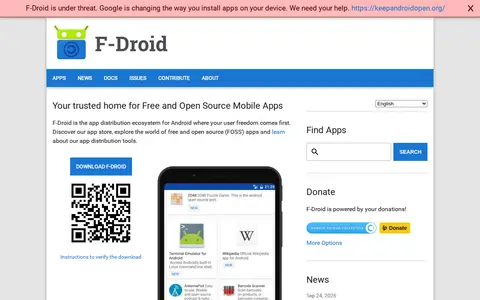
F-Droid is an app distribution ecosystem for Android focused on free and open source software. It operates a repository of verified free software Android apps and provides server tools, scripts and build and release tools for setting up and running an app store, including additional or alternative repositories.
Find published open datasets through filters, categories and keyword search.
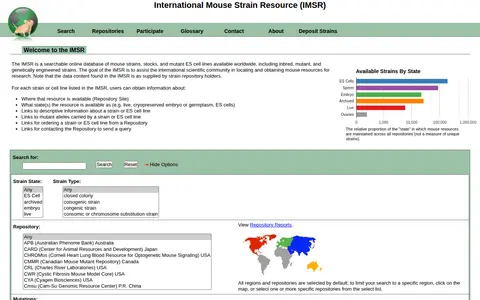
The International Mouse Strain Resource is a searchable online database of mouse strains, stocks and mutant ES cell lines available worldwide from repositories. It lists where each resource is held and in what state it is available, and links to descriptive information, mutant alleles, ordering and repository contact. Data is supplied by the strain repository holders.
The International Ocean Discovery Program was a scientific ocean drilling program that concluded in 2024 after eleven years. It studied the subseafloor, and its platforms were operated by science operators: the JOIDES Resolution Science Operator, MarE3 within JAMSTEC, and the ECORD Science Operator using mission-specific platforms. Cores and samples may still be requested from the IODP Core Repositories.
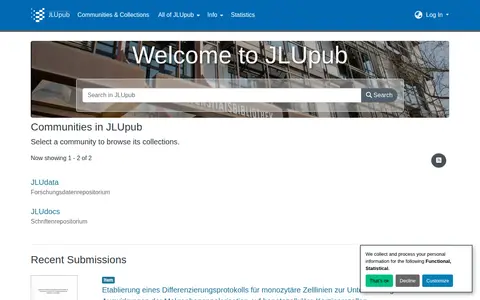
JLUpub is the institutional repository platform of Justus Liebig University Giessen. It hosts two community repositories: JLUdata for research data and JLUdocs for scholarly publications. The platform hosts recent academic submissions, including a 2026 study on bias correction of ERA5-Land air temperature in remote tropical regions using participatory monitoring data.
JMIR Publications is the official website of the leading open access digital health research publisher. It hosts over 30 open access journals with more than 43700 free-to-read and downloadable articles, including the peer-reviewed Journal of Medical Internet Research. The publisher also offers JMIRx overlay journals for preprint repositories, and focuses on disseminating digital health research to researchers, patients, and other knowledge users.
The JEFF Official Releases page is a public portal for the NEA GitLab Joint Evaluated Fission and Fusion Library. It provides links to evaluated and processed nuclear data files developed on the NEA GitLab, including the JEFF-4.0 library released in June 2025 and older JEFF data libraries released between 1986 and 2017. Restricted content is hosted on GitLab repositories and data pipelines.
LDbase is an open science data repository for the educational and developmental science communities. It provides a secure platform to store and access research data, alongside resources related to data management and analysis. Unlike dataset-oriented repositories, LDbase is structured around projects to align with the workflows of its target field. Users can browse data, search for projects, start new projects, and access support via regular virtual office hours.
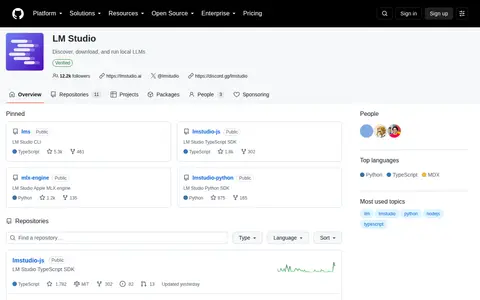
LM Studio is a GitHub organization that provides tools for working with local large language models. As of the listing snapshot, it hosts 11 public repositories, offers functionality to discover, download, and run local LLMs, and has its code available on GitHub.
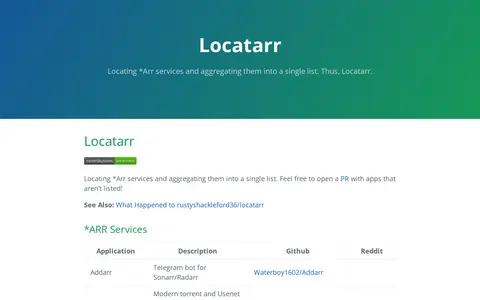
Locatarr is a directory that locates *Arr services and aggregates them into a single list. The page indexes applications such as Sonarr, Radarr, Lidarr, Prowlarr and Bazarr, with short descriptions and links to their GitHub repositories. It also notes that additions can be proposed via pull request.
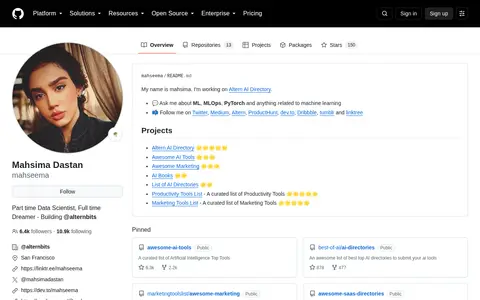
GitHub profile of Mahsima Dastan, a part-time data scientist who states work on the Altern AI Directory. The profile lists pinned repositories with curated lists of AI tools, AI directories, marketing tools, SaaS directories and AI books.
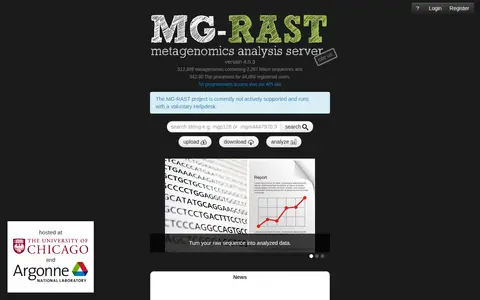
MG-RAST is an open source, open submission web application server that suggests automatic phylogenetic and functional analysis of metagenomes. It is also one of the biggest repositories for metagenomic data. Users can turn raw sequence into analyzed data and deposit metagenomic data for public reference.
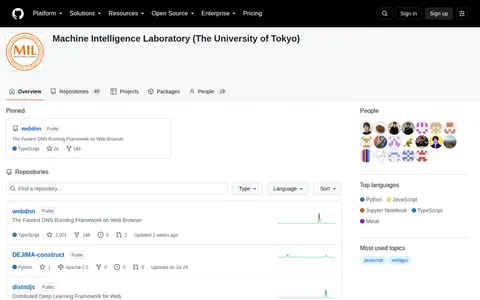
mil-tokyo is the GitHub organization for the Machine Intelligence Laboratory at The University of Tokyo. The organization maintains 49 publicly available software repositories, which can be followed on the GitHub platform.
Miru is a free, open source multifunctional media entertainment application supporting video, comics, and novel expansion sources on Android, Windows, and Web. It is being developed with Flutter and uses the QuickJS engine for extensions, with functionality being implemented gradually. An official extension repository provides video sources, and custom extension repositories and proxies are supported.

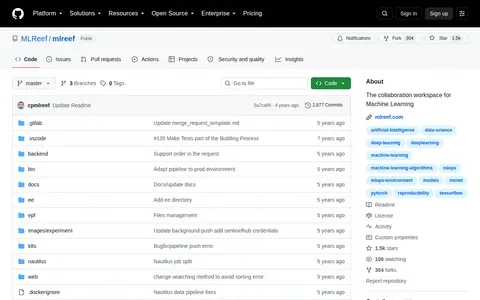
MLReef is an open source ML-Ops platform for collaborating, reproducing and sharing machine learning work. The repository notes it is no longer supported or updated there, with work continuing on GitLab. Described sections include data management with versioned data hosting, containerized code repositories, experiment tracking and ML pipelines on Kubernetes, cloud or bare metal.
Moonshot AI is a GitHub organization focused on AI and machine learning research and development. As of the listing snapshot, it hosts 42 public repositories, with areas of work including research, benchmarks, agents, service infrastructure, and community engagement, and its code is available on GitHub.
A guide for using Obtainium to install and update Morphe apps (YouTube, YouTube Music, Reddit, MicroG-RE, PotHelper) and Piko apps (Instagram, X). Included apps are prebuilt on a fork of the ReVanced Magisk Module, with new versions made each time a patch releases. APKs come from APKMirror and Uptodown, and patches from official repositories. It notes PoToken is currently non-functional.
The official Telegram channel of the Nagram messenger. It links to GitHub repositories for Nagram and Nagram-iOS, plus a chat group and an assets channel. Subscribers can view or join the channel in Telegram.
A Natural Resources Canada geoscience tools and data page that gathers geological, geophysical and geochemical resources. It includes a lexicon of Canadian geological names, petroleum exploration databases, geochemical surveys, geophysical data repositories, groundwater and permafrost networks, and marine geoscience databases and map services.
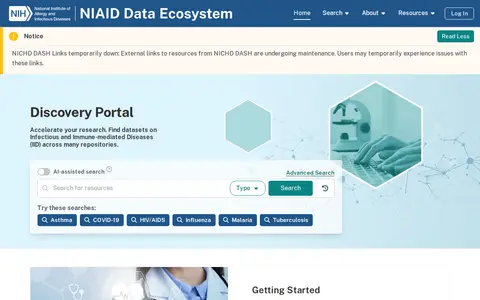
The NIAID Data Ecosystem Discovery Portal is a search engine for datasets, resources, and tools related to infectious and immune-mediated diseases. It allows searching across many repositories and includes AI-assisted search and advanced search, with resources organized by topic and by NIAID-funded programs.
A service that provides shareable links to download build artifacts from GitHub Actions builds. Public repositories are accessible by default without login, and links can point to the latest artifact or a particular run. A GitHub App can be installed so downloads for a repository do not share the global API rate limit.