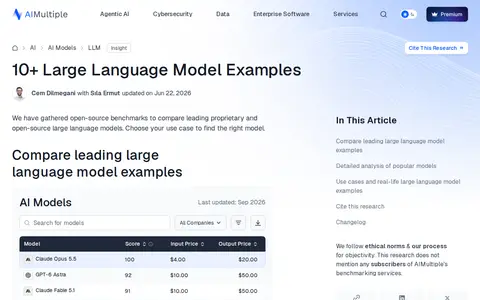

This webpage provides a curated list of large language model examples, alongside insights on business adoption, language model training, and influential models. It includes comparative analysis of leading LLMs such as OpenAI’s GPT-5, Claude 4.6, Gemini, DeepSeek-R1, Qwen, Llama 4, and xAI Grok-4 and Grok-4.1.
Directory
Search results
Published directory entries matching your search.

The MCHF/MCDHF Database is a NIST collection of transition data from relativistic theories computed by different computational methods. The Landé gJ factor is provided for a few collections. Data is accessed by selecting an element from the periodic table, then a spectrum, a reference number, and a property. Atomic structure codes used in the calculations, including HFFortran95, ATSP, ATSP2K and GRASP2K, are available for download.
MIT 6.S191 is MIT's introductory program on deep learning methods, with applications in vision, robotics, medicine, language, game play, art and more. It is described as a high-intensity bootcamp teaching deep learning fundamentals, with lectures, software labs and a final project proposal competition. Prerequisites assume calculus and linear algebra.
The Nucleic Acid Knowledgebase (NAKB) is a portal for 3D structural information about nucleic acids, succeeding the Nucleic Acid Database. It provides annotations, search, reports, statistics, an atlas and visualization for nucleic-acid containing structures held by the NDB and the Protein Data Bank, covering X-ray, electron microscopy and NMR methods. Each structure links to external resources annotating and analyzing nucleic acid structures and their complexes.
OH SHINT! is an OSINT resource for online investigations, research links, search methods, and public data tools.
Lithuanian OSINT article introducing open-source intelligence concepts, tools, and methods.
OSINT Combine is an OSINT resource for online investigations, research links, search methods, and public data tools.
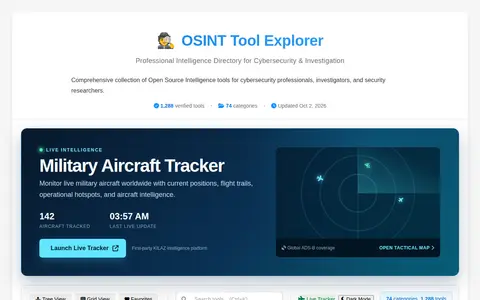
OSINT Tool Explorer is an OSINT resource for online investigations, research links, search methods, and public data tools.
OSINTgeek is an OSINT resource for online investigations, research links, search methods, and public data tools.
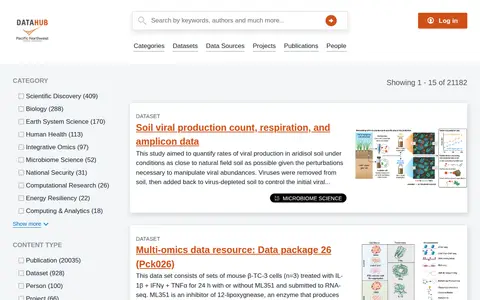
The Pacific Northwest National Laboratory DataHub is a searchable repository of scientific data and publications. The site offers filtering by category, content type and tags across topics such as biology, earth system science and computing. Listed content types include publications, datasets, people, projects, data sources, institutions and software.
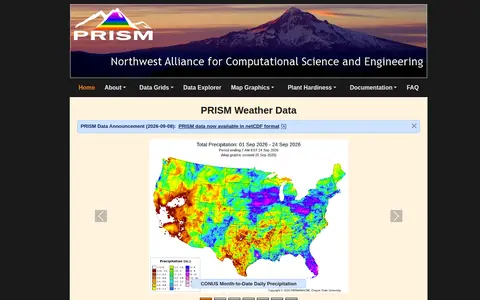
PRISM Climate Data is a project of the PRISM Group at Oregon State University that gathers weather observations, applies quality control and mapping methods, and develops spatial datasets showing short- and long-term weather patterns. Datasets cover 1895 to the present and are offered free of charge, with bulk downloads and single grid cell time series.
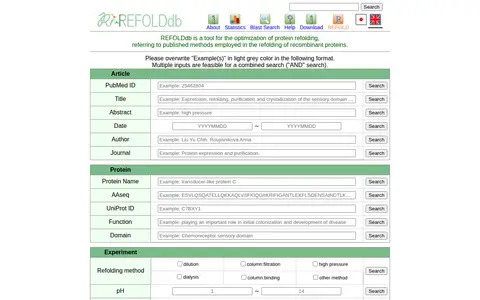
REFOLDdb is a tool for optimizing protein refolding, drawing on published methods used in refolding recombinant proteins. It offers a combined search using multiple inputs, along with statistics, BLAST search, help and download options.
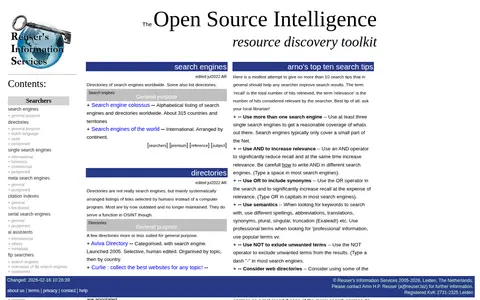
Reuser is an OSINT resource for online investigations, research links, search methods, and public data tools.
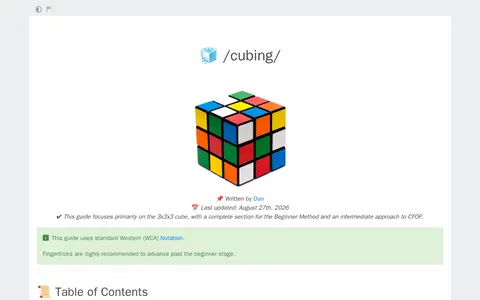
A guide by Dan on solving the 3x3x3 Rubik's Cube, using standard Western (WCA) notation. It covers the Beginner Method in full and an intermediate approach to CFOP, with sections on solving speed, notation and core methods.
Guide and directory covering shadow libraries, mirrors, access methods, and book-search resources.
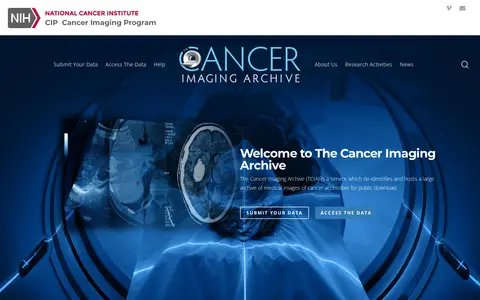
The Cancer Imaging Archive (TCIA) is a service that de-identifies and hosts a large archive of medical images of cancer accessible for public download. Many datasets are submitted by the user community. TCIA offers ways to browse, search, and download data, along with video tutorials, documentation, and a helpdesk.
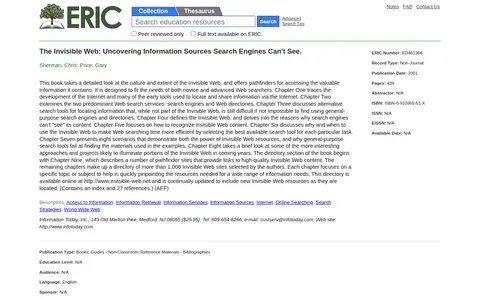
A 2001 book by Chris Sherman and Gary Price examining the nature and extent of the Invisible Web and offering pathfinders for accessing its content, aimed at novice and advanced web searchers. Chapters cover the development of the Internet, search engines and web directories, why search engines cannot see invisible web content, how to recognize it, and when to use it. A directory section lists more than 1,000 Invisible Web sites by topic.
The Key to Unlocking the Web's Secrets is an OSINT resource for online investigations, research links, search methods, and public data tools.
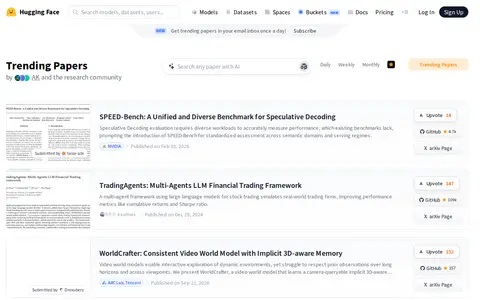
Your daily dose of AI research from AK.
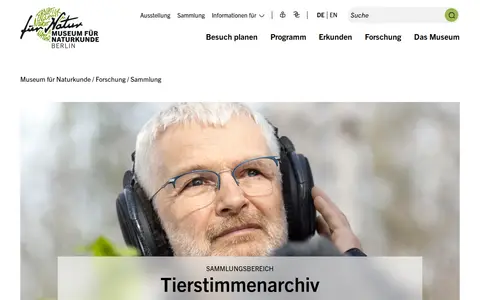
Search biology data collections and supporting dataset from DEU.
Digital Methods tool for scraping search engine results and collecting web research data.
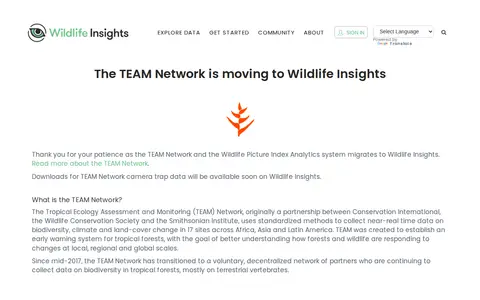
The Tropical Ecology Assessment and Monitoring (TEAM) Network, originally a partnership of Conservation International, the Wildlife Conservation Society, and the Smithsonian Institution, uses standardized methods to collect near-real-time data on biodiversity, climate, and land-cover change at 17 sites across Africa, Asia, and Latin America. It aims to establish an early warning system. The network is migrating to Wildlife Insights.
Searchable repository for finding computer datasets and software.
What is OSINT? is an OSINT resource for online investigations, research links, search methods, and public data tools.