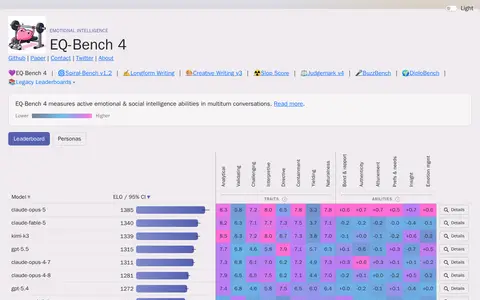
EQ-Bench 4 is a benchmark that measures active emotional and social intelligence abilities in multiturn conversations. It uses 120 personas with assigned traits, including adversarial ones, in roleplay chats played by Gemini 3.1 Pro Preview. Transcripts are assessed by three judges to produce a ranked Elo score.
Directory
Search results
Published directory entries matching your search.
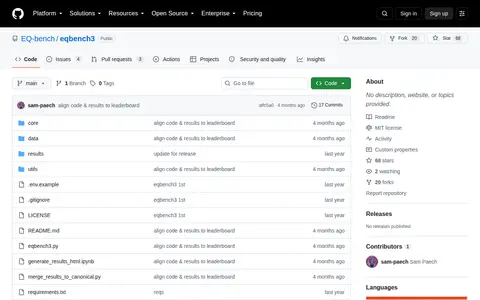
EQ-Bench 3 is a multi-turn emotional intelligence benchmark for language models. It presents role-play scenarios and analysis tasks requiring empathy, insight and social skill, and an auxiliary judge model scores or pairwise-compares the outputs. An MIT-licensed repository with a readme, results and data folders, it includes rubric scoring and pairwise ELO analysis options.
EveryMac.com is a reference site established in 1996 that documents technical specifications, configuration details, upgrade options, device identifiers, benchmarks and global prices for Apple computers and devices. It also offers tools to compare Macs, sort models, and look up Macs by serial number, plus a storage upgrade compatibility guide covering G3 and later Macs.
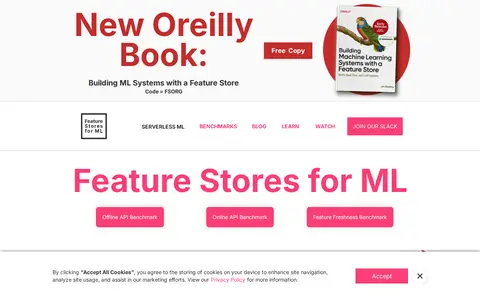
Feature Stores for ML is a global community of data science professionals, researchers, and engineers focused on feature stores for machine learning pipelines. It creates educational content about feature stores and the surrounding data and AI ecosystem, hosts monthly industry meetups, and provides resources including blog posts, videos, benchmarks, and an MLOps dictionary.
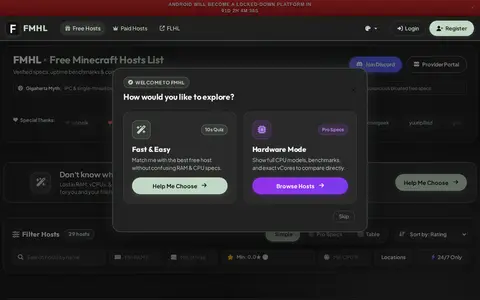
FMHL is a directory of free Minecraft server hosters. It lists hosts with ratings and specifications, and offers filters for region, 24/7 availability, RAM, storage, CPU and name. Specs are described as verified, with uptime benchmarks and community ratings indexed by Myuui and the community.
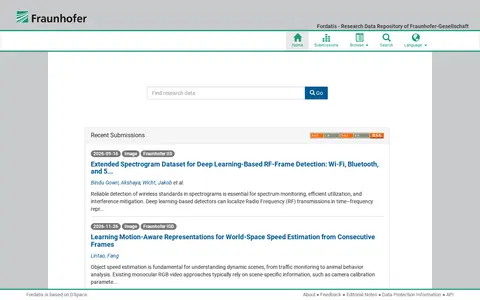
Fordatis is the research data repository of the Fraunhofer-Gesellschaft. It hosts research publications and datasets from Fraunhofer institutes and Fraunhofer associations, with content searchable by institute, document type, publication date, author, title, and language, and available in German and English. Recent publications include works on RF spectrogram datasets for deep learning, motion-aware speed estimation, and 3D instance segmentation benchmarks.
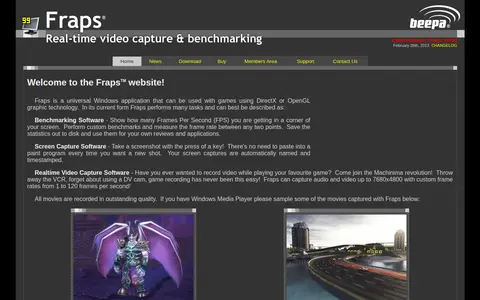
Fraps is a Windows application for games using DirectX or OpenGL graphics. It displays frames per second, performs custom benchmarks, takes screenshots with a key press, and records video and audio, with custom frame rates from 1 to 120 frames per second. A free download is offered, and an unrestricted full version is available for purchase.
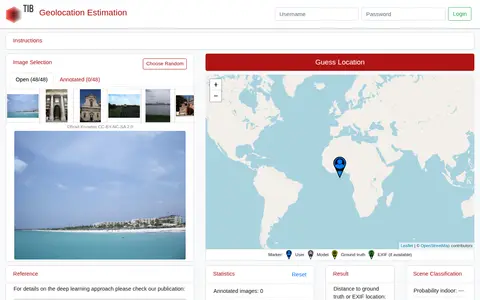
GeoEstimation is a tool for estimating the geolocation of photos. Users select an image from a predefined benchmark test set and click a world map to make a guess. Results are shown as a heat map of likely locations and a visualization of contributing photo parts, alongside scene classification probabilities for indoor, nature and urban settings.
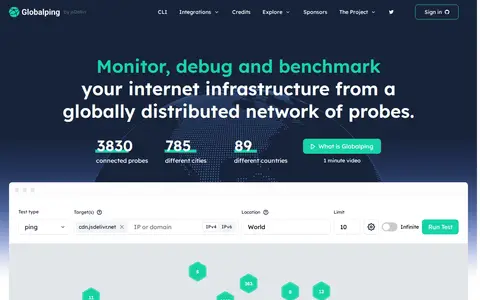
Globalping is a platform for running network commands such as ping, traceroute and DNS resolve on probes distributed worldwide. It is used to monitor, debug and benchmark internet infrastructure. It offers a REST API, CLI and integrations.
This is a Kaggle page for a Google prompt engineering whitepaper. It invites users to join a community of builders, researchers and labs evaluating AI agents, models and frontier technology through crowdsourced benchmarks, competitions and hackathons.
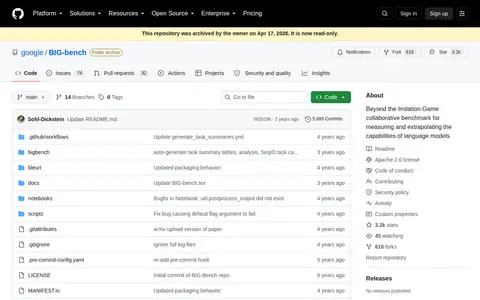
BIG-bench is a collaborative benchmark intended to probe large language models and extrapolate their future capabilities. It includes more than 200 tasks, summarized by keyword and task name. The repository was archived by its owner and is now read-only.

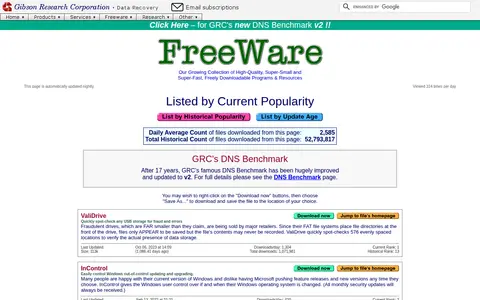
GRC.COM hosts a collection of free downloadable programs and resources, including its DNS Benchmark, ValiDrive, InControl and InSpectre tools. The page lists projects by current popularity and notes daily and total download counts.
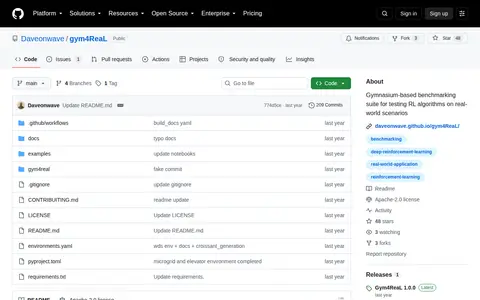
Gym4ReaL is an open-source GitHub repository maintained by Daveonwave. It is a Gymnasium-based benchmarking suite for testing reinforcement learning algorithms on real-world scenarios. The repository includes documentation on supported characteristics, reinforcement learning paradigms, folder structure, contribution guidelines, and licensing terms.
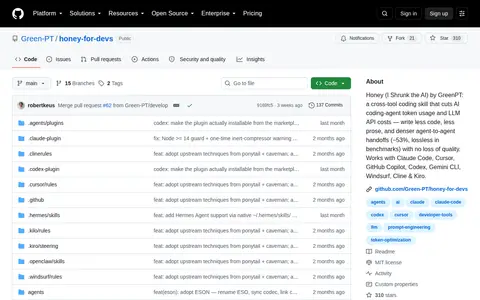
Honey (I Shrunk the AI) by GreenPT is a cross-tool coding skill that reduces AI coding-agent token usage and LLM API costs. It enables writing less code and prose and supports denser agent-to-agent handoffs, with reported 53% cost reduction and no quality loss in benchmarks. It is compatible with Claude Code, Cursor, GitHub Copilot, Codex, Gemini CLI, Windsurf, Cline, and Kiro.
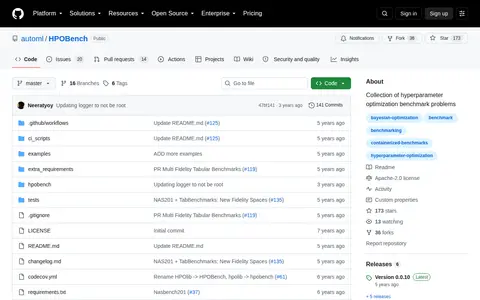
Library for hyperparameter optimization and black box optimization benchmarks.
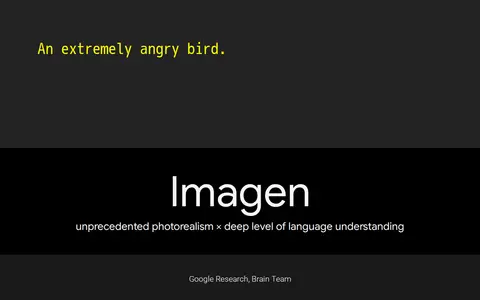
Imagen is a text-to-image diffusion model from Google Research's Brain Team that creates photorealistic images from input text. It builds on large transformer language models for text understanding and cascaded diffusion models for image generation. The project also introduced DrawBench, a benchmark for comparing text-to-image models.
The Indico LLM Leaderboard provides benchmarking for large language models on extractive, classification, and predictive tasks. It includes accuracy comparisons, cost of ownership assessments, and datasets such as CORD and Kleister NDA, with the latest update in August 2024.
The Institute of Museum and Library Services provides a data page with tools and reports for exploring library and museum data. It includes Library Search & Compare for individual library data and ten-year trends, an indicators workbook on economic status and broadband, a state funding report compilation, a state comparison tool, public library benchmarking tables, and administrative discretionary grant data.
Edit /src/streamlit app.py to customize this app to your heart's desire.:heart:.
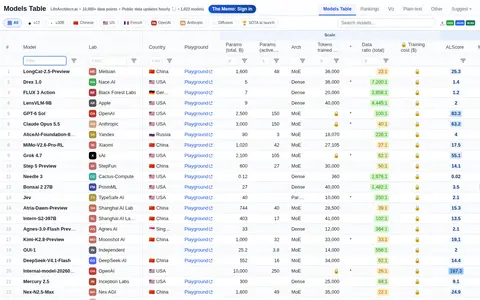
LifeArchitect.ai hosts a Models Table of large language model data, including parameters, tokens trained, and benchmark scores such as MMLU, MMLU-Pro, GPQA and HLE. The page also presents rankings, a data dictionary and visualization snapshots of frontier models.
Linear Digressions is a podcast series covering machine learning and AI topics, with episodes such as "LLM as a Judge," a cross-post on AI and podcasting from the Harvard Data Science Review, and a benchmark installment on ExploitGym. One episode examines mechanistic interpretability, described as an approach that opens the model itself to trace why it behaves as it does.
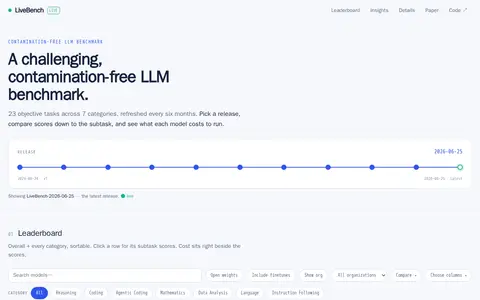
A Challenging, Contamination-Free LLM Benchmark.
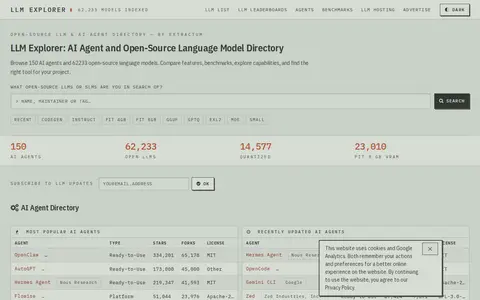
LLM Explorer is a directory of open-source language models and AI agents. It lists 150 AI agents and 64,811 open-source large and small language models, grouped into categories with benchmarks and analytics.
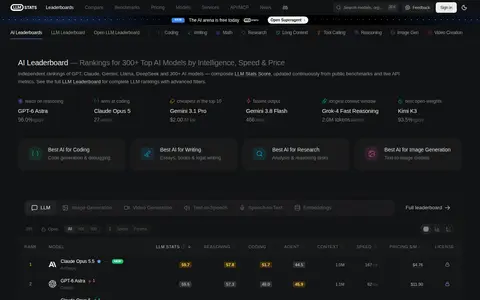
LLM Stats is an AI leaderboard that ranks GPT, Claude, Gemini, Llama, DeepSeek and more than 300 AI models by intelligence, speed and price. Scores are computed from public benchmarks and live API metrics.