The EU Clinical Trials Register offers a free search of clinical trials in European Union member states and the European Economic Area. Its search engine queries information entered into the EudraCT database, with simple and advanced search modes and filters. It also displays information on EudraCT trials, and ongoing EU/EEA trials are displayed through the Clinical Trials Information System.
Directory
Search results
Published directory entries matching your search.
The European Zebrafish Resource Center archives zebrafish lines and supplies biomedical researchers in Europe with fish, plasmids, and sequencing, genetic, and chemical screening services. Its collection holds over 30,000 mutant, transgenic, and wildtype lines, and it offers cryopreservation training and international zebrafish and medaka courses.
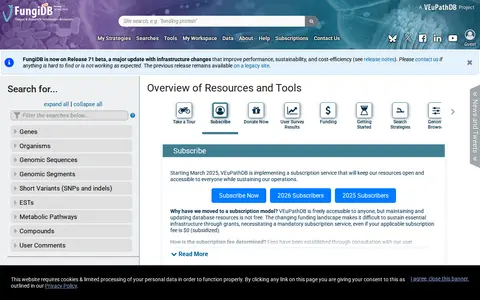
FungiDB is part of VEuPathDB, offering FAIR access to genomic data for fungi and other eukaryotic microbes, including pathogenic species and their hosts and vectors. It provides integrated resources for biomedical research and is working toward long-term financial sustainability.
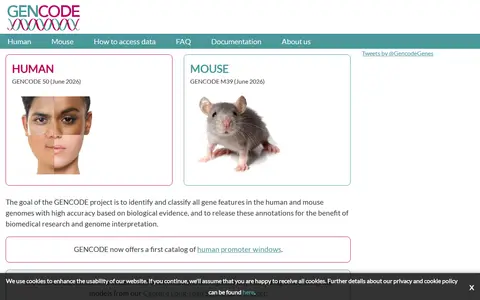
GENCODE is a project that aims to identify and classify all gene features in the human and mouse genomes with high accuracy based on biological evidence, and to release these annotations for biomedical research and genome interpretation. It provides human and mouse gene annotations, including lncRNA annotations and a primary transcript set.
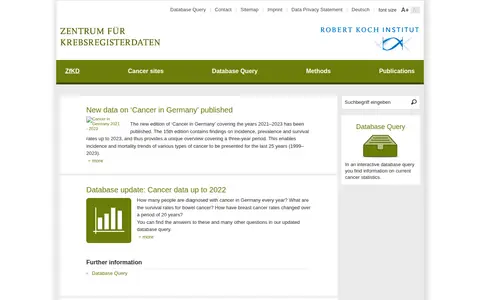
The German Centre for Cancer Registry Data at the Robert Koch Institute provides cancer statistics for Germany. It offers an interactive database query with information on current cancer statistics and covers many cancer sites. Its methods section includes registration completeness, incidence, prevalence and survival rate estimations. It publishes reports on cancer epidemiology in Germany.
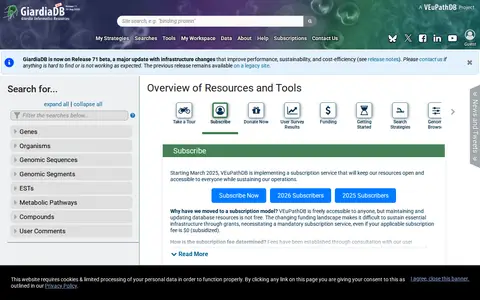
GiardiaDB is a component of VEuPathDB, a platform that provides FAIR access to genomic data for eukaryotic microbes including protists and fungi, as well as their hosts and arthropod vectors of pathogenic species. VEuPathDB is focused on securing the long-term financial sustainability of its widely used biomedical data resources.
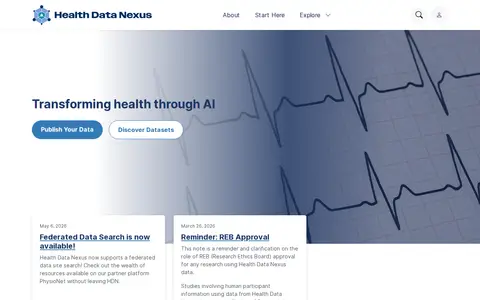
Health Data Nexus is an open data platform for AI research and education in medicine. It offers federated data search, allowing users to search partner platform PhysioNet resources without leaving the site. Datasets are listed under credentialed access, and access zones impose requirements including a data use agreement and, for Zone 3, REB approval.
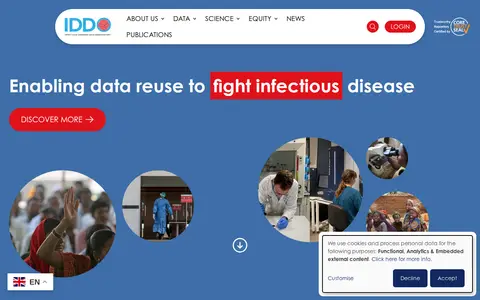
Infectious Diseases Data Observatory (IDDO) is an organisation that enables reuse of infectious disease data to support disease control efforts. It pools and standardises data, applies strict privacy controls to pseudo-anonymise data, shares data responsibly and maintains gold standard data repositories for a range of infectious diseases including malaria, COVID-19, Ebola and antimicrobial resistance. It also provides data access guidelines and related resources for users.
The ISIMIP Repository is a searchable archive of climate impact model data. It holds input data such as climate forcing, socioeconomic forcing and static geographic information, plus output data across sectors including agriculture, terrestrial biodiversity, biomes, fire, regional forests, temperature-related mortality, lakes and fisheries. Users search by simulation round, covering ISIMIP2a through ISIMIP4b.
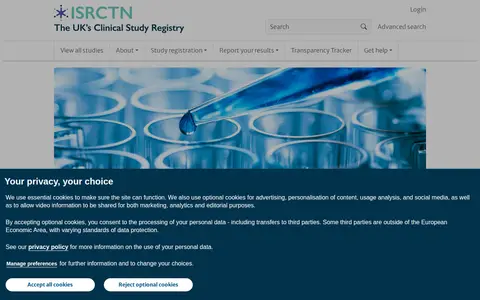
The ISRCTN registry is a clinical study registry recognised by the WHO and ICMJE that accepts proposed, ongoing and completed clinical research studies. It provides content validation, curation and unique identification numbers needed for publication, and all study records are freely accessible and searchable. Registration is ideally prospective, though retrospective registration is accepted.
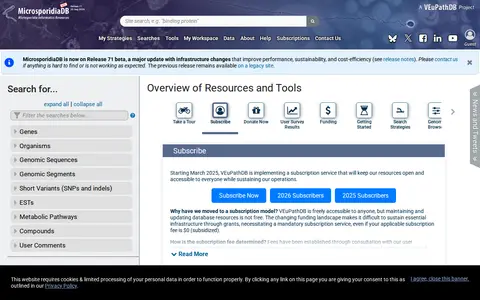
MicrosporidiaDB is a database that provides FAIR access to genomic data for eukaryotic microbes, including protists and fungi, as well as hosts and arthropod vectors of pathogenic species. It is part of the VEuPathDB project, which works to secure long-term financial sustainability for globally relied-upon biomedical data resources.
MiEx is a modern Minecraft World Exporter written in Java that exports worlds into USD. It uses Minecraft's Resource Pack system for accurate exports and supports custom resource packs, biome colours, animated textures and texture atlases. It also supports modded worlds and a Level-of-Detail system for exporting larger worlds.
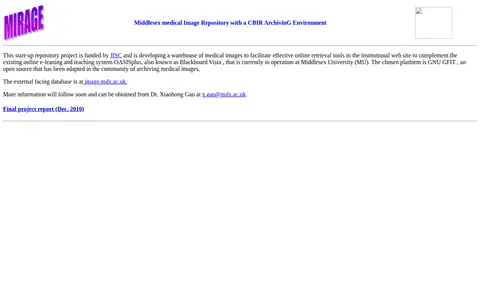
MIRAGE is a start-up repository project at Middlesex University funded by JISC. It is developing a warehouse of medical images to support online retrieval tools on the institutional website, complementing the existing OASISplus (Blackboard Vista) teaching system. The chosen platform is GNU GFIT, an open source adapted for archiving medical images, with an external database at image.mdx.ac.uk.
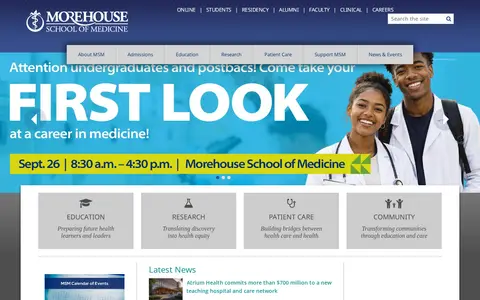
Morehouse School of Medicine is an Atlanta institution that trains physicians, biomedical scientists and public health practitioners. Its stated aim is to improve the health and well-being of people of color and underserved urban and rural populations in Georgia and the nation. Its activities span education, research, patient care and community work.
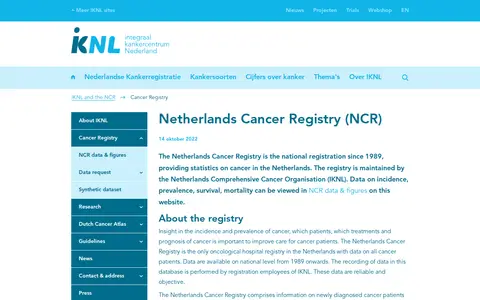
The Netherlands Cancer Registry is a national registration maintained by the Netherlands Comprehensive Cancer Organisation (IKNL) since 1989. It provides statistics on cancer incidence, prevalence, survival and mortality in the Netherlands, and comprises data on newly diagnosed cancer patients, including diagnosis, tumour staging, site, morphology, co-morbidity and treatment received directly after diagnosis.
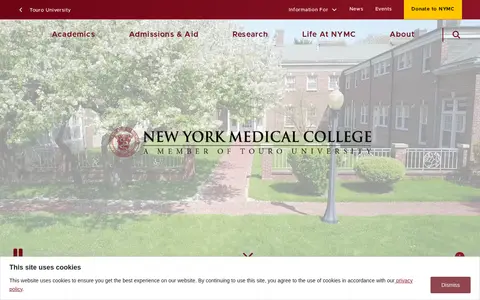
New York Medical College is a private health sciences university and a member of Touro University, located in Westchester County outside New York City. It comprises the School of Medicine, the School of Health Sciences and Practice, and the Graduate School of Biomedical Sciences. The college describes a humanistic, collaborative education with clinical training across the tri-state area.
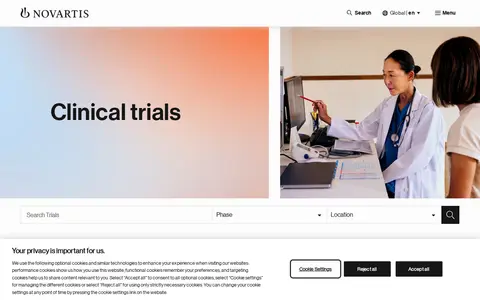
Novartis clinical trials information page describing the company's clinical research and its transparency materials, including lay protocol synopses, patient trial summaries, clinical trial results and anonymized dossiers submitted to health authorities. It also covers opportunities for patients and healthcare professionals to participate and points to ClinicalTrials.gov for a full listing of active and completed studies.
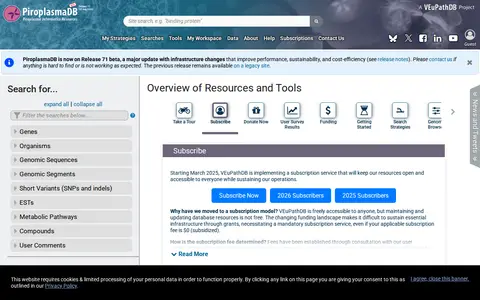
PiroplasmaDB is a resource within VEuPathDB, which provides FAIR access to genomic data for eukaryotic microbes (protists and fungi), hosts, and arthropod vectors of pathogenic species. VEuPathDB is working to secure the long-term financial sustainability of its globally relied-upon biomedical data resources.
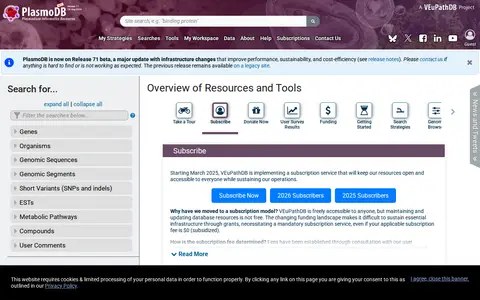
PlasmoDB is a component of VEuPathDB, which provides FAIR (Findable, Accessible, Interoperable, Reusable) access to genomic data for eukaryotic microbes, including protists and fungi, as well as their hosts and arthropod vectors of pathogenic species. VEuPathDB works to ensure the long-term financial sustainability of these globally used biomedical data resources.
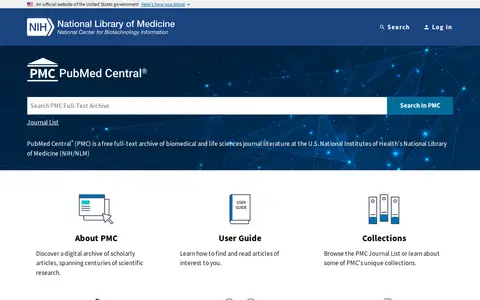
PubMed Central is a free full-text archive of biomedical and life sciences journal literature at the U.S. National Institutes of Health's National Library of Medicine. It archives 12.5 million scholarly articles and offers resources for authors, publishers, and developers, including tools for bulk download and text mining.
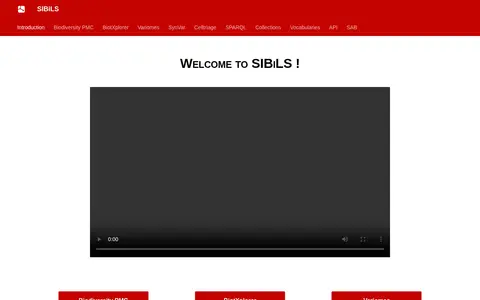
SIBiLS is a service of the Swiss Institute of Bioinformatics that provides personalized information retrieval in biological literature. It offers fully customizable searches in semantically enriched content using keywords or mapped biomedical entities from standardized and legacy vocabularies. Its collections include MEDLINE, PubMedCentral, Plazi treatments and PMC supplementary files, updated daily, and it is accessible via REST APIs.
SimTK is a platform enabling open access to biomedical simulation tools and models. It hosts projects with cloud-based storage, version control, wikis, forums, mailing lists, issue trackers, and GitHub integration. Files can receive DOIs, and projects can form communities.
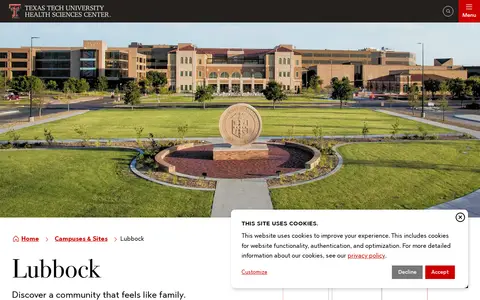
Texas Tech University Health Sciences Center's Lubbock location is the institution's flagship campus for healthcare education across six schools. It describes hands-on research, clinical experience and collaborations with community health systems. The page lists schools including medicine, nursing, health professions, biomedical sciences and pharmacy.
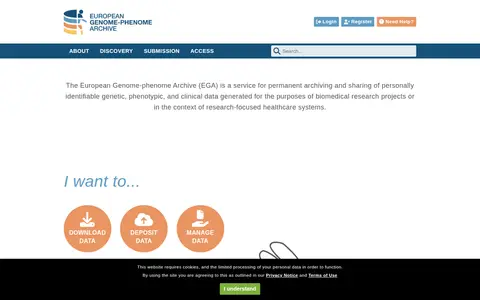
The European Genome-phenome Archive is a service for permanent archiving and sharing of personally identifiable genetic, phenotypic, and clinical data generated for biomedical research projects or in research-focused healthcare systems.