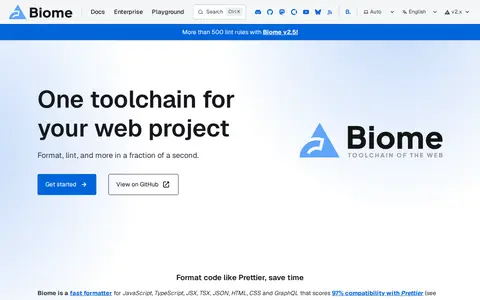

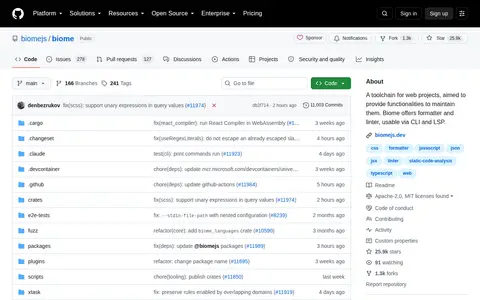
Biome is a web toolchain that formats and lints code, with the formatter covering JavaScript, TypeScript, JSX, TSX, JSON, HTML, CSS, SCSS, GraphQL, YAML and Markdown at 97% compatibility with Prettier, and the linter offering 607 rules from ESLint, TypeScript ESLint and other sources. A single check command runs formatter, linter and assist actions.
Directory
Search results
Published directory entries matching your search.
Biome is a GitHub repository or organization with source code, releases, documentation, or project resources.
Biomed Central helps search books, ebooks, papers, library records, or reading archives.
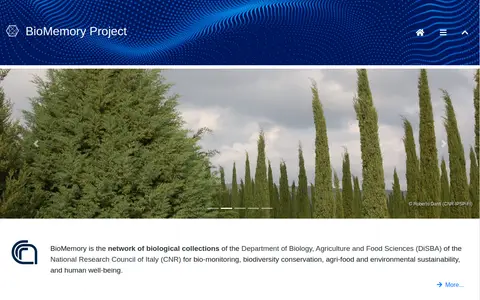
BioMemory is a CNR project presenting a map of BioMemory collections. The listed collections are hosted by CNR institutes and cover bioresources such as herbaceous plants, trees, bacteria and DNA, animal blood, milk and tissues, filamentous fungi, plant parasitic and entomopathogenic nematodes, plant viruses and viroids, and grapevine varieties and clones. Collection types include field, cryopreserved and seed collections.
Research data portal for exploring epidemiology and medical biometry/statistics records, including datasets.
Explore Clinical & Biomedical Language Models provides machine-learning models, research, training resources, or evaluation tools.
Dataset repository covering epidemiology and medical biometry/statistics, with searchable clinical trial data.
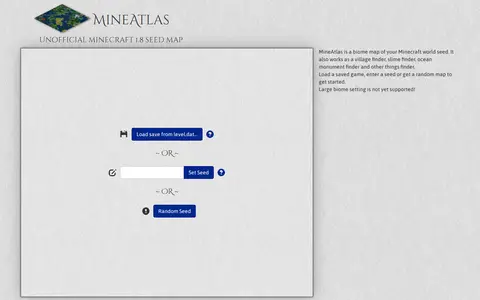
An unofficial biome map of a Minecraft world seed for version 1.8. It can act as a village finder, slime finder and ocean monument finder, and users can load a saved game, enter a seed or get a random map. Hovering shows biome names, and shading indicates hilliness.
Synapse is a platform for supporting scientific collaborations centered around shared biomedical data sets. It serves as the host site for a variety of scientific collaborations, individual research projects, and DREAM challenges. Its stated goal is to make biomedical research more transparent, more reproducible, and more accessible to a broader audience of scientists.
Search epidemiology and medical biometry/statistics data collections and supporting datasets from USA.
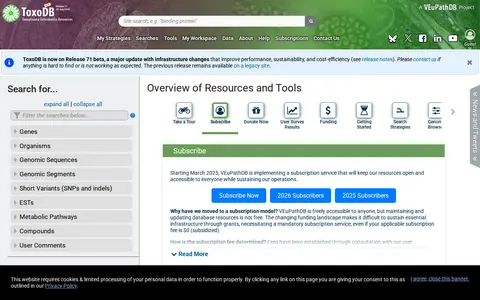
ToxoDB is a biomedical data resource hosted on the VEuPathDB platform. VEuPathDB provides FAIR access to genomic data for eukaryotic microbes including protists and fungi, as well as hosts and arthropod vectors of pathogenic species, and is working to secure long-term financial sustainability for these globally relied-upon biomedical data resources.
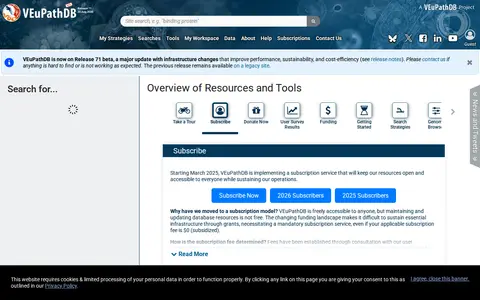
VEuPathDB is a biomedical data resource that provides FAIR access to genomic data for eukaryotic microbes including protists and fungi, as well as hosts and arthropod vectors of pathogenic species. It supports the long-term financial sustainability of globally relied-upon biomedical data resources.
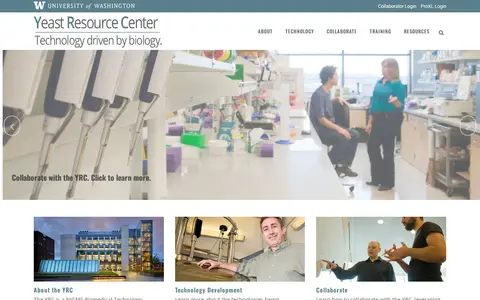
The Yeast Resource Center is an NIGMS Biomedical Technology Research Center based at the University of Washington in Seattle. It develops technology applied to biomedical problems, offers software and research articles, and allows researchers to collaborate using its technology and expertise. Its work includes biosensor development and protein cross-linking mass spectrometry combined with structural modelling.
PubMed is a biomedical literature search service that hosts more than 40 million citations from MEDLINE, life science journals, and online books. Some citations include links to full-text content from PubMed Central and publisher websites. The service provides tools such as advanced search, clinical queries, and a single citation matcher to help users locate relevant research.
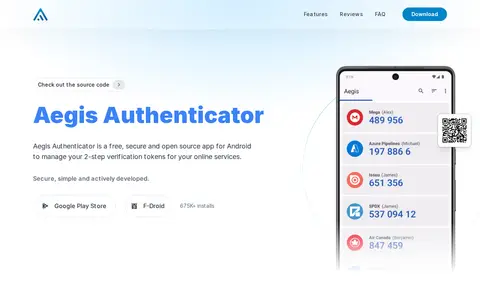
Aegis Authenticator is a free and open source Android app for managing two-step verification tokens. It stores tokens in an encrypted vault with optional biometric unlock, supports import and export from other 2FA apps, automatic backups, themes and icon packs.
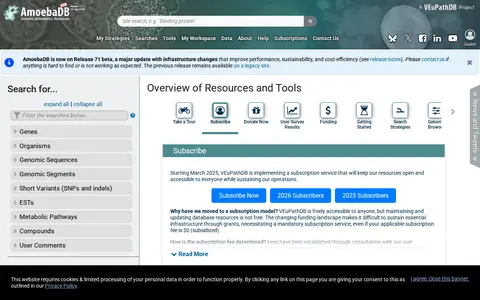
AmoebaDB is part of the VEuPathDB platform, which provides FAIR access to genomic data for eukaryotic microbes including protists and fungi, as well as hosts and arthropod vectors of pathogenic species. The platform works to secure the long-term financial sustainability of its globally used biomedical data resources.
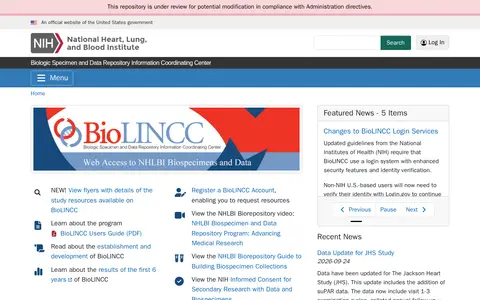
BioLINCC is a clinical specimen database operated by the National Heart, Lung, and Blood Institute. It allows users to search for study datasets and biospecimens, including open specimen collections, and to submit requests for them. Accounts are required to request resources, and users must verify their identity through Login.gov or ID.me depending on location.
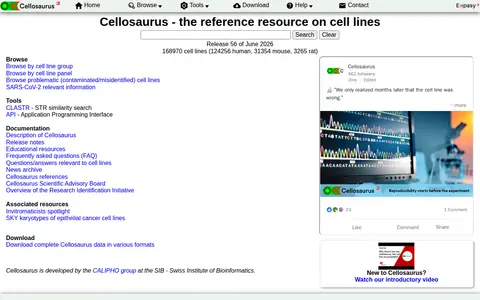
Cellosaurus is a knowledge resource and database that aims to describe cell lines used in biomedical research. Its scope includes immortalized, naturally immortal tissue limited-life distributed cell lines, and vertebrate cell lines with emphasis on human, mouse and rat, plus invertebrate and plant cell lines. Records include names, synonyms, accession numbers, species of origin and comments. It also offers search tools, downloads and documentation.
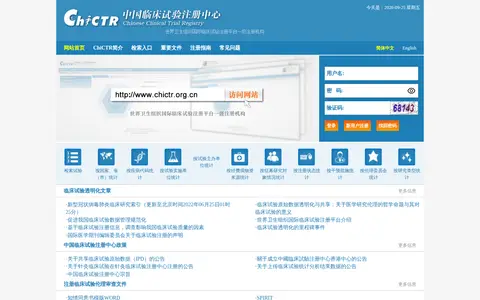
The Chinese Clinical Trial Register is a primary registry of the WHO International Clinical Trials Registry Platform. The website provides a trial search, registration guidance, and policy documents. It includes statistics by country, disease code, institution, and registration status.
ChunkBase offers a collection of apps for Minecraft, including a Seed Map and Seed Finder. The apps help find Minecraft seeds and locate biomes and structures on an interactive map. Version support varies across apps.
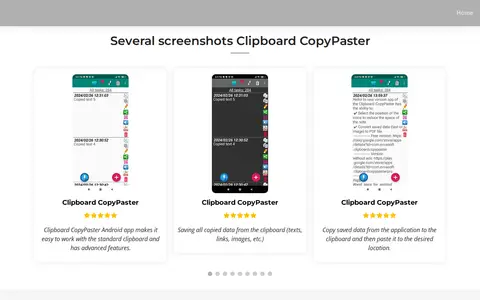
Clipboard CopyPaster is a free Android clipboard manager by EVVAsoft. It saves copied texts, links and images, and allows copying saved data back to the clipboard. Features include editing, sharing, notes, search, QR codes, themes, a password, biometrics, backups, PDF conversion and a floating window. On Android 10 and higher, the app must be opened to save clipboard contents.
The Danish National Birth Cohort is a research data collection open to researchers with research ideas requiring prospectively collected data from pregnancy and childhood. Its site provides information on applying for access, an overview of available data, publications, and interview questionnaires, and lists response rates and acknowledgement guidance.
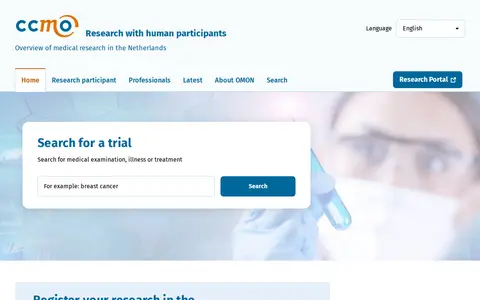
The Overview of Medical Research in the Netherlands (OMON) is a website for searching medical research. It includes research from the former National Trial Register, ToetsingOnline, the Research Portal and the public portal of CTIS, and allows users to register their own research in the Research Portal. The former NTR information is available in English only, and other information is generally available in both Dutch and English.
ELIXIR Luxembourg is the Luxembourgish node of ELIXIR, the European life science information infrastructure. It describes services for long-term sustainability of tools and data for Translational Medicine, including secure data hosting, a biomedical data catalogue, disease and pathway maps on the MINERVA Platform, the FAIR Cookbook, RDMkit and a knowledge hub.