
The Research Data Center provides external researchers with access to economic and social science research data for non-commercial research or teaching at universities. Its data offerings include microdata on R&D activities of German companies, aggregated R&D data, higher education course catalogues and a startup monitor comparing university entrepreneurship support. The center advises on data selection, access and analysis.
Directory
Search results
Published directory entries matching your search.
Fortinet map visualizing cyber attack activity, malware detections, and global threat events.
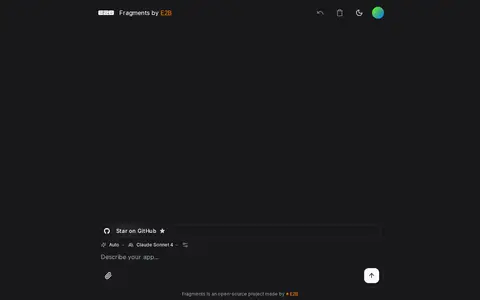
Fragments supports software development with code generation, analysis, debugging, or documentation.
French international broadcaster publishing world news, analysis, video and live television in several languages.
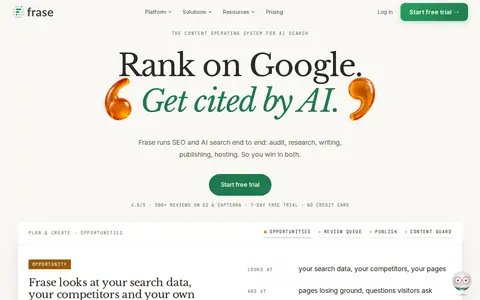
Frase io tracks rankings, SERP visibility, and keyword performance across search results.
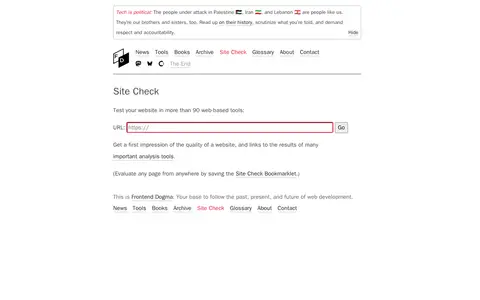
A site check tool that tests a website in more than 90 web-based tools. It gives a first impression of website quality and links to results from analysis tools. A bookmarklet can evaluate any page.
Efficient pure-Matlab implementations of graph algorithms to complement MatlabBGL's mex functions.
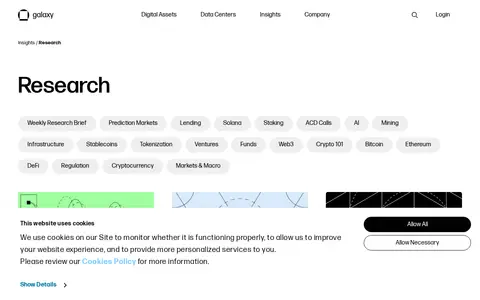
Galaxy Research publishes in-depth crypto and blockchain research reports covering topics such as crypto mining, hedge funds, venture reports, regulation, DeFi, and prediction markets. The research page lists reports and weekly briefs on market and cryptocurrency developments.
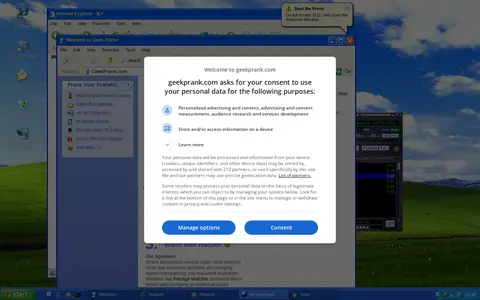
An online Windows XP simulator intended for pranking friends by secretly opening it on their computer in full screen. The site imitates the Windows XP operating system, letting users open programs, interact with the interface and trigger a blue error screen. It also offers Minesweeper and Tetris.
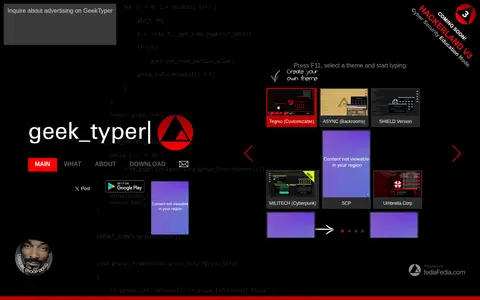
A hacking simulator that imitates the typing seen in movies and games. Users press F11, select a theme and start typing. Themes include Tegnio, SHIELD Version, Mr. Robot, Visual Studio, Fallout Version, Minecraft, Matrix, NASA and Plain Terminal.
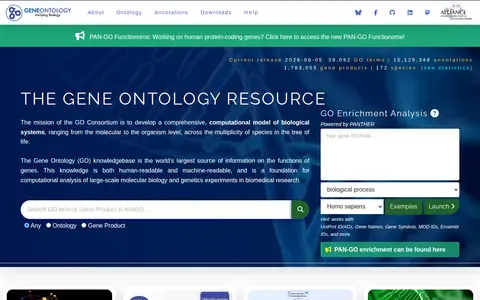
The Gene Ontology project is a bioinformatics initiative developing a computational representation of knowledge about how genes encode biological functions. Its knowledgebase provides human-readable and machine-readable information on gene functions, intended as a foundation for computational analysis of molecular biology and genetics experiments. The resource also offers ontology browsing, annotation downloads, GO-CAM models, and tools with API access.
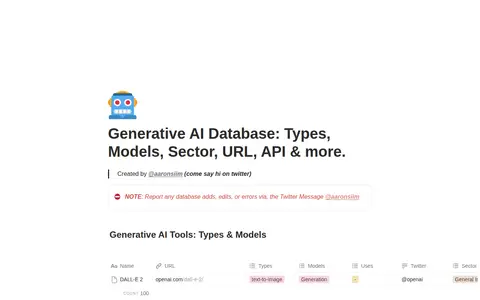
Generative AI Database is a Notion-based collaborative AI workspace built to align with an organization's existing context. It enables users to build and orchestrate AI agents directly alongside team projects, meetings, and connected applications.
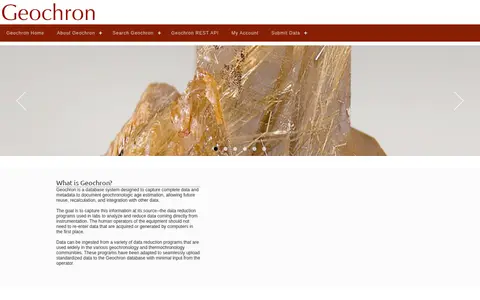
Geochron is a database system for capturing data and metadata documenting geochronologic age estimation, enabling future reuse, recalculation and integration. Data can be ingested from data reduction programs used in geochronology and thermochronology communities, which are adapted to upload standardized data to the database. A REST search service accepts GET variables such as geographic bounds, ages, analysis method, material, rock type and laboratory.
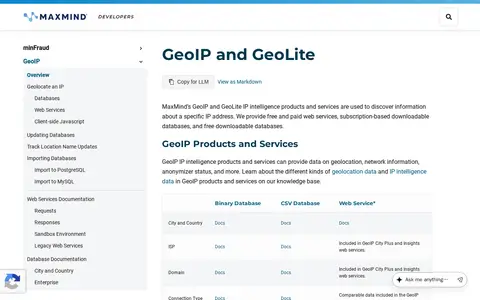
GeoLite databases and web services from MaxMind provide free geolocation and limited network data for IP addresses. The data is less accurate than MaxMind's paid GeoIP products. A free GeoLite account is required to download databases or query the web services, which use the same integration methods and documentation as GeoIP with minor modifications.
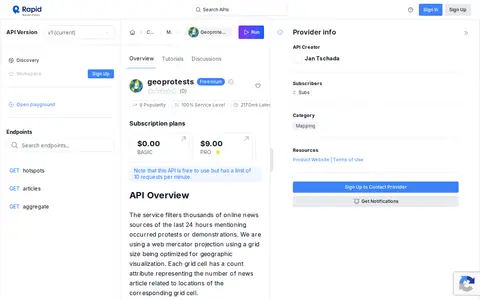
API for accessing geolocated protest and unrest data for maps, analysis, and research workflows.
Right now, ChatGPT, Perplexity, Claude, and Gemini are answering questions about your industry. They.
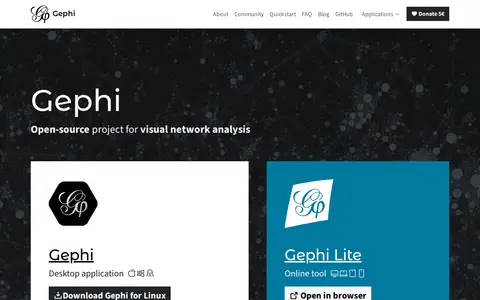
Gephi is free, open-source software for network visualization and analysis. It is available as a desktop application and as Gephi Lite in the browser. It includes algorithms for community detection, centrality measures and clustering, multiple layout algorithms, appearance customization and image exports. The source code is released under the GPL license.

Gestell studies PTX, SASS, compiler lowering, and GPU execution behavior.
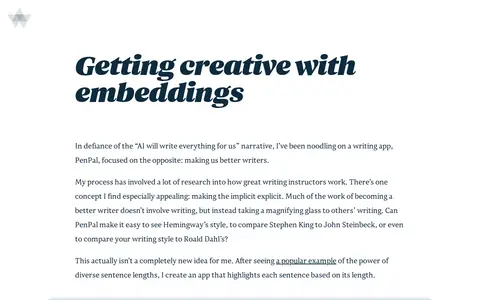
This is an article by Amelia Wattenberger exploring creative uses of embeddings, including her development of the PenPal writing app and a sentence length highlighting tool for analyzing writing style.
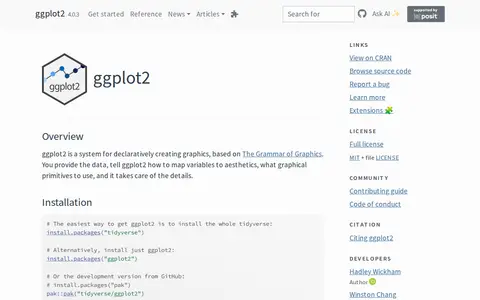
ggplot2 is a system for declaratively creating graphics, based on The Grammar of Graphics. Users provide the data and specify how variables map to aesthetics and which graphical primitives to use, and the system handles the details. It is described as over 10 years old, and installation is available through the tidyverse or as a standalone package.
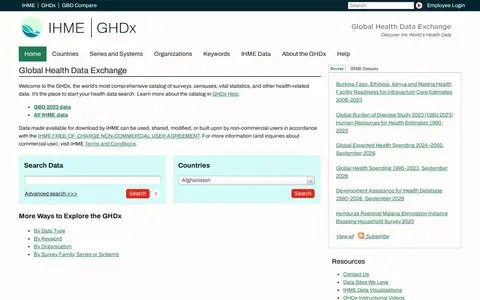
The Global Health Data Exchange (GHDx) is a catalog of global health and demographic data. It records information about data topics, links to data providers, and offers direct downloads where permission exists. The catalog covers surveys, censuses, vital statistics, registries, indicators, estimates, administrative health data, and health-related financial data. IHME-published data downloads may be used by non-commercial users under a free non-commercial user agreement.
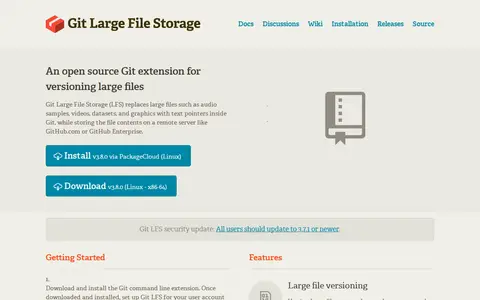
Git Large File Storage (Git LFS) is an open source Git extension for versioning large files. It replaces large files such as audio samples, videos, datasets, and graphics with text pointers inside Git while storing the file contents on a remote server like GitHub.com or GitHub Enterprise. Installation is available for Windows, Mac, and Linux. Tracking file types does not convert pre-existing files, which requires the git lfs migrate command.
GiveWell is a nonprofit that researches cost-effective ways to save and improve lives, shares its analysis openly, and directs donations to recommended programs. It publishes charity reviews and offers giving funds through which donors can support the opportunities its researchers identify.
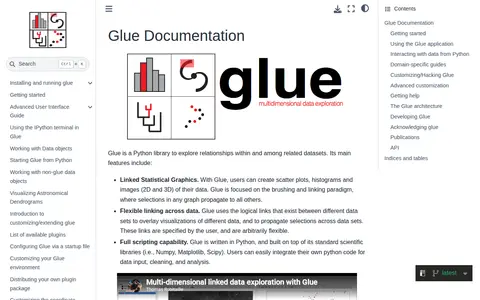
Glue is a Python library for exploring relationships within and among related datasets. It provides linked statistical graphics such as scatter plots, histograms and 2D and 3D images, with selections in one graph propagating to others. It supports user-specified links across datasets and scripting through Python's scientific libraries.