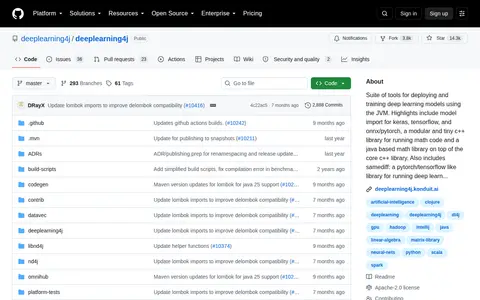

Deeplearning4j is an open-source suite of tools for deploying and training deep learning models using the Java Virtual Machine (JVM). It supports model import from Keras, TensorFlow, and ONNX/PyTorch, includes a modular C++ math library with a corresponding Java library built on top, and offers SameDiff, a library for deep learning operations similar to PyTorch and TensorFlow.
Directory
Search results
Published directory entries matching your search.

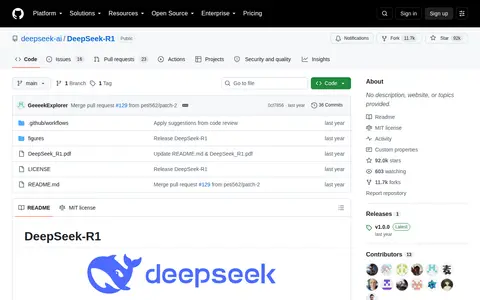
DeepSeek-R1 is the first-generation reasoning model family from DeepSeek, including DeepSeek-R1-Zero and DeepSeek-R1. The repository describes training via large-scale reinforcement learning and cold-start data, and open-sources the models plus six distilled dense models based on Llama and Qwen.
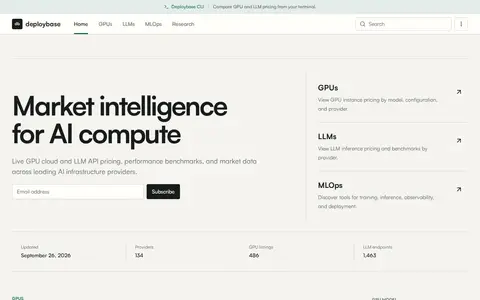
A market intelligence site for AI compute that tracks live GPU cloud and LLM API pricing, performance benchmarks and market data across AI infrastructure providers. It publishes comparisons of GPU cloud pricing by provider and of LLM performance versus cost, including articles on Azure, AWS, Google Cloud, CoreWeave and Lambda GPU offerings.
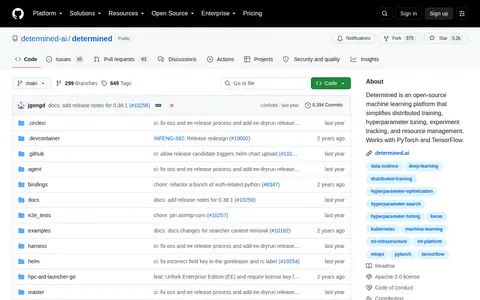
Determined is an open-source machine learning platform that simplifies distributed training, hyperparameter tuning, experiment tracking, and resource management. It works with PyTorch and TensorFlow, offering a Python library, command line interface, and web UI for managing machine learning workflows.
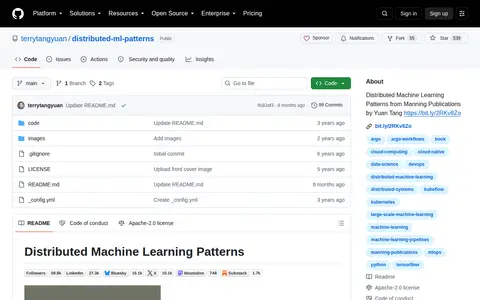
Repository containing references and code for the book Distributed Machine Learning Patterns from Manning Publications by Yuan Tang. The book covers applying patterns to build scalable and reliable machine learning systems, constructing pipelines with data ingestion, distributed training and model serving, and automating tasks with Kubernetes, TensorFlow, Kubeflow and Argo Workflows.
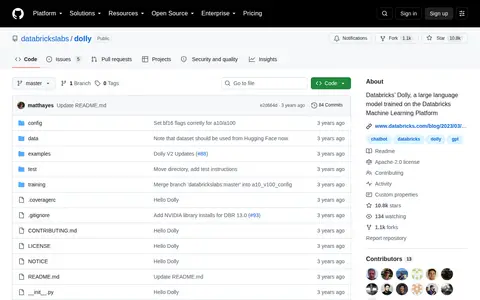
Databricks’ Dolly, a large language model trained on the Databricks Machine Learning Platform.
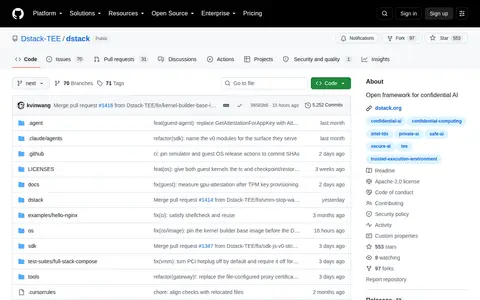
dstack is an open framework for confidential AI that runs containers inside confidential VMs with Intel TDX, using existing Docker Compose files. It supports attested workload identities and native NVIDIA Confidential Computing on H100 and Blackwell GPUs, with options for self-hosted TDX machines or Phala Cloud.
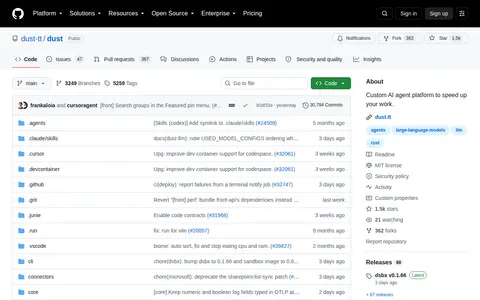
Design and Deploy Large Language Model Apps.
Eden AI offers a unified API for accessing large language models and specialist AI models, including OCR, speech, translation and vision. It standardizes requests, responses, authentication, billing and monitoring across providers, and supports routing requests by cost, performance and region.
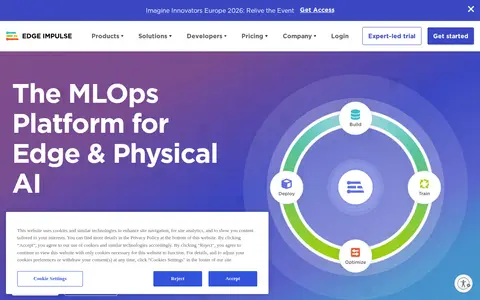
Edge Impulse is an MLOps platform for edge AI and physical AI. It provides native MLOps workflows covering end-to-end pipelines, security, versioning and model monitoring, and is used to develop, deploy and manage AI solutions at scale across the edge hardware ecosystem. A Developer plan is offered at $0 per month.
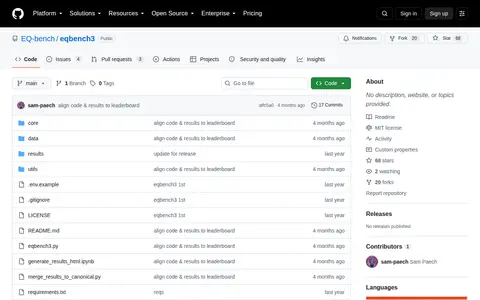
EQ-Bench 3 is a multi-turn emotional intelligence benchmark for language models. It presents role-play scenarios and analysis tasks requiring empathy, insight and social skill, and an auxiliary judge model scores or pairwise-compares the outputs. An MIT-licensed repository with a readme, results and data folders, it includes rubric scoring and pairwise ELO analysis options.
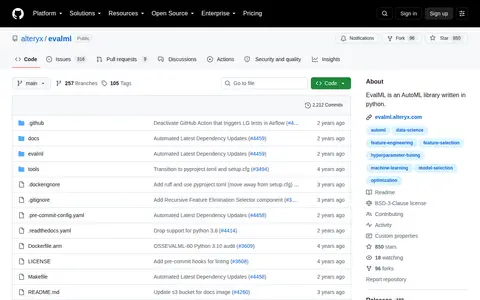
EvalML is an AutoML library written in Python that builds, optimizes, and evaluates machine learning pipelines using domain-specific objective functions. It includes data quality checks, cross-validation, preprocessing, feature engineering, feature selection, and model understanding tools. Install from PyPI or conda-forge.
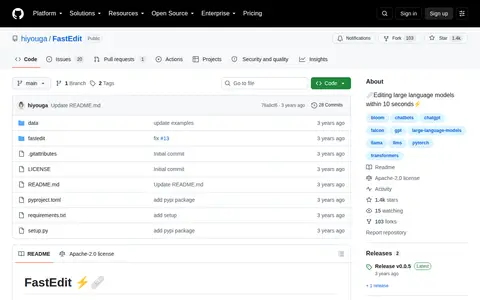
FastEdit is a repository intended to help developers inject fresh and customized knowledge into large language models using one command. It supports models including GPT-J, LLaMA, LLaMA-2, BLOOM, Falcon, Baichuan, and InternLM. The implemented algorithm is Rank-One Model Editing (ROME). It requires Python 3.8+ and PyTorch 1.13.1+.
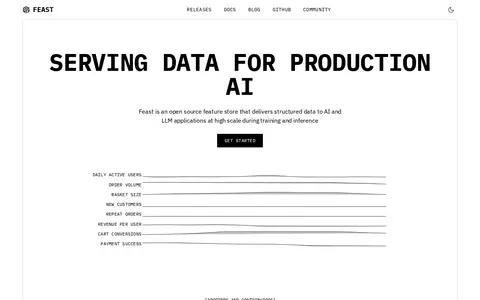
Feast is an end-to-end open source feature store for machine learning. It allows teams to define, manage, discover, and serve features, delivering structured data to AI and LLM applications during training and inference. Documented use cases include real-time recommendations, fraud detection, risk scoring, and customer segmentation.
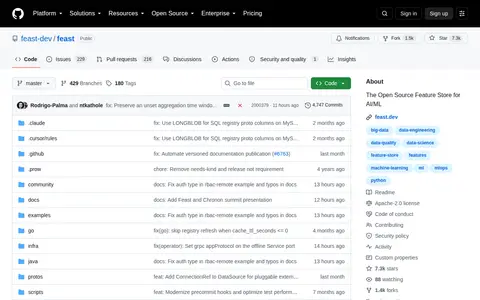
Feast is an open source feature store for machine learning. It manages an offline store for historical data, a low-latency online store, and a feature server. It generates point-in-time correct feature sets to avoid data leakage and provides a single data access layer abstracting feature storage from retrieval. Installable with pip and initialized through a CLI.
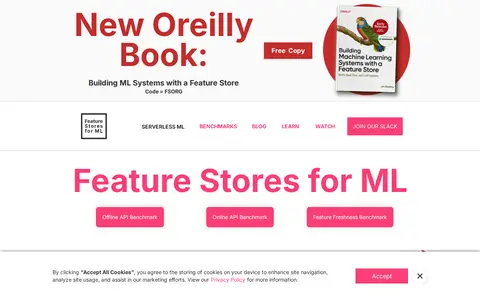
Feature Stores for ML is a global community of data science professionals, researchers, and engineers focused on feature stores for machine learning pipelines. It creates educational content about feature stores and the surrounding data and AI ecosystem, hosts monthly industry meetups, and provides resources including blog posts, videos, benchmarks, and an MLOps dictionary.
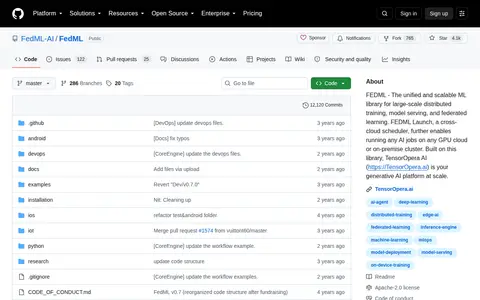
FedML is a unified and scalable open-source machine learning library for large-scale distributed training, model serving, and federated learning. It includes FEDML Launch, a cross-cloud scheduler for running AI workloads on GPU clouds or on-premise clusters, and forms the foundation of the TensorOpera AI generative AI platform.
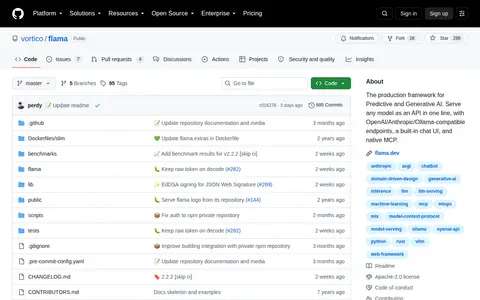
Flama is a production framework for predictive and generative AI. It enables serving any machine learning model as an API with a single line of code, and offers OpenAI, Anthropic, and Ollama-compatible endpoints, a built-in chat user interface, and native MCP support.
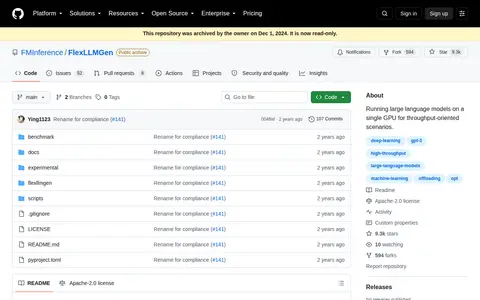
FlexGen is a software project that enables running large language models on a single GPU. It focuses on throughput-oriented scenarios, offering an approach to efficient inference. The project is available on GitHub as FMInference/FlexLLMGen.
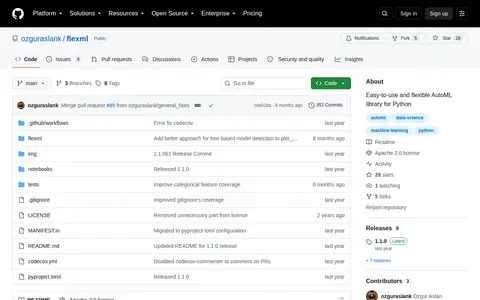
FlexML is an AutoML library for Python that assists in building machine learning models by automating model selection and hyperparameter tuning. It supports regression and classification tasks and offers quick and wide experiment modes for choosing how many models to train.
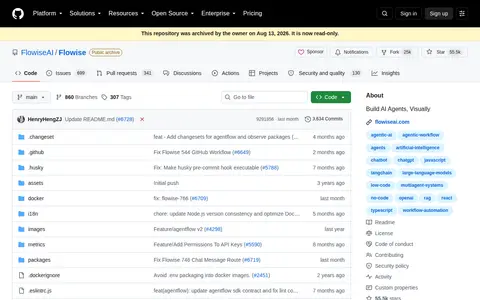
Drag & drop UI to build your customized LLM flow using LangchainJS.
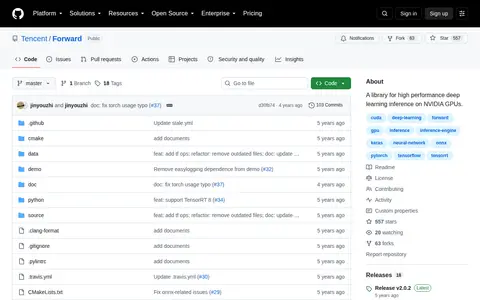
Library for high performance deep learning inference on NVIDIA GPUs.
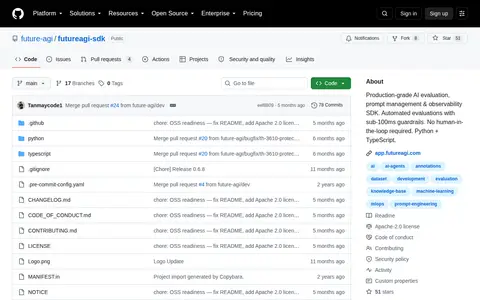
Future AGI SDK is a production-grade software development kit for AI evaluation, prompt management, and observability. It offers automated evaluations with sub-100ms guardrails and does not require human-in-the-loop. The SDK supports Python and TypeScript.
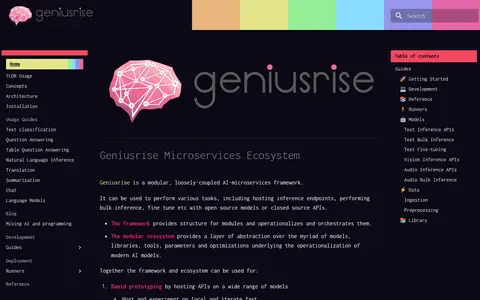
Host inference APIs, bulk inference and fine tune text, vision, audio and multi-modal models.