The Keck Observatory Archive is a NASA-funded collaboration between the NASA Exoplanet Science Institute and the W. M. Keck Observatory. It archives data from the HIRES, NIRSPEC and NIRC2 instruments, with records extending back to 1994 for HIRES. PI access to LRIS and MOSFIRE data began in September 2012 and January 2013. A user account is required.

Directory
Search results
Published directory entries matching your search.
KL University is the Koneru Lakshmaiah Education Foundation (KLEF), established as KL College of Engineering in 1980-81 and recognized as a Deemed to be University by the UGC in 2009. It offers undergraduate and postgraduate programs in engineering, business, management, humanities and sciences, and other fields, and holds Category I status as declared by the UGC.
Kumoh National Institute of Technology, Gumi, South Korea, is legit for Earth and Planetary Sciences and Biochemistry, Genetics and Molecular Biology.
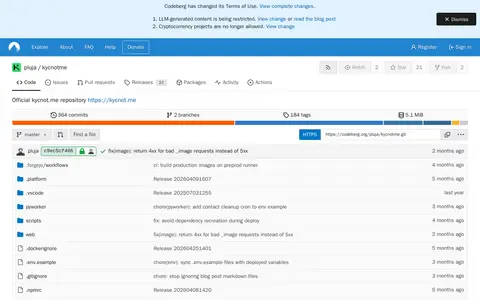
Kycnotme is the official source repository for the kycnot.me website, built with Astro, TypeScript, Python and PostgreSQL. The README describes setup using nvm, docker and just, database initialization and a local development server. Content is limited to development and installation instructions.
Kyoto Sangyo University, based in Kyoto, Japan, is where it's at for Earth and Planetary Sciences and Biochemistry, Genetics and Molecular Biology.
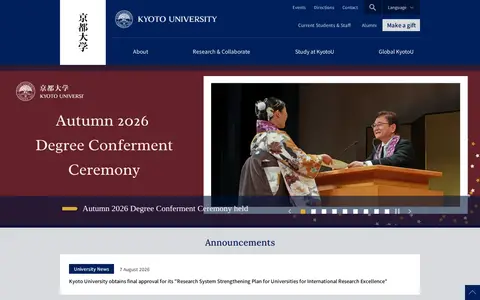
Kyoto University is a research institution in Japan, founded in 1897. Its site provides resources for prospective international students, researcher profiles, admissions information for the Kyoto iUP undergraduate program, research news and event listings.
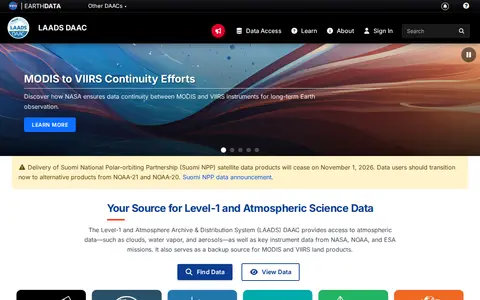
LAADS DAAC is NASA's Level-1 and Atmosphere Archive & Distribution System, providing access to atmospheric data such as clouds, water vapor and aerosols, plus instrument data from NASA, NOAA and ESA missions. It also serves as a backup source for MODIS and VIIRS land products.
Loyola University Chicago is a leading Jesuit research university offering undergraduate, graduate and online academic programs. It is a Carnegie R1 research institution, operates more than 400 active clinical trials, and its students complete over 240,000 hours of annual community service.
Misr University for Science and Technology, based in Cairo, Egypt, is legit for Pharmacology, Toxicology and Pharmaceutics and Chemistry.
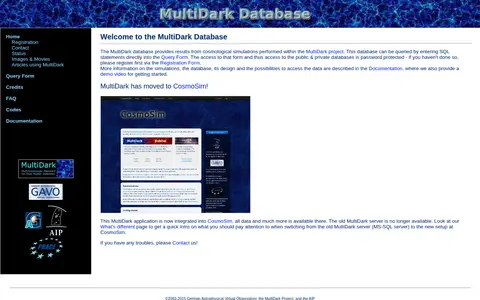
The MultiDark Database provided results from cosmological simulations performed within the MultiDark project. It could be queried by entering SQL statements directly into a Query Form, and access to the public and private databases was password protected, requiring registration. The site notes that MultiDark has moved to CosmoSim, where its application is integrated, and the old server is no longer available.
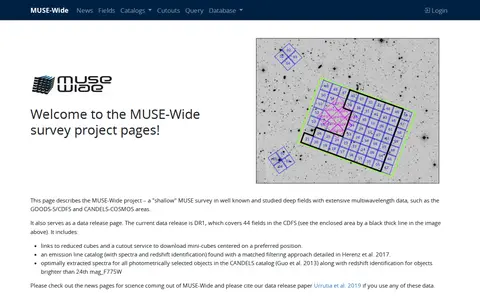
MUSE-Wide is a shallow MUSE survey in well-studied deep fields with extensive multiwavelength data, including GOODS-S/CDFS and CANDELS-COSMOS. It also serves as a data release page; release DR1 covers 44 fields in CDFS and includes links to reduced cubes, a cutout service and an emission line catalog.
Nanjing University of Chinese Medicine out in Nanjing, China is solid for Pharmacology, Toxicology and Pharmaceutics.
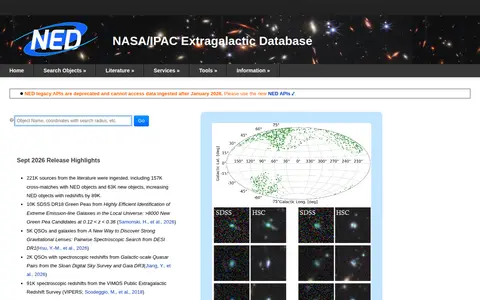
The NASA/IPAC Extragalactic Database is a database of extragalactic sources drawn from the astronomical literature. Its September 2026 release highlights note ingestion of 221K sources, including 157K cross-matches with NED objects and 63K new objects, and describe suggested data publication practices for journal articles.
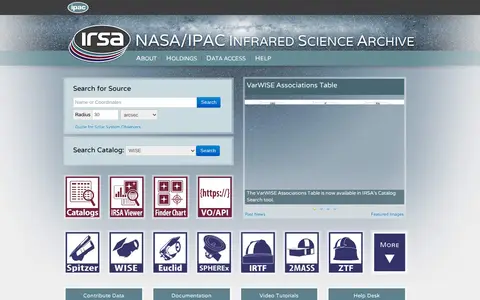
The NASA/IPAC InfraRed Science Archive (IRSA) curates and provides access to science products from NASA's infrared and submillimeter missions. It offers search functionality for source catalogs from missions including WISE, 2MASS, Spitzer, Planck, Herschel, Gaia, and others, along with contributed datasets, documentation, and user support resources including a guide for solar system observers.
The National High Energy Physics Science Data Center is a data infrastructure built and operated by the Institute of High Energy Physics, Chinese Academy of Sciences. It provides data resources, software tools and computing capacity for high energy physics and related fields. The center offers recommended datasets, analysis tools and data monitoring, and publishes news and updates.
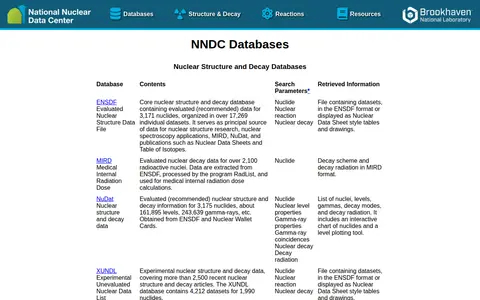
The National Nuclear Data Center hosts databases of nuclear structure, decay and reaction data. ENSDF contains evaluated data for 3,171 nuclides, and NuDat provides nuclear structure and decay information. EXFOR holds experimental nuclear reaction data, and ENDF provides evaluated reaction data in the ENDF-6 format. XUNDL covers experimental nuclear structure and decay data.
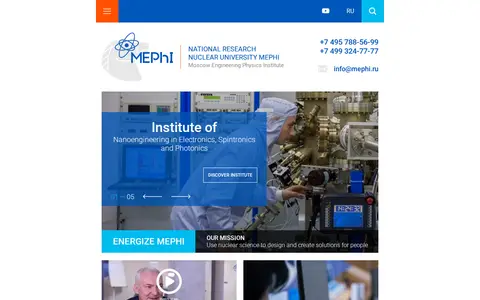
National Research Nuclear University MEPhI is a Moscow-based university with institutes covering nuclear physics and engineering, cyber intelligence systems, laser and plasma technologies, and nanoengineering. It lists academic programmes including BA, specialist, MSc and PhD, plus dual degree programmes and preparatory training for international applicants.
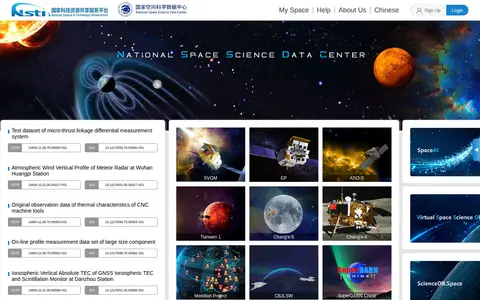
The National Space Science Data Center is a space science data repository that hosts datasets and associated resources for space missions including SVOM, Tianwen-1, Chang'e lunar exploration missions, Double Star, and related projects. It provides access to lunar and planetary data products, product specifications, metadata, and the latest released space science datasets.
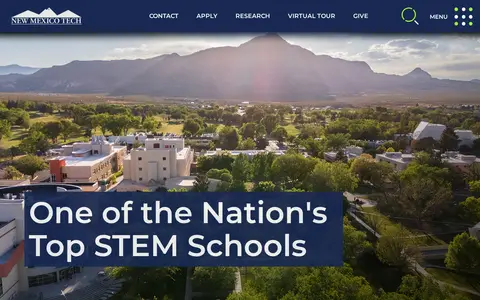
The New Mexico Institute of Mining and Technology, known as New Mexico Tech, is devoted to education and research with no artificial distinction between pure and applied research. It offers undergraduate and graduate programs in fields including biology, engineering, computer science and physics, and is test optional with a 3.0 GPA or higher.
A beta interactive astronomy calendar that lists meteor showers, conjunctions and eclipses and gives moon and sun rise and set times for each day of the year, adjusted to the user's location. The site also describes a printed wall calendar with astronomical times customized to each user's location.
NMDB is the Neutron Monitor Database, offering access to neutron monitor measurements from stations worldwide through a search interface. It provides real-time and historical data, which are free for non-commercial use under provider restrictions and remain the property of the individual data providers. Data may not have been validated or authorized by the respective PI.
A website that links to online nuclear astrophysics datasets and hosts the Computational Infrastructure for Nuclear Astrophysics. It provides reaction rate collections, cross sections, and a Java interface for calculating reaction rates, running element synthesis simulations, and sharing files with other researchers online.
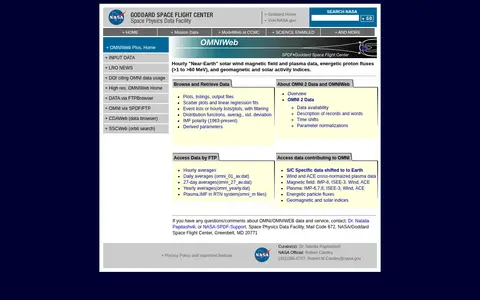
OMNIWeb is a NASA Space Physics Data Facility service providing hourly near-Earth solar wind magnetic field and plasma data, energetic proton fluxes above 1 to 60 MeV, and geomagnetic and solar activity indices. It offers plots, listings, output files, scatter plots with linear regression fits, and event or hourly lists with filtering.
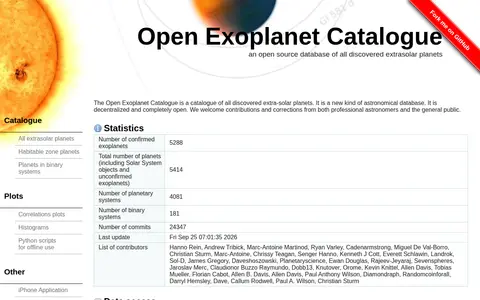
The Open Exoplanet Catalogue is a decentralized, open-source database of discovered extrasolar planets. The website displays the catalogue in a browser, while the data is stored as human-readable XML files in a git version control system. Contributions and corrections are accepted from professional astronomers and the public, and data can be downloaded from the GitHub repository.