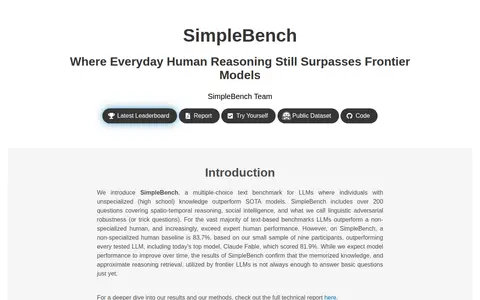
SimpleBench is a multiple-choice text benchmark for LLMs with over 200 questions covering spatio-temporal reasoning, social intelligence and trick questions. Its report states a non-specialized human baseline of 83.7 percent from a small sample of nine participants.
Directory
Search results
Published directory entries matching your search.
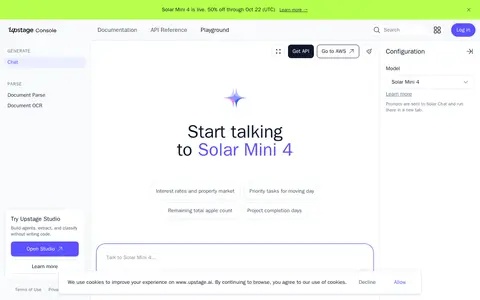
Solar is a browser-based playground from Upstage Console that lets users test Solar LLM and Document AI tools. It supports features including AI chat, document parsing, OCR, and question answering over user-uploaded files.
AI-generated visualization prototyping and editing platform, support 2D, 3D models, combined with LLM(Large Language Model) for quick editing.
StableLM: Stability AI Language Models.
DSPy is a framework developed by Stanford NLP for programming language models rather than using traditional prompting workflows. The open-source project is hosted on GitHub, with official documentation available at dspy.ai.
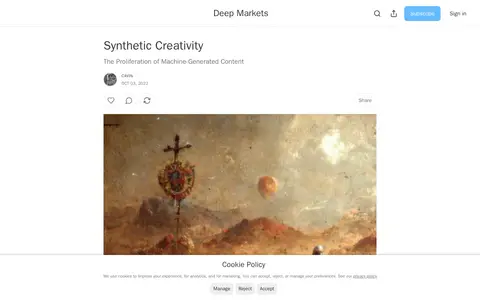
An article by Cavin on Deep Markets discussing machine-generated content and creativity. It describes technology as leverage over creation: writing, the printing press, the internet, digital tools and machine learning. It also covers synthetic text from large language models such as OpenAI's GPT-3, published in summer 2020.
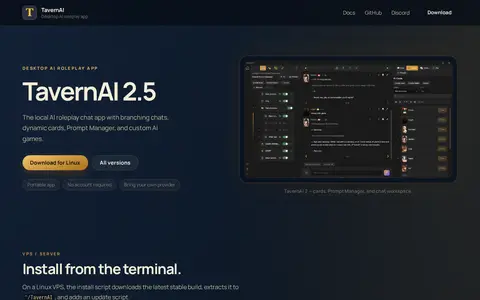
TavernAI 2 is a desktop AI roleplay chat app distributed as a portable app for Windows and Linux, also installable on a VPS. It runs models locally or connects to built-in and custom AI provider integrations, with branching chats, dynamic participants, a Prompt Manager, and custom AI games.
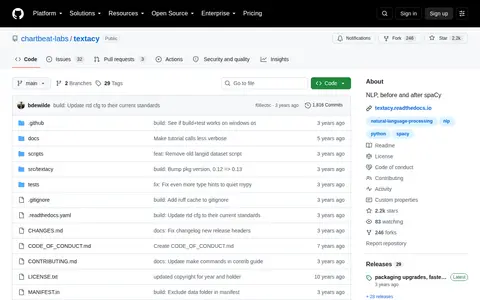
textacy is a Python library for natural language processing tasks built on the spaCy library. It focuses on tasks before and after spaCy processing, with tokenization, part-of-speech tagging and dependency parsing delegated to that library. Features include cleaning and normalizing raw text, extracting n-grams, entities, acronyms and keyterms, similarity metrics, and training topic models.
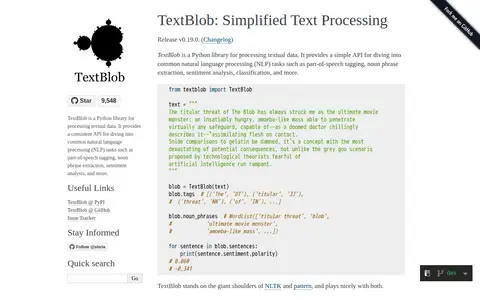
TextBlob is a Python library for processing textual data. It offers a simple API for natural language processing tasks including part-of-speech tagging, noun phrase extraction, sentiment analysis, classification, and tokenization. The documentation lists features such as word and phrase frequencies, parsing n-grams, lemmatization, spelling correction, and WordNet integration. It builds on NLTK and pattern, and new models or languages can be added through extensions.
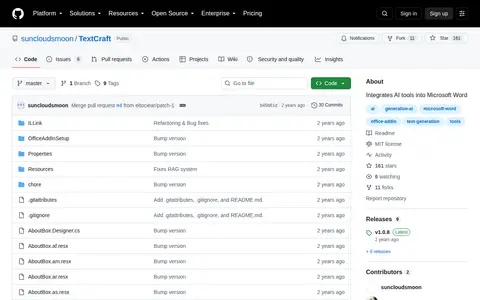
Creates, rewrites or summarizes written content with language models.
The case against AI-generated users is an IDEO journal article that explores the use of AI-generated synthetic users for design research. It discusses alternative methods to meet research goals, compares the value of traditional design research to outputs from large language models, and offers forward-looking perspectives on design research practices.
Toolbaz offers free AI tools for writing, image and audio generation, powered by models including GPT-5, Claude, Gemini and Meta-AI. The site lists writer tools such as article and content writer, story and book writer, and rewriting and editing tools.
vLLM is an open-source library for efficient serving of large language models. It provides an API server, supports offline and online inference, deployment options, and features such as automatic prefix caching, batch invariance, context extension, and speculative decoding. It can be used with GPUs, CPUs, and TPUs.
Vocali.se is a free web service that separates vocals and music from songs or audio files, allowing users to create karaoke versions. It runs a machine learning engine using pre-trained Demucs models and requires no software installation or account registration. Processing takes less than three minutes, after which the separated files download automatically.
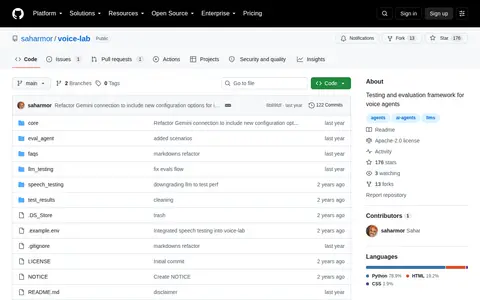
A comprehensive testing and evaluation framework for voice agents across language models, prompts, and agent personas.
G4F Chat is a conversational AI platform that supports private, customizable conversations using multiple AI providers and models. It includes features such as cloud sync, conversation export, markdown rendering, speech recognition, voice synthesis, custom system prompt configuration and MCP server support.
Creates, rewrites or summarizes written content with language models.
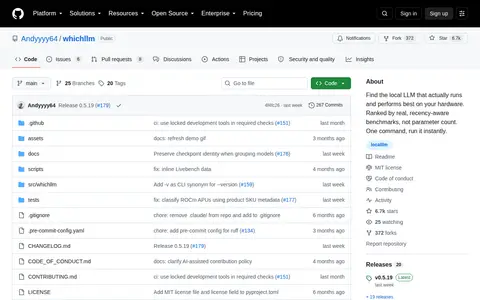
WhichLLM is a tool that identifies local large language models that run effectively and perform best on a user's hardware. It ranks models by real, recency-aware benchmarks rather than parameter count, and can be run instantly with a single command.
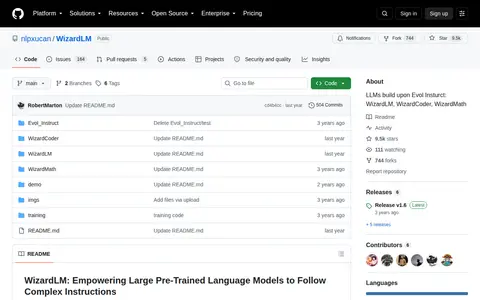
WizardLM is a repository of large language models including WizardLM, WizardCoder and WizardMath, described as LLMs built upon Evol Instruct. The page lists model checkpoints and benchmark results, with WizardCoder-33B-V1.1 reported at 79.9 pass@1 on HumanEval and WizardMath-7B-V1.1 reported at 83.2 pass@1 on GSM8k.
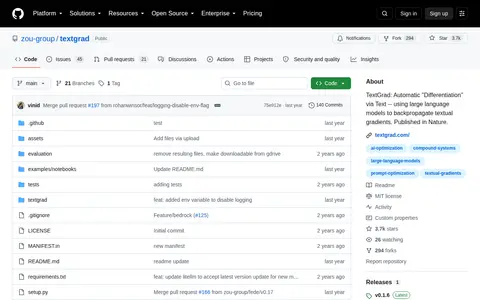
Automatic "Differentiation" via Text, using large language models to backpropagate textual gradients.
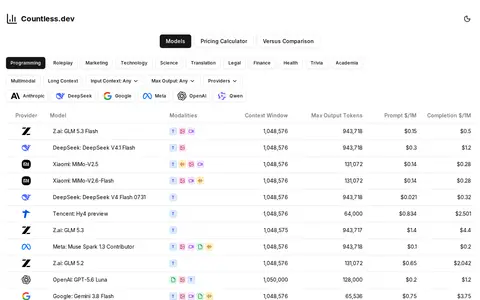
AI Price Compare, hosted at countless.dev, is a tool that aggregates AI model providers in a single location. It offers a comprehensive pricing calculator and feature comparison tool to help users identify the large language model best suited to their needs, with coverage of providers including OpenAI, Anthropic and Google.

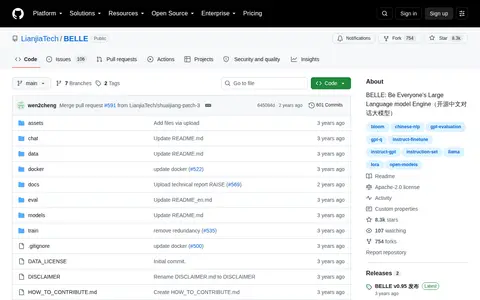
BELLE, short for Be Everyone's Large Language model Engine, is an open-source Chinese conversational large language model hosted on GitHub by LianjiaTech. The project provides relevant training code and open datasets for the model.
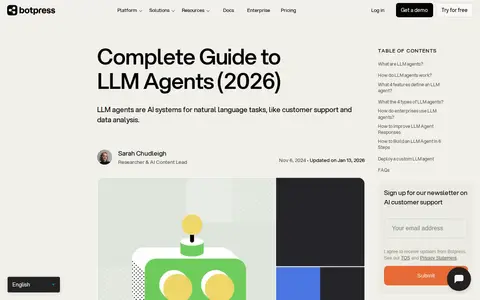
A Botpress-published guide that explains large language model (LLM) agents, including their definition, core features, common types, and improvement techniques, and notes that LLM agents are AI systems for natural language tasks such as customer support and data analysis.