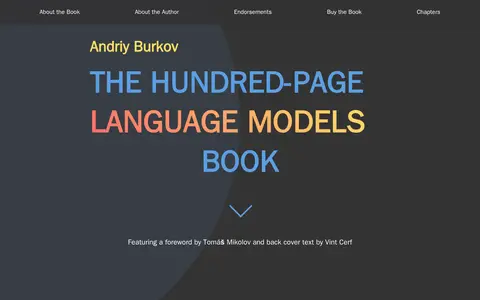
The Hundred-Page Language Models Book by Andriy Burkov is a concise hands-on guide covering machine learning basics through advanced transformer architectures and large language models. It explains AI fundamentals, text representation, count-based models, recurrent neural networks, and transformers, with mathematical foundations and Python code examples. The book targets ML practitioners and engineers building text-based applications.
Directory
Search results
Published directory entries matching your search.
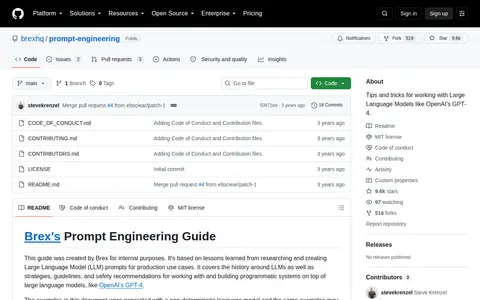
brexhq/prompt-engineering is a GitHub repository containing Brex's Prompt Engineering Guide. It provides tips and tricks for working with Large Language Models such as OpenAI's GPT-4, with content covering the definition of large language models, an incomplete history of language models, and the concept of prompts.
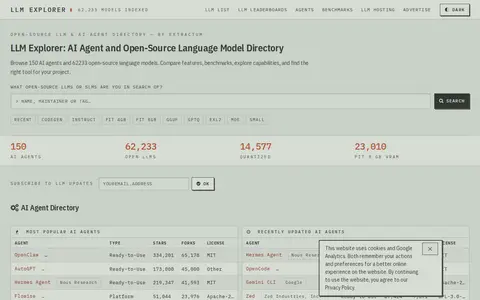
LLM Explorer is a directory of open-source language models and AI agents. It lists 150 AI agents and 64,811 open-source large and small language models, grouped into categories with benchmarks and analytics.
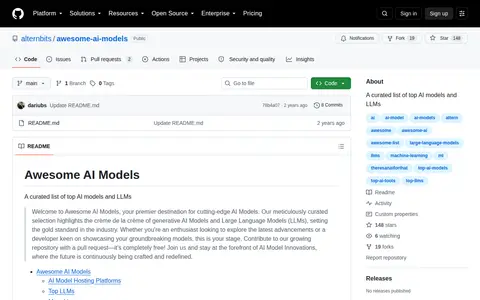
A curated GitHub list of top AI models and large language models, organized into AI model hosting platforms and top LLMs sections. It includes hosting platforms such as Hugging Face and GitHub Models, and lists models from providers including Meta, Google, Mistral AI and DeepSeek. Contributions are made through pull requests.
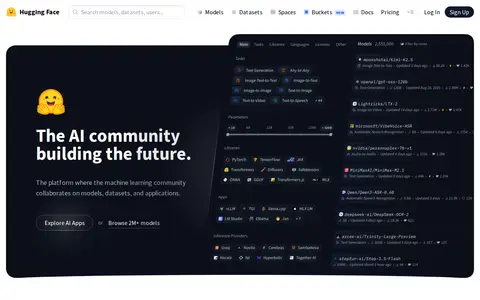
A collaboration platform where the machine learning community shares models, datasets and applications. It hosts public models, datasets and Spaces, and offers an open source stack including libraries such as Transformers, Datasets and Accelerate. It also provides paid Compute and Enterprise solutions, with an Inference Providers API giving access to models from multiple AI providers.

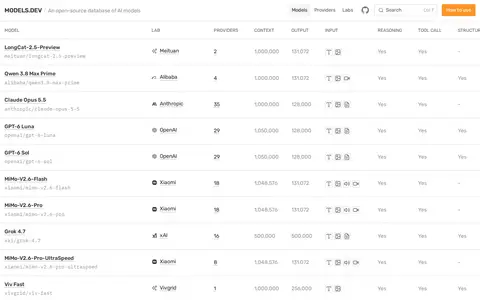
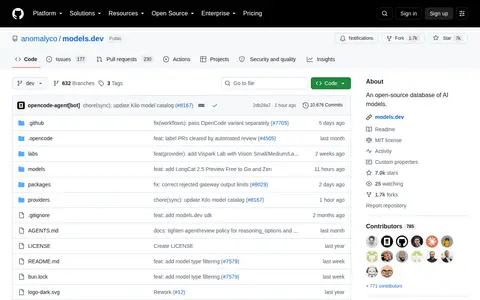
Models.dev is an open-source database that lists AI model specifications, pricing and features. It covers models from multiple providers with details such as context length, modalities and open or closed availability.

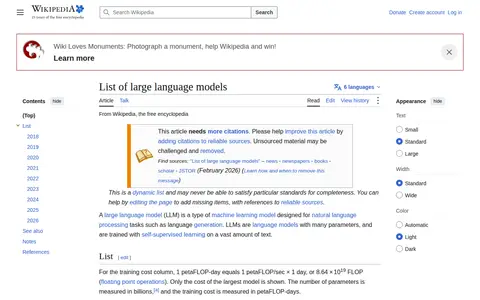
Wiki LLM List is a Wikipedia article that catalogs large language models, organized chronologically by release year from 2018 to 2026. The entry includes a structured list of these AI models, supporting references, and links to related content.
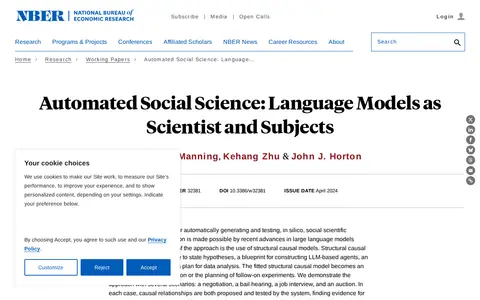
An NBER working paper presenting an approach for automatically generating and testing social scientific hypotheses in silico, using large language models with structural causal models. The approach is demonstrated in a negotiation, a bail hearing, a job interview, and an auction.
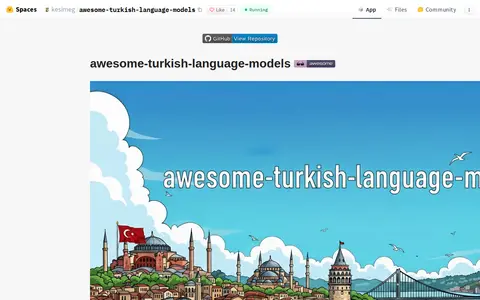
Awesome Turkish Language Models is a Hugging Face Space that hosts a curated list of Turkish AI models, datasets, and papers. It also functions as an application that fetches Markdown content from user-provided URLs and converts it to formatted HTML for reading.
Explore Clinical & Biomedical Language Models provides machine-learning models, research, training resources, or evaluation tools.
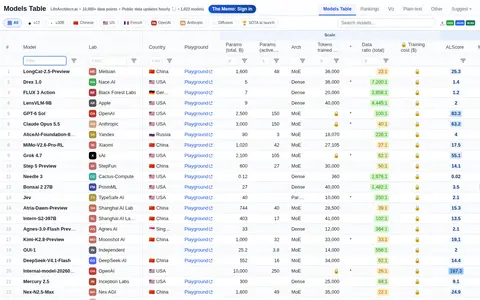
LifeArchitect.ai hosts a Models Table of large language model data, including parameters, tokens trained, and benchmark scores such as MMLU, MMLU-Pro, GPQA and HLE. The page also presents rankings, a data dictionary and visualization snapshots of frontier models.
The Dark Risk of Large Language Models WIRED UK provides machine-learning models, research, training resources, or evaluation tools.
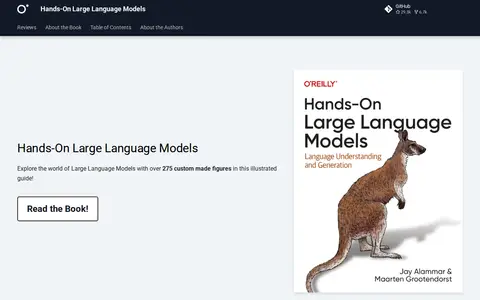
Hands-On Large Language Models is an illustrated guide to large language models. It includes over 275 custom figures, working code examples, timelines, and references to key research papers. The book has received positive reviews from Andrew Ng, Nils Reimers, Josh Starmer, Luis Serrano, Leland McInnes, and Prof. DDr. Roman Egger.
A blog article about red-teaming large language models, described as a form of evaluation that elicits model vulnerabilities that might lead to undesirable behaviors. It discusses undesirable behaviors such as revealing personal information, misinformation, bias, hatefulness and toxic content, and compares red-teaming with adversarial attacks. It notes that red-teaming prompts look like regular natural language prompts.
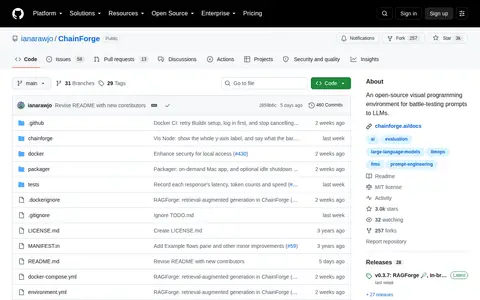
ChainForge is an open-source visual programming environment for battle-testing prompts to large language models. It supports querying multiple models at once, comparing response quality across prompts, models and model settings, and setting evaluation metrics to visualize results. Built on ReactFlow and Flask, it can be installed locally with pip or tried on the web, where features are limited.
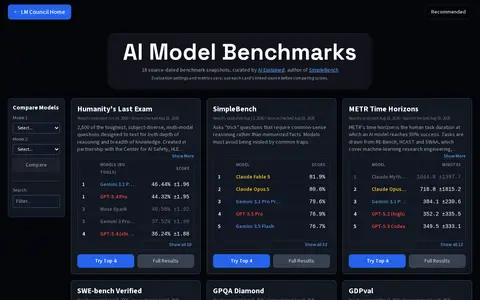
LM Council presents source-dated benchmark snapshots for AI models. It covers GPT, Claude, Gemini and other frontier models across benchmarks including Humanity's Last Exam, FrontierMath, GPQA and SWE-bench, with a comparison tool selecting two models. Each snapshot links its source and checked date, and evaluation settings and metrics vary.
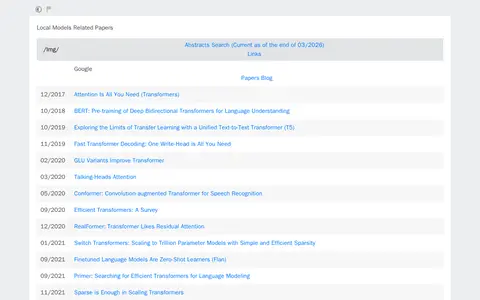
A directory of abstracts and links to academic papers focused on local language models, current as of the end of March 2026. The listing compiles research published between 2017 and 2023, including foundational works such as Attention Is All You Need, BERT, T5, and PaLM, alongside studies on efficient transformer inference, multimodal models, and instruction tuning.
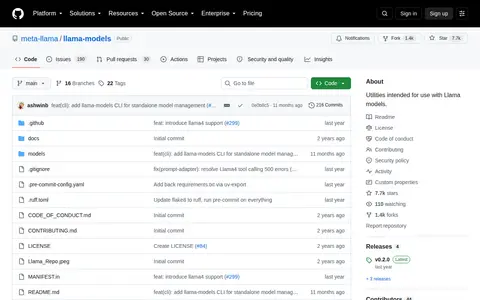
Official repository to use and implement LLaMA 3.1 models, Meta's state-of-the-art large language models.
Models.dev is a GitHub repository or organization with source code, releases, documentation, or project resources.
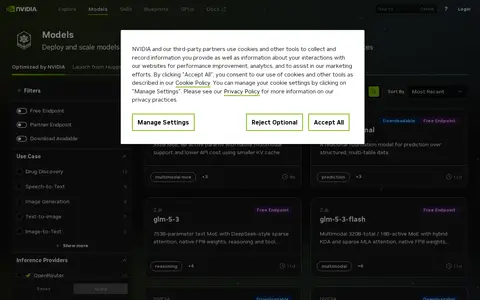
NVIDIA NIM is a catalog of models offered as inference microservices for deployment on the user's GPU infrastructure. The listings include downloadable models and free or partner endpoints, organized by use cases such as image generation, speech-to-text and drug discovery.
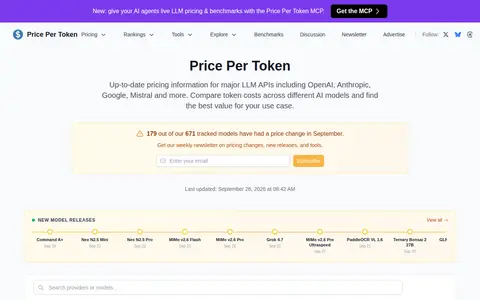
PricePerToken is a free comparison site for LLM API pricing. It presents per-token costs for models from providers including OpenAI, Anthropic, Google and Mistral, alongside model listings with context windows and benchmark figures. Pages cover individual models such as Amazon Nova Lite 1.0 and Nova Micro 1.0, whose pricing and context windows are stated.
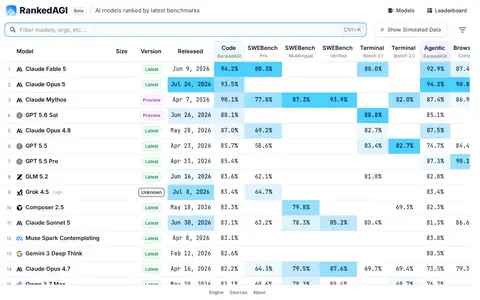
RankedAGI is a website that compares benchmarks across different AI models. It features benchmarks such as SWE Bench Verified, Codeforces, LMSYS and LiveBench, and presents a ranked table of models with size, version, release date, context length, cutoff knowledge, license and organization.
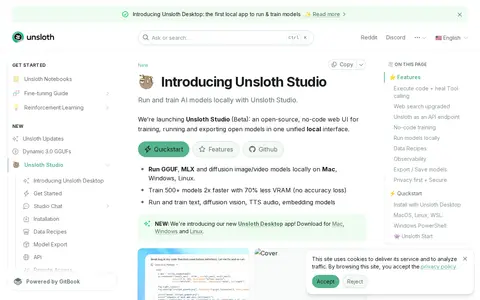
Unsloth Studio is an open-source, no-code web UI for training, running and exporting open models in one local interface. It supports GGUF, MLX and diffusion image/video models on Mac, Windows and Linux, and runs AI models offline without a GPU. A graphical Data Recipes workflow creates synthetic datasets from uploaded files.
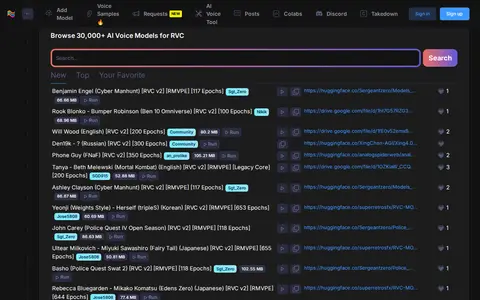
A site for browsing AI voice models for RVC. It lists 30,000+ voice models covering characters, singers and creators, allows previewing samples, and supports running compatible voices online with EasyAIVoice.