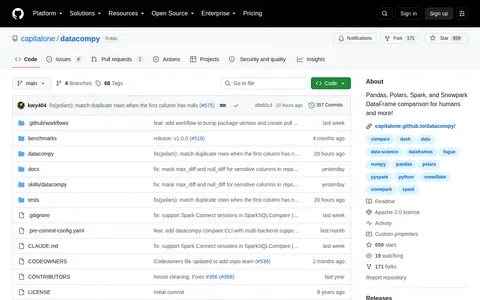

DataComPy is a package for comparing two DataFrames or tables. It supports Pandas, Polars, Spark (classic and Spark Connect), and Snowflake, and was originally created as a replacement for SAS PROC COMPARE for Pandas DataFrames. It prints stats and lets users adjust required match accuracy.
Directory
Search results
Published directory entries matching your search.

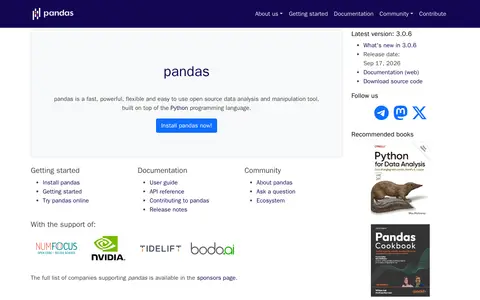
pandas is an open source, BSD-licensed library providing high-performance, easy-to-use data structures and data analysis tools for the Python programming language. It is described as a data analysis and manipulation tool built on top of Python. Documentation, a user guide and an API reference are available.
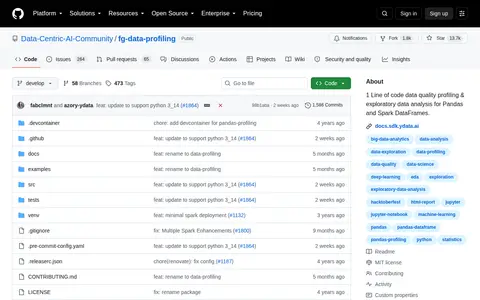
Create HTML profiling reports from pandas DataFrame objects.
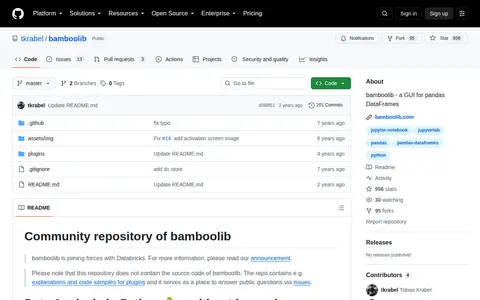
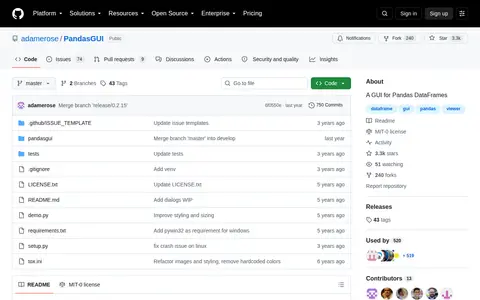
An intuitive GUI for Pandas DataFrames.
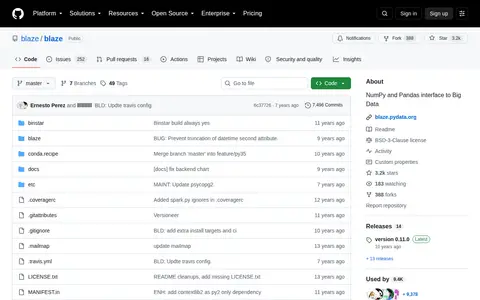
NumPy and Pandas interface to Big Data.
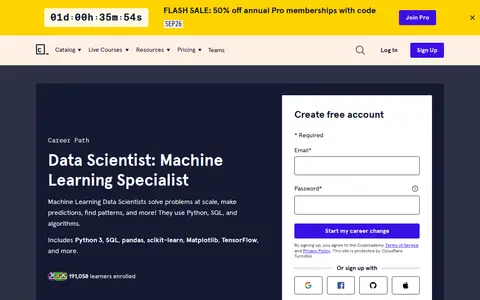
Codecademy's Data Scientist: Machine Learning Specialist Career Path is a beginner-level course covering Python 3, SQL, pandas, scikit-learn, Matplotlib, and TensorFlow. The path is listed as taking 95 hours on average and includes 59 projects with no prerequisites, and is described as teaching analysis of data, drawing predictions with machine learning, and building neural networks.
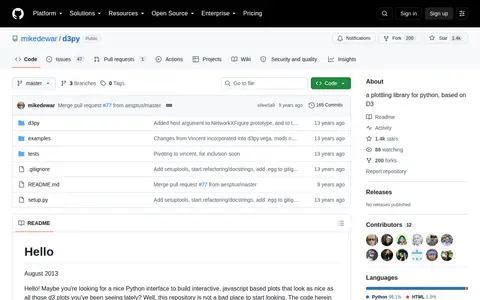
d3py is a plotting library for Python based on D3. It builds on d3.js and the pandas DataFrame module to plot data from the command line or simple scripts into a browser window. Its README describes the code as an experiment, notes that it is not actively developed, and points to vincent as an alternative.
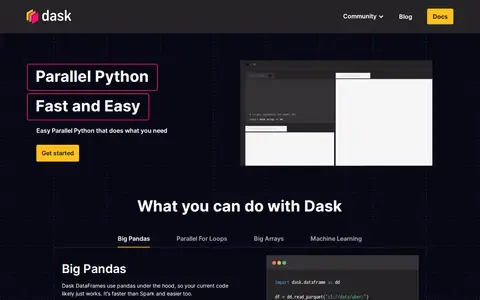
Dask is an open-source Python library for parallel computing maintained by contributors across dozens of companies. The site describes uses including Dask DataFrames for pandas, parallel for loops, large arrays with NumPy and Xarray, and machine learning. It can run on a laptop or be deployed on resource managers such as Kubernetes or cloud.
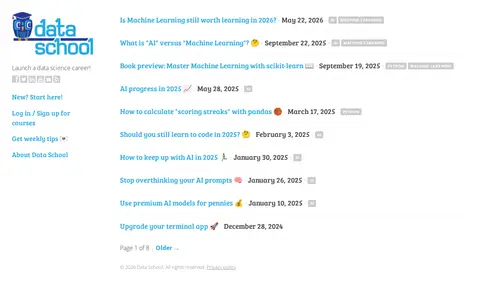
Data School is a blog about data science and machine learning. Its posts cover topics such as the difference between AI and machine learning, learning scikit-learn, AI progress, and using pandas for calculations. Posts are tagged by subject including Python, AI, and machine learning.
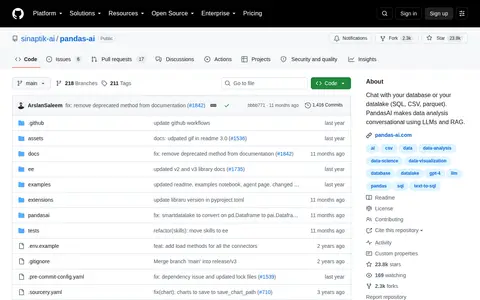
PandasAI is an open-source library that enables conversational data analysis using large language models and retrieval-augmented generation. It allows users to interact with databases or datalakes supporting SQL, CSV, and parquet file formats.
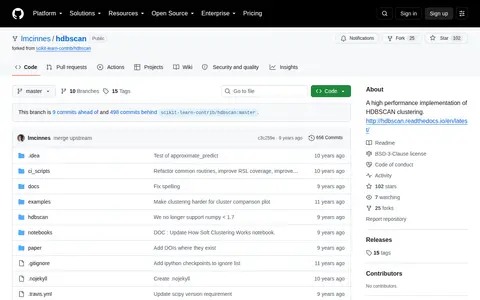
HDBSCAN is a high performance implementation of hierarchical density-based clustering. It performs DBSCAN over varying epsilon values and integrates results to find a clustering with the best stability over epsilon, allowing clusters of varying densities. The package inherits from sklearn classes and supports arrays, pandas dataframes, sparse matrices or distance matrices as input.
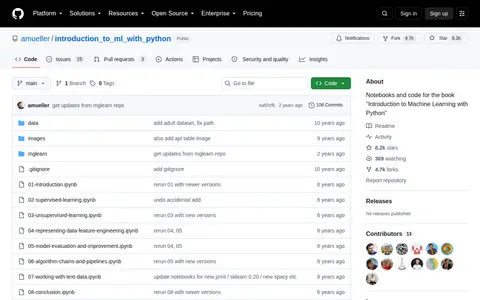
A GitHub repository holding the notebooks and code for the book "Introduction to Machine Learning with Python" by Andreas Mueller and Sarah Guido, together with the mglearn library of helper functions for figures and datasets. The book requires scikit-learn 0.20.0, and the code also needs numpy, scipy, matplotlib, pandas and pillow.
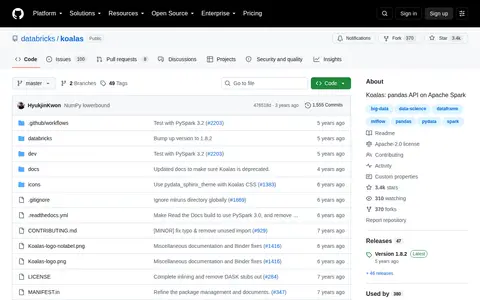
Koalas, from Databricks, implements the pandas DataFrame API on top of Apache Spark. The repository is marked deprecated and in maintenance mode; Koalas supports Apache Spark 3.1 and below, and PySpark is recommended directly for Spark 3.2 and above. It is available under the Apache-2.0 license.
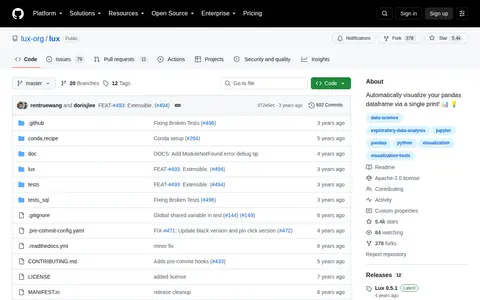
Lux is a Python library for automated data exploration. When a pandas dataframe is printed in a Jupyter notebook, Lux recommends a set of visualizations highlighting trends and patterns, shown in an interactive widget for browsing and exploring the dataset.
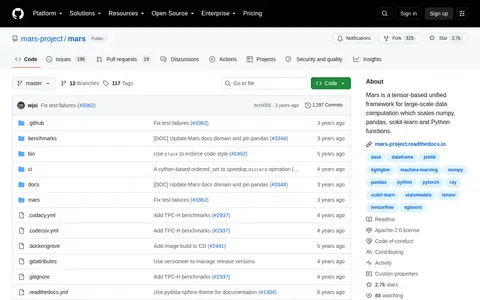
Mars is an open source tensor-based unified framework for large-scale data computation. It scales numpy, pandas and scikit-learn, offering tensor, DataFrame and learn interfaces that resemble the original libraries. A session can be started locally or connected to an existing Mars cluster.
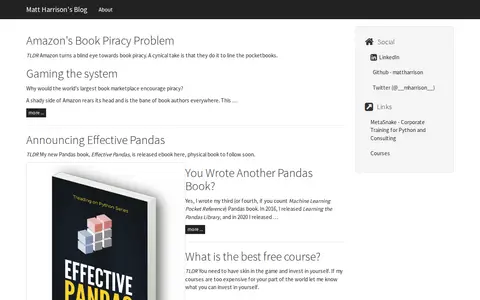
Matt Harrison is a personal blog authored by Matt Harrison. The blog covers topics including Amazon book piracy, the Effective Pandas book, Python and data science courses, and general software development content.
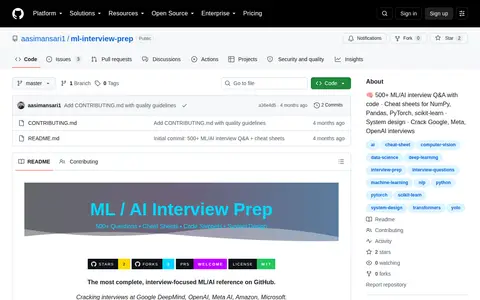
ML/AI Interview Prep is a GitHub-hosted resource collection for machine learning and artificial intelligence technical interview preparation. It includes over 500 interview questions and answers with accompanying code, cheat sheets for NumPy, Pandas, PyTorch, and scikit-learn, and system design content targeted at candidates for roles at companies including Google, Meta, and OpenAI.
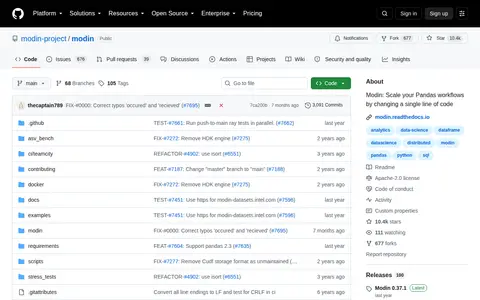
Speed up your Pandas workflows by changing a single line of code.
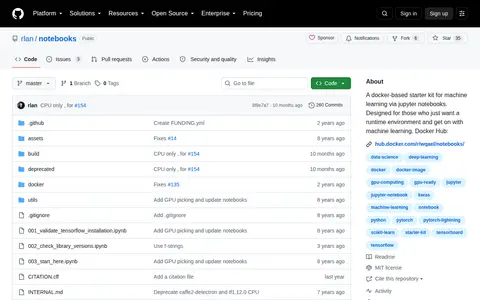
Notebooks is a Docker-based starter kit for machine learning through Jupyter notebooks, intended for users who want a ready runtime environment. Its images cover combinations of Keras, TensorFlow and PyTorch with CUDA v8 through v11, and include JupyterLab, scikit-learn, pandas and visualization, vision and NLP libraries. Python 3 only, as Python 2 is end-of-life.
Open-source project that provides machine-learning models, research, training resources, or evaluation tools.
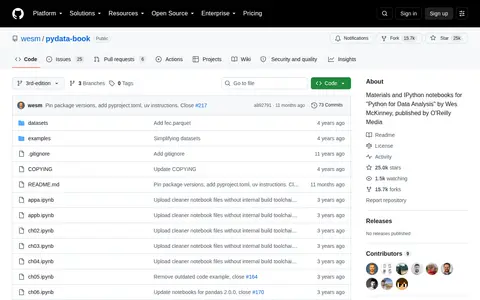
The repository holds materials and IPython notebooks for "Python for Data Analysis, 3rd Edition" by Wes McKinney, published by O'Reilly Media. Notebooks cover chapters on Python basics, NumPy, pandas, data loading, cleaning, visualization, time series and modeling libraries, plus appendices. The code is released under the MIT license.
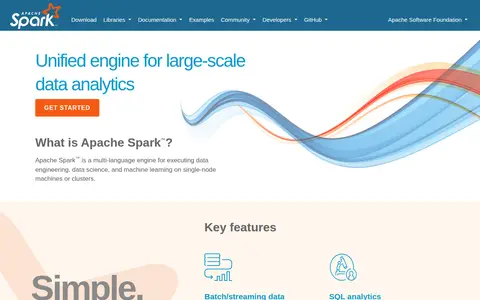
Apache Spark is a multi-language engine for executing data engineering, data science, and machine learning on single-node machines or clusters. It provides high-level APIs in Java, Scala, Python and R, and supports Spark SQL, pandas API on Spark, MLlib, GraphX and Structured Streaming. The documentation covers downloads, the shell and client applications.
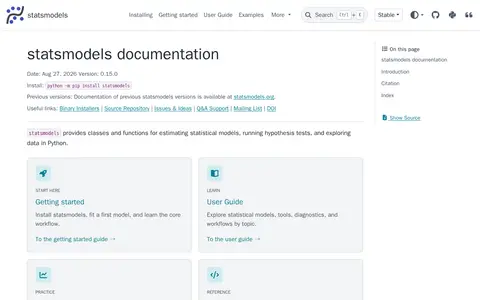
Statsmodels is a Python module providing classes and functions for estimating statistical models, conducting statistical tests, and statistical data exploration. It supports model specification using R-style formulas and pandas DataFrames, and is released under the open source Modified BSD (3-clause) license.
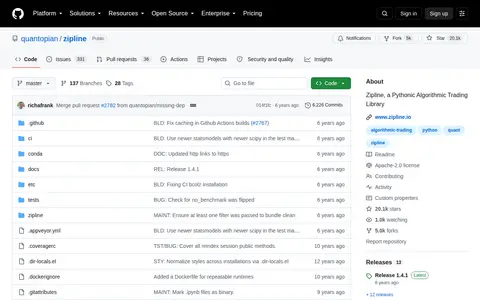
Zipline is a Pythonic algorithmic trading library and an event-driven system for backtesting. It is described as used in production as the backtesting and live-trading engine powering Quantopian. Historical data input and performance statistics output are based on Pandas DataFrames. Zipline supports Python 2.7, 3.5 and 3.6 and may be installed via pip or conda.