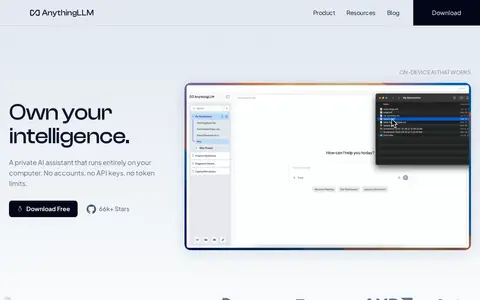
AnythingLLM is a free, private AI assistant that runs on the user's device, requiring no accounts or API keys. The page describes document knowledge and a meeting assistant, and states the app is available for macOS, Windows and Linux.
Directory
Search results
Published directory entries matching your search.
Applio is an open-source AI voice conversion suite. It provides voice conversion, real-time voice changing, speech synthesis, model training, voice blending and audio analysis. The project states it is MIT licensed and runs on Windows, macOS and Linux, with a desktop app or Gradio WebUI, and no accounts or telemetry.
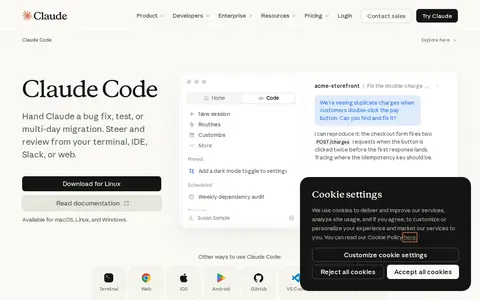
Claude Code is Anthropic's agentic coding tool for developers. It understands a codebase, edits files and runs commands. It is available as a terminal, IDE, Slack or web tool for macOS, Linux and Windows. Projects group related coding sessions so multiple Claude agents can run at once, and auto mode runs by default on Pro, Max and Team plans.
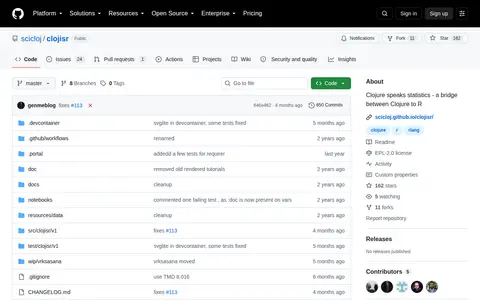
ClojisR is a bridge between Clojure and R, described as "Clojure speaks statistics." It targets only JVM Clojure and supports a function-centric API for calling R functions on R objects from Clojure. It requires Linux, MacOS or WSL, JDK 1.8 or later, Clojure 1.9.0 or later, and the Rserve R package.
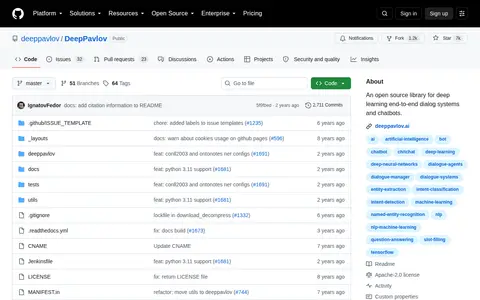
DeepPavlov is an open-source library for deep learning end-to-end dialog systems and chatbots. Version 1.0 is described as an NLP framework built on PyTorch and transformers for modular, configuration-driven development of NLP models, intended for practitioners with limited NLP/ML knowledge. It supports Linux, Windows 10+ through WSL/WSL2, and MacOS Big Sur+ on Python 3.6 to 3.10.
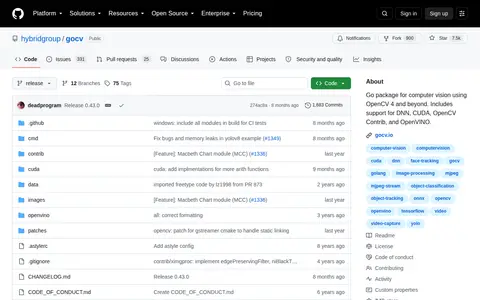
GoCV is a Go package providing language bindings for the OpenCV 4 computer vision library. It supports recent Go and OpenCV releases (v4.12.0) on Linux, Docker, macOS, and Windows, and includes support for DNN, CUDA, OpenCV Contrib, and OpenVINO.
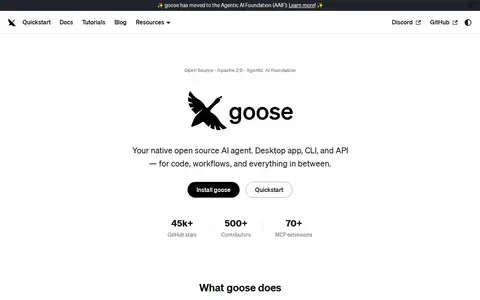
goose is an open source AI agent that runs on the user's machine. It is available as a desktop app for macOS, Linux and Windows, a CLI, and an API built in Rust. The agent is general-purpose, covering code, workflows, research, writing and automation. It connects to 70+ extensions via the Model Context Protocol and works with 15+ LLM providers, including API keys or existing subscriptions.
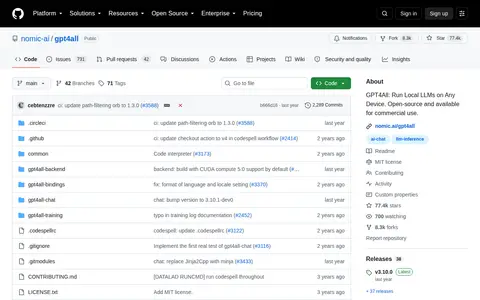
GPT4All is an open-source application for running large language models privately on desktops and laptops without API calls or GPUs. It offers installers for Windows, macOS and Linux, a Python client, and integrations with LangChain, Weaviate and OpenLIT.
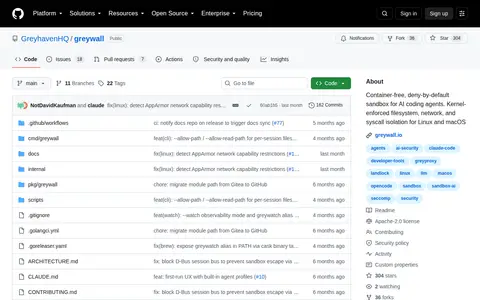
Greywall is a container-free, deny-by-default sandbox designed for AI coding agents. It provides kernel-enforced filesystem, network, and syscall isolation for Linux and macOS operating systems, and is hosted as a public repository on GitHub.
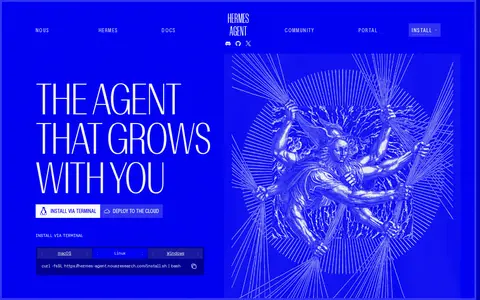
Hermes Agent is an open-source, self-hosted AI agent by Nous Research. It is available as a terminal app and as Hermes Desktop for macOS, Windows and Linux, with persistent memory and a messaging gateway for platforms such as Telegram, Discord, Slack, WhatsApp, Signal and email. It is free under the MIT license.
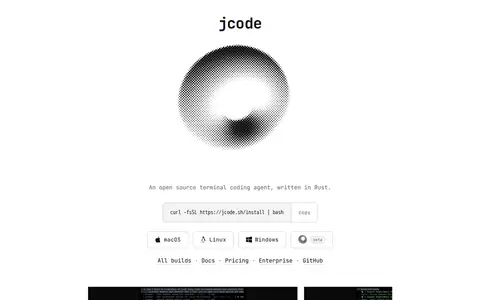
jcode is an open-source terminal coding agent written in Rust. It supports agent swarms, background tasks, and a small RAM footprint, and is installed with one command on macOS, Linux, or Windows. Login flows connect subscription and API model providers, and the agent itself is free while hosted inference plans are available.
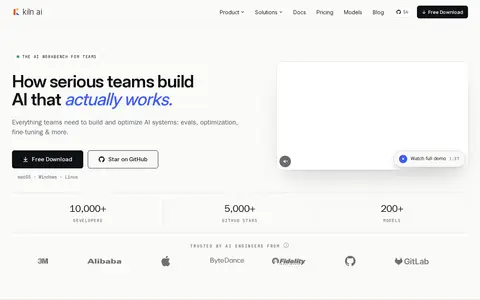
Kiln AI is a platform and open-source library for building, evaluating, and optimizing AI systems. It offers tools for working with retrieval-augmented generation, AI agents, synthetic data, model fine-tuning, and prompt optimization, with a free downloadable application available for macOS, Windows, and Linux.
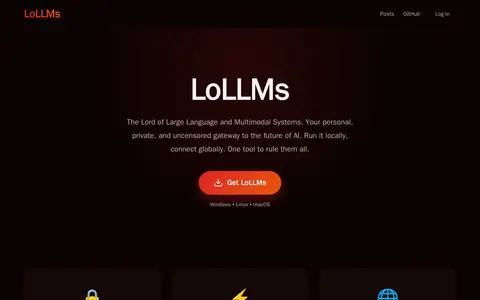
LoLLMs, described as the Lord of Large Language and Multimodal Systems, is a local AI tool for running models. It states full local execution and hardware support for NVIDIA, AMD, Apple Silicon or CPU. It is offered for Windows, Linux and macOS.
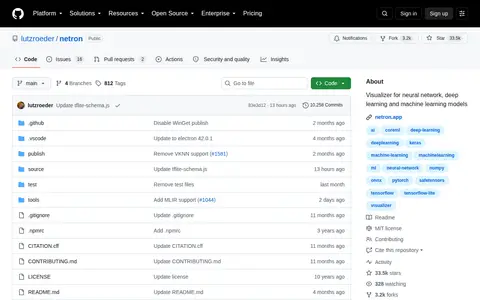
Netron is a viewer for neural network, deep learning and machine learning models. It supports formats including ONNX, TensorFlow Lite, PyTorch, TensorFlow, Core ML, OpenVINO, Keras, Caffe, Darknet, Safetensors and NumPy. It is available as a browser version and installers for macOS, Linux and Windows, plus a Python package. Experimental support exists for MLIR, JAX, GGUF and other formats.
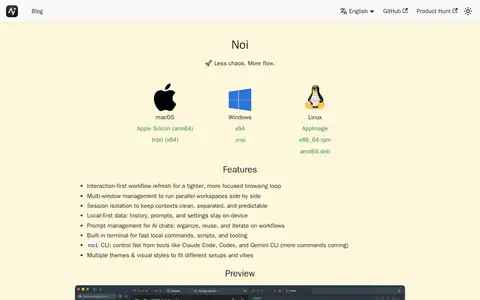
Noi is a desktop application that provides an interaction-focused browsing workflow. It offers multi-window management for parallel workspaces, session isolation, and local-first data storage for history, prompts, and settings. It also includes prompt management for AI chats, a built-in terminal, and a CLI for controlling Noi from tools such as Claude Code and Codex. Builds are listed for macOS, Windows, and Linux.
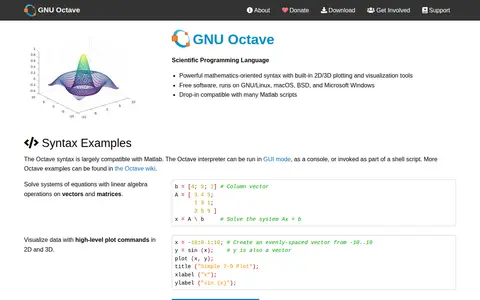
GNU Octave is a programming language for scientific computing with mathematics-oriented syntax and built-in 2D/3D plotting and visualization tools. It is free software licensed under the GNU General Public License and runs on GNU/Linux, macOS, BSD, and Microsoft Windows. Its syntax is largely compatible with Matlab, and it can be extended by packages.
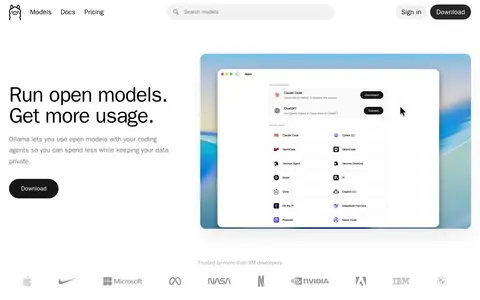
Ollama is a tool for running and building with open AI models locally or in the cloud on macOS, Windows and Linux. Its pricing page lists Free, Pro, Max, Team and Enterprise subscription plans, with paid plans including usage credits and cloud model access. The Free plan includes running models locally and starter usage credits.
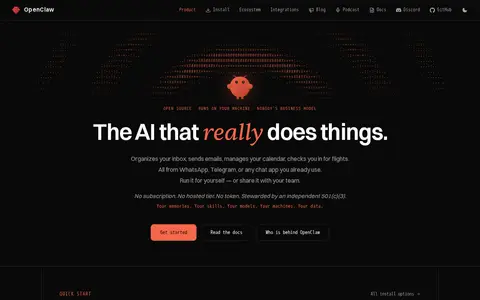
OpenClaw is an open-source AI assistant that runs on the user's machine and works from WhatsApp, Telegram or other chat apps. According to the site, it organizes inboxes, sends emails, manages calendars and checks users in for flights. Desktop apps are listed for macOS, Windows and Linux, and an enterprise platform is in development ahead of a 1.0 release.
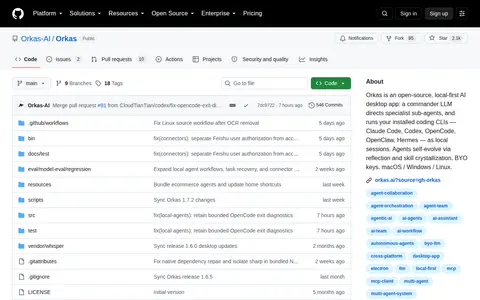
Orkas is an open-source, local-first AI desktop app. A commander LLM directs specialist sub-agents and runs installed coding CLIs including Claude Code, Codex, OpenCode, OpenClaw, and Hermes as local sessions. Its agents self-evolve via reflection and skill crystallization, supports bring-your-own keys, and is compatible with macOS, Windows, and Linux.
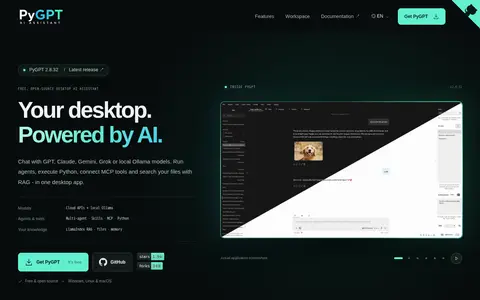
PyGPT is a free, open-source desktop AI assistant compatible with Windows, Linux and macOS operating systems. It supports both cloud-based and local AI models, and offers features including AI chat, multi-agent workflows, RAG-powered knowledge retrieval from user files, skills and plugin support, Python and MCP automation, and voice, vision and content generation capabilities.
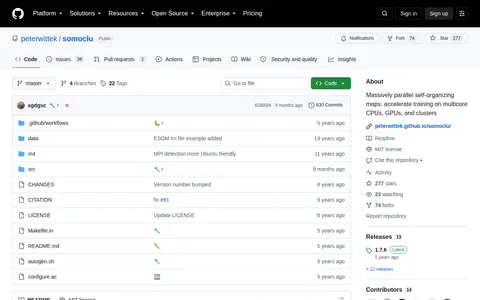
Somoclu is a massively parallel implementation of self-organizing maps, using multicore CPUs, MPI for cluster workload distribution, and CUDA acceleration. It supports OpenMP, MPI, and CUDA, runs on Linux, macOS, and Windows, and offers planar and toroid maps, rectangular and hexagonal grids, and Gaussian and bubble neighborhood functions. Both dense and sparse input data are supported, with interfaces for Python, R, Julia, and MATLAB.
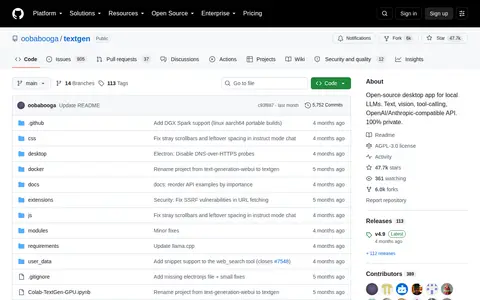
TextGen is an open-source desktop app for local LLMs, with text, vision, tool-calling and web search, plus a UI and API. It supports multiple backends including llama.cpp, Transformers, ExLlamaV3 and TensorRT-LLM, and an OpenAI/Anthropic-compatible API. It also offers LoRA training and image generation. Portable builds are provided for Linux, Windows and macOS.
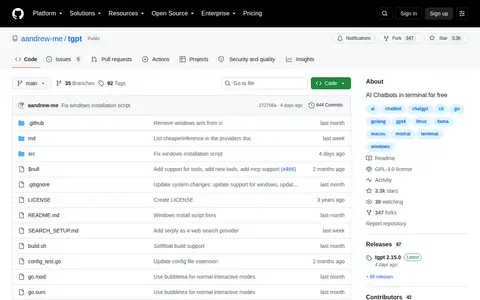
tgpt is a cross-platform command-line interface tool for using AI chatbots in the terminal. It is available for GNU/Linux, macOS, FreeBSD and Windows, and can be installed through scripts, package managers such as Homebrew, Pacman, Scoop, Chocolatey and Go, or from release executables. The project is distributed under the GPL-3.0 license.
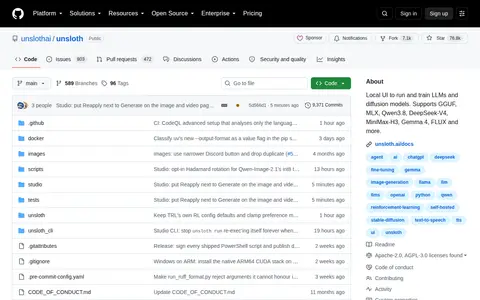
Unsloth is a desktop application for running and training LLMs and diffusion models locally. It supports model formats including GGUF and MLX, and offers fine-tuning methods such as LoRA, QLoRA, full fine tuning and reinforcement learning, along with dataset building and model export. Native builds are offered for Windows, macOS and Linux, with additional installation options.