A personal blog by Alex Smola titled Adventures in Data Land, covering machine learning topics. Entries include efficient LLM inference tutorials, random projections, effective sample size, voice agents and evaluation, and porting MXNet to Blackwell and Apple Silicon. Posts reference events such as the Machine Learning Summer School 2026 in NYC.
Directory
Search results
Published directory entries matching your search.

A GitHub repository for generating retro pixel game characters with generative adversarial networks. It includes the TinyHero dataset of 64x64 pixel characters generated from the Universal LPC spritesheet, with 3648 images. Notebooks cover a DCGAN based on the PyTorch tutorial, a conditional DCGAN and a deep convolutional autoencoder. Art is dual licensed under GPL 3.0 and CC-BY-SA 3.0.
Agent Leaderboard is a Hugging Face Space created by galileo-ai that displays interactive leaderboards ranking large language models on agentic tasks. Users can select a task category, evaluation methodology, and performance metric to generate updated comparison tables and visualizations of model performance.
A Hugging Face Space created by Sanchay3011 that allows users to upload datasets for AI-assisted data cleaning, visualization, modeling, and automated report generation, providing data insights and automated outputs. The space is currently in a sleeping state due to inactivity.
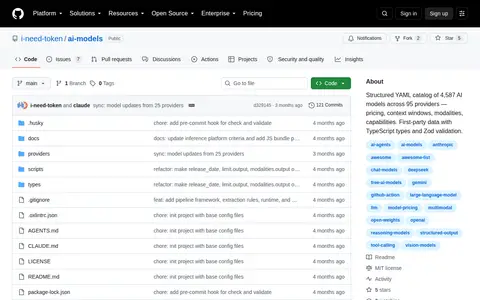
AI Models Catalog is a structured YAML catalog of AI model providers and their models, sourced from first-party APIs and official documentation. It includes TypeScript type definitions and Zod runtime validation schemas, plus scripts to sync data from providers and validate YAML files against schemas.
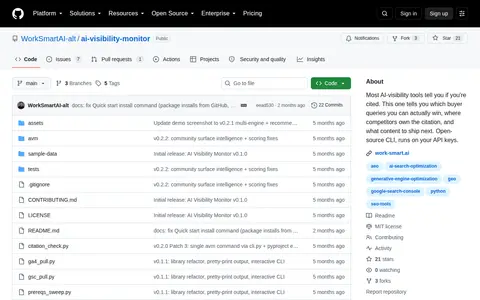
AI Visibility Monitor is an open-source CLI that runs buyer queries against ChatGPT, Claude, and Perplexity and reports which queries are winnable, source surfaces, and visibility trends. It runs on the user's own API keys, with no signup and no SaaS upsell.
AI-Chat-to-Visual is a Hugging Face Space developed by Agents-MCP-Hackathon. It allows users to upload datasets and generate visualizations by describing desired plots via chat, using the Altair library. The space is currently inactive and sleeping due to inactivity.
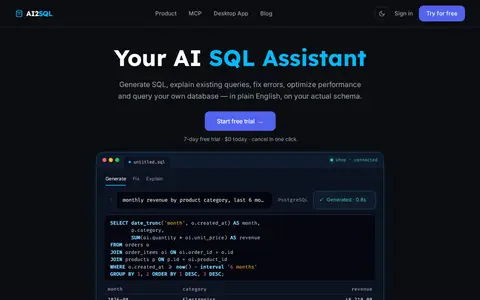
AI-powered SQL query builder enables you to quickly build SQL queries without any knowledge of SQL for beginners.
AICaller.io is a robocaller that makes automated outbound phone calls using AI for sales and marketing. It supports lead qualification, meeting booking, appointment booking and data gathering, offers a choice of voices, and connects to over 6,000 applications via Zapier. It can be used through a web portal or APIs.
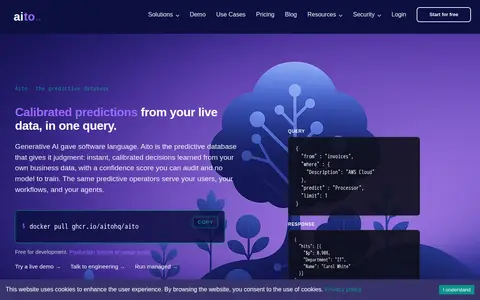
Aito.ai is a predictive database that delivers instant, calibrated predictions from a user's live data through single queries. It supports use cases including predictive accounting, ERP, e-commerce, and application functionality, with capabilities for predictions, recommendations, classification, smart search, knowledge graphs, and AI agents. It offers a free tier for development and production licensing scaled to usage.
Analyzes structured data and helps produce queries, insights or visualizations.
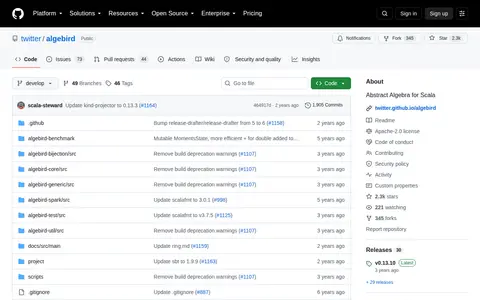
Algebird is an open-source Scala library developed by Twitter that provides abstract algebra functionality for use in Scala software projects. It is hosted and maintained on the GitHub platform for collaborative development.
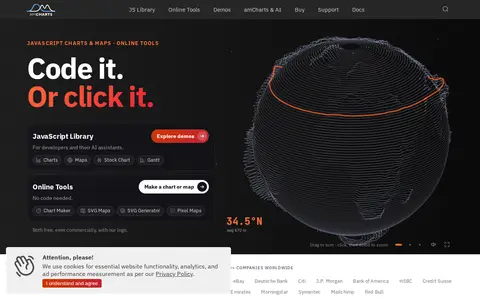
amCharts is a TypeScript library for JavaScript charts, offering 60+ chart types plus maps, stock charts, and Gantt charts. The site states the library is free to use and React-ready. Documentation lists React, Angular, Vue.js, Next.js, and other integrations.
Analyzes structured data and helps produce queries, insights or visualizations.
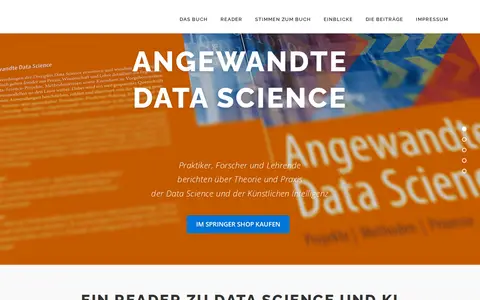
German book about applied data science.
AnyChart is a JavaScript charting library with an API and documentation. It offers a large number of chart types, and the site lists related products for stock charts, HTML5 maps and Gantt charts. Version 9.0.0 added chart types including arc diagram, dependency wheel, org chart, stream graph, waffle chart, lollipop and dumbbell. The library is described as working with any development stack.
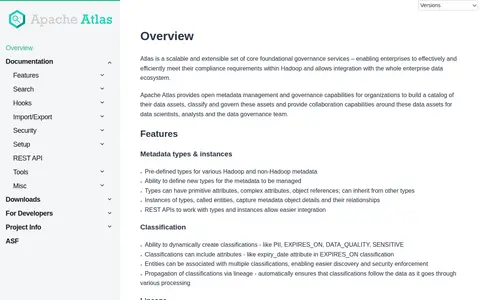
Apache Atlas – Data Governance and Metadata framework for Hadoop.
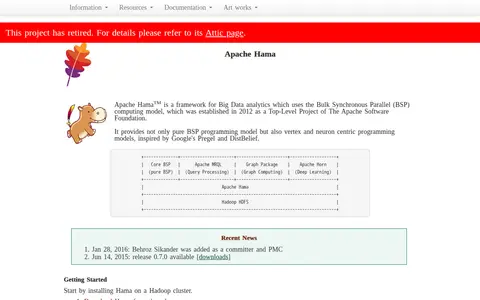
Apache Hama is a retired Apache Software Foundation Top-Level Project established in 2012. It is a framework for Big Data analytics that uses the Bulk Synchronous Parallel (BSP) computing model. It also provides vertex-centric and neuron-centric programming models inspired by Google's Pregel and DistBelief. Its components include core BSP, Apache MRQL for query processing, a graph computing package, and Apache Horn for deep learning, and it integrates with Hadoop HDFS.
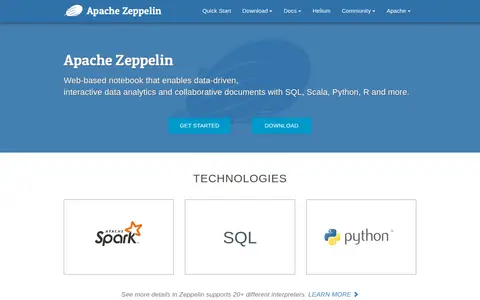
Apache Zeppelin is a web-based notebook for data-driven, interactive data analytics and collaborative documents with SQL, Scala, Python, R and more. It uses interpreters to plug in language and data-processing backends, including built-in Apache Spark integration, and includes basic charts, pivot charts, dynamic forms and paragraph publishing to embed results in websites.
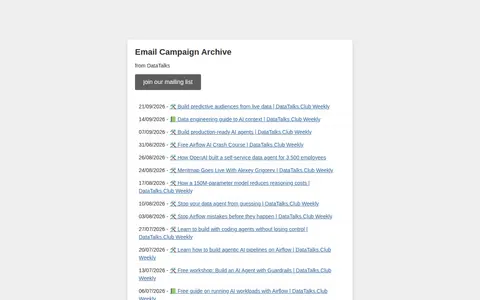
DataTalks.Club. A weekly newsletter about data-related things..
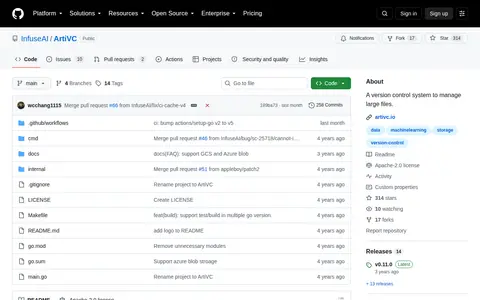
ArtiVC is a command-line tool for data versioning on cloud storage. It snapshots data and switches between versions, supporting commit history, commit messages, version tags, diffing commits, and pulling data from a specific version. Backends include local filesystem, remote filesystem over SSH, AWS S3, Google Cloud Storage, and Azure Blob Storage, with more through Rclone. No additional server is required.
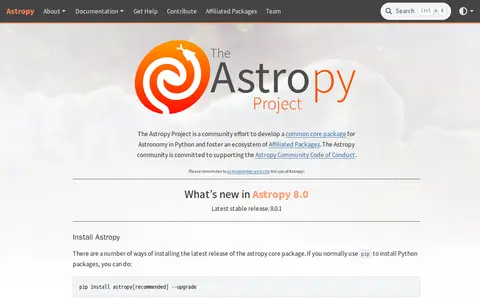
Astropy is a community effort to develop a common core package for astronomy in Python and foster an ecosystem of Affiliated Packages. Installation is available via pip and other package managers, and the project provides tutorials, documentation, and community help channels.
AutoRAG is a project developed by Marker-Inc-Korea that enables an agent to locate content on a user's computer. Its functionality improves with frequent use, and it includes an agent component with defined core values, architecture and operational details.
AutoViz is a Python library that automatically visualizes any dataset, any size, with a single line of code. It also offers the FixDQ() function for a quick assessment of dataset quality and fixing data quality issues. The project aims to provide an automated approach to exploratory data analysis through quick and easy data visualization plus data quality, abstracting away the complexities of various plotting libraries and techniques.