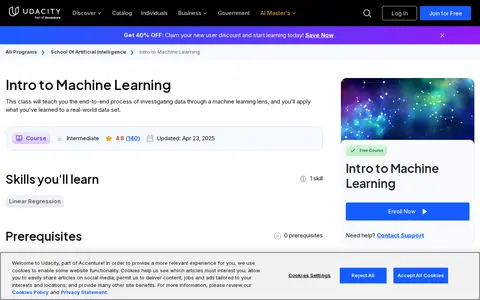

Sebastian Thrun’s Introduction To Machine Learning provides AI-assisted learning, courses, tutorials, or study support.
Directory
Search results
Published directory entries matching your search.

github.com
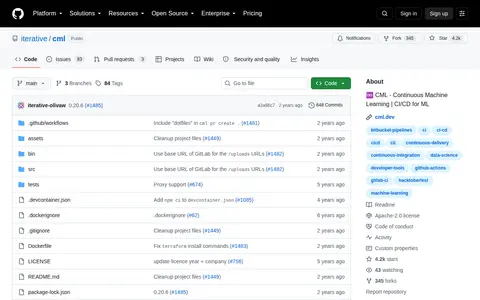
CML, or Continuous Machine Learning, is an open-source CLI tool for implementing CI/CD with a focus on MLOps. It is used to automate development workflows, including machine provisioning, model training and evaluation, comparing ML experiments across project history, and monitoring changing datasets. It can generate a visual report with results and metrics automatically on every pull request, using GitLab, GitHub, or Bitbucket.

github.com
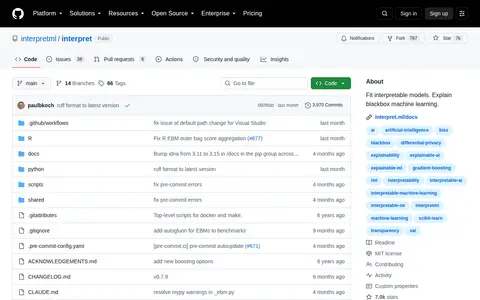
InterpretML is an open-source package that collects machine learning interpretability techniques. It allows training interpretable glassbox models and explaining blackbox systems, to understand a model's global behavior or the reasons behind individual predictions. It includes the Explainable Boosting Machine, developed at Microsoft Research, plus other glassbox models and blackbox explainers.

github.com
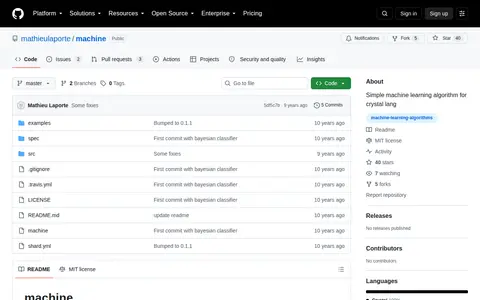
Open-source project that provides machine-learning models, research, training resources, or evaluation tools.

github.com
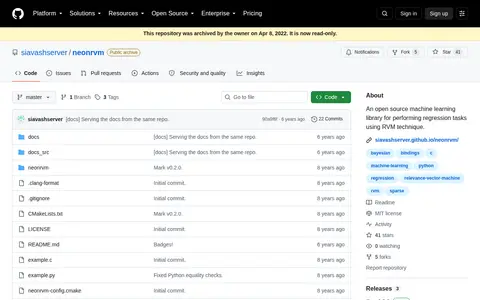
neonrvm is an open-source machine learning library for performing regression tasks using the Relevance Vector Machine (RVM) technique. It is written in Python and available on GitHub. The library aims to provide efficient implementations for RVM-based regression.

deepmarkets.substack.com
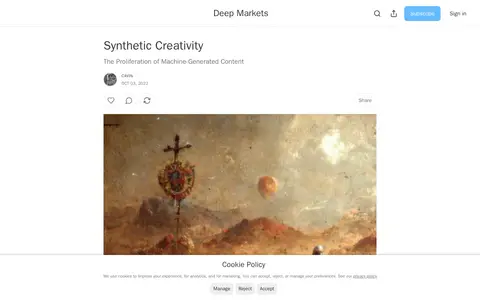
An article by Cavin on Deep Markets discussing machine-generated content and creativity. It describes technology as leverage over creation: writing, the printing press, the internet, digital tools and machine learning. It also covers synthetic text from large language models such as OpenAI's GPT-3, published in summer 2020.
github.com
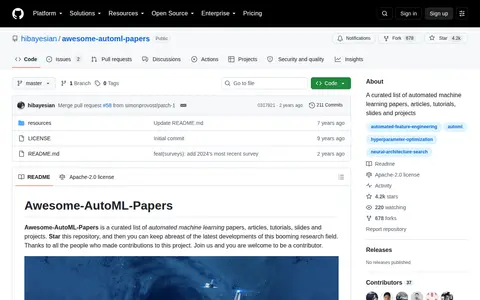
Awesome AutoML Papers is a GitHub-hosted curated list focused on automated machine learning (AutoML). It aggregates academic papers, articles, tutorials, slide decks, and related projects in the AutoML field, serving as a centralized reference for users exploring automated machine learning research and developments.
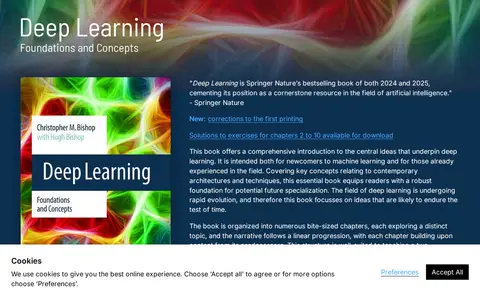

bishopbook.com
A book offering a comprehensive introduction to central ideas underpinning deep learning, intended for newcomers to machine learning and those already experienced in the field. It covers concepts relating to contemporary architectures and techniques and includes a self-contained introduction to probability theory. Hardback, PDF eBook, and a free-to-use online version are listed as access options.
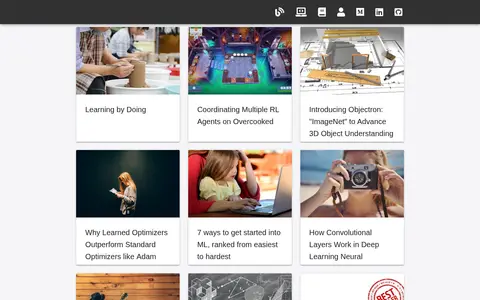

jinglescode.github.io
Hong Jing (Jingles) is a data scientist and Alibaba PhD student who writes about machine learning and neuroscience. The site collects blog articles on topics such as reinforcement learning agents, learned optimizers, convolutional layers, transformer models and decoding brain signals.
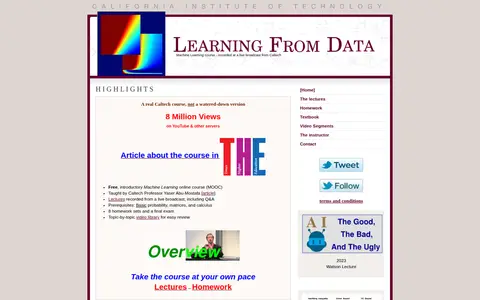
home.work.caltech.edu
An introductory machine learning course taught by Caltech Professor Yaser Abu-Mostafa, recorded from a live broadcast and available as a free online MOOC. It covers basic theory, algorithms and applications across 18 lectures, with homework sets and a final exam. Prerequisites are basic probability, matrices and calculus.

mlberkeley.substack.com
Alien Dreams: An Emerging Art Scene - ML@B Blog provides machine-learning models, research, training resources, or evaluation tools.

github.com
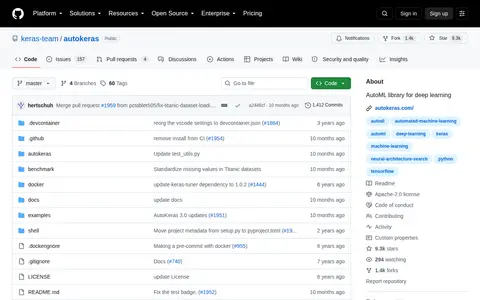
AutoKeras is an AutoML library for deep learning built on Keras, developed by DATA Lab at Texas A&M University. The project describes its goal as making machine learning accessible to everyone. It can be installed with pip, and the documentation states it is currently only compatible with Python 3.7 or later and TensorFlow 2.8.0 or later.

bigml.com
BigML is a machine learning platform for classification, regression, time series forecasting, cluster analysis, anomaly detection, association discovery, topic modeling and principal component analysis. Models can be used for predictions through remote services or exported and embedded into applications. A three-day free trial gives access to all functionality.
github.com
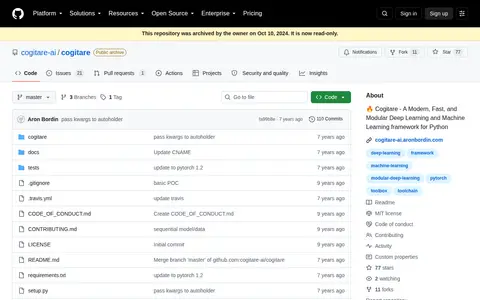
Cogitare is a modern, fast, modular deep learning and machine learning framework for Python built on top of PyTorch, with a user-friendly interface for beginners and advanced toolsets for experts.
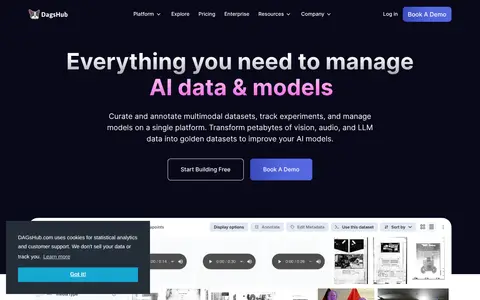

dagshub.com
DagsHub is an AI platform for managing the machine learning lifecycle, covering dataset curation and annotation, experiment tracking, and model management. It supports unstructured and multimodal data such as text, images, audio, video, and documents. The platform is built on open source tools and formats. DagsHub states it does not currently provide compute resources and relies on the user's own infrastructure.
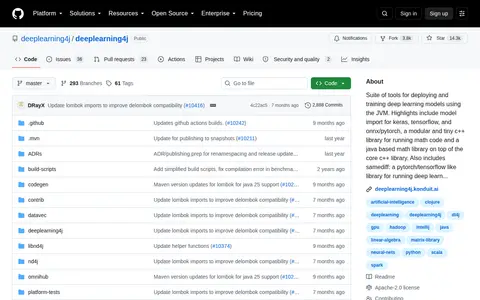
github.com
Deeplearning4j is an open-source suite of tools for deploying and training deep learning models using the Java Virtual Machine (JVM). It supports model import from Keras, TensorFlow, and ONNX/PyTorch, includes a modular C++ math library with a corresponding Java library built on top, and offers SameDiff, a library for deep learning operations similar to PyTorch and TensorFlow.
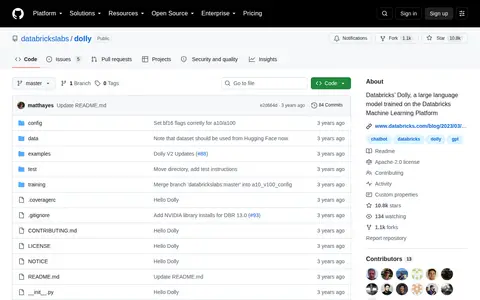
github.com
Databricks’ Dolly, a large language model trained on the Databricks Machine Learning Platform.

github.com
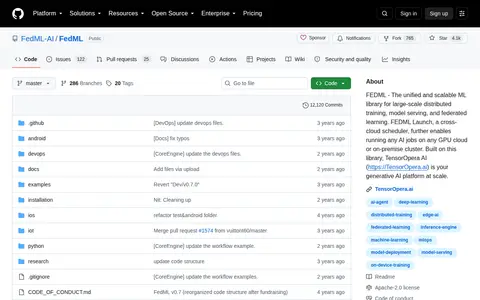
FedML is a unified and scalable open-source machine learning library for large-scale distributed training, model serving, and federated learning. It includes FEDML Launch, a cross-cloud scheduler for running AI workloads on GPU clouds or on-premise clusters, and forms the foundation of the TensorOpera AI generative AI platform.

github.com
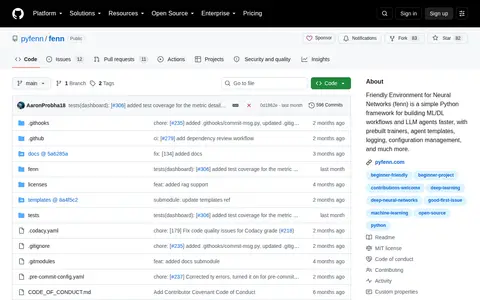
fenn is a Python framework for building machine learning and deep learning workflows and LLM agents. It provides prebuilt trainers, agent templates, logging, and configuration management, with YAML configuration parsed and injected into the entrypoint with CLI override support. It is released under the MIT license.
github.com
General Machine Learning library using Numenta’s Cortical Learning Algorithm.
iamtrask.github.io
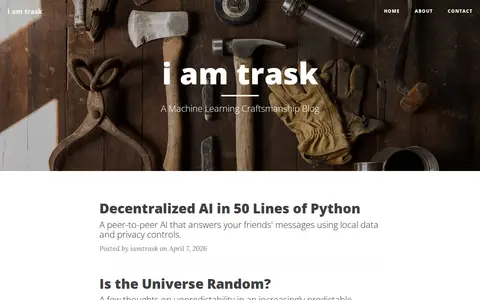
I am trask is a machine learning craftsmanship blog. Posts listed include Decentralized AI in 50 Lines of Python, Is the Universe Random?, Safe Crime Detection, Deep Learning without Backpropagation and Building Safe A.I.
github.com
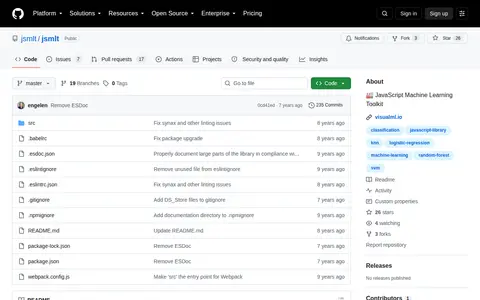
JSMLT is an open source JavaScript library for education in machine learning. It implements supervised learning algorithms, including SVM, random forest, decision tree, perceptron, neural networks, k-nearest neighbors and logistic regression, and provides visualization examples for exploring how the algorithms work.

github.com
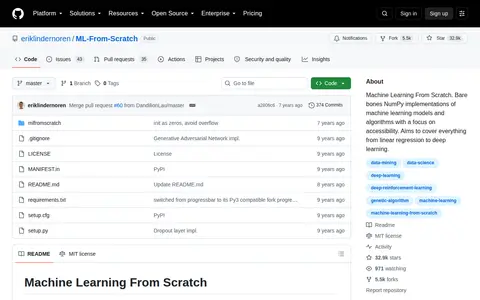
ML-From-Scratch is a GitHub repository that provides bare bones NumPy implementations of machine learning models and algorithms with a focus on accessibility, aiming to cover methods from linear regression to deep learning.

github.com
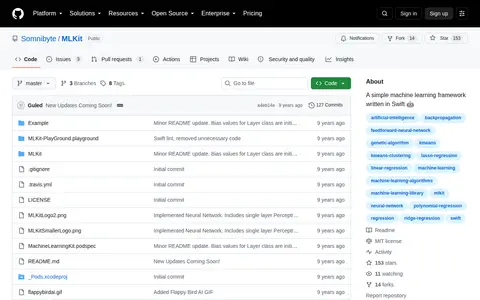
MLKit is a simple machine learning framework written in Swift. Currently it features algorithms dealing with regression, with planned expansion to classification, clustering, recommender systems and deep learning. The project is under active development and is not ready for use in commercial or personal projects, and can be installed via CocoaPods as MachineLearningKit.