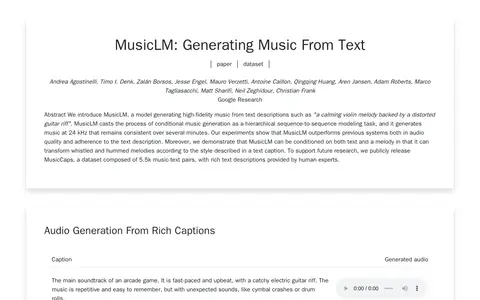
MusicLM is a model that generates high-fidelity music from text descriptions. It frames conditional music generation as hierarchical sequence-to-sequence modeling and produces audio at 24 kHz consistent over several minutes. It can also be conditioned on text and a melody, transforming whistled or hummed melodies according to a text caption. The project released MusicCaps, a dataset of 5.5k music-text pairs with descriptions by human experts.

Directory
Search results
Published directory entries matching your search.
MyVibe is a tool that uses AI to transform web projects into deployable applications. It allows users to upload, convert, and publish their web creations instantly, and is powered by ArcBlock.
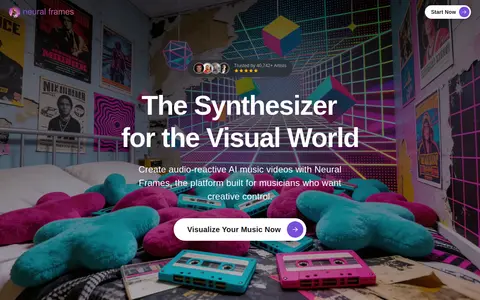
neural frames uses AI to create, edit, transform, or animate video content.
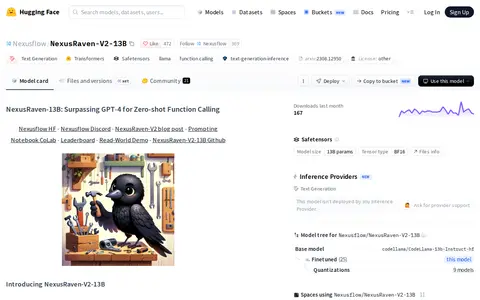
Nexusflow/NexusRaven-V2-13B is a 13-billion parameter language model available on Hugging Face. It is designed for zero-shot function calling and text generation, aiming to advance open-source artificial intelligence. The model can be used with libraries such as Transformers and provides instructions for deployment via inference providers, notebooks, and local applications.
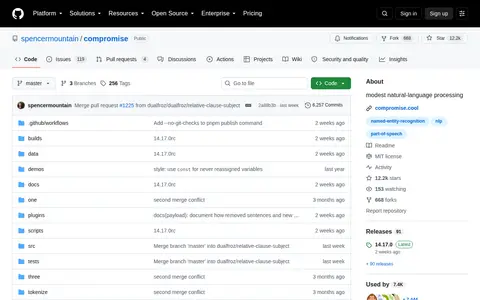
Compromise is a JavaScript natural-language processing library that turns text into data, offering tokenization of words, sentences and punctuation along with part-of-speech tagging, matching, and transformations such as verb conjugation and number handling. It runs on the client side, is about 250kb minified, and includes plugins, with multilingual support listed for French, German, Italian and Spanish.
Nuance presents itself as now part of Microsoft, offering productivity solutions including speech recognition and AI-powered solutions for physicians and radiologists in healthcare. The page highlights transforming workflows and improving patient experiences.
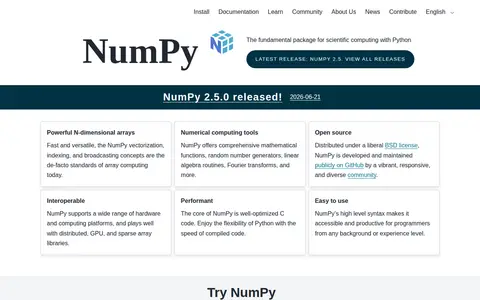
NumPy is a Python library providing a multidimensional array object and routines for fast operations on arrays, including mathematical, logical, sorting, Fourier transforms, linear algebra and random simulation. It is open source under a BSD license and is described as the fundamental package for scientific computing in Python, with core code written in optimized C.
NVIDIA AI is a suite of enterprise artificial intelligence solutions offered by NVIDIA. The portfolio includes accelerated infrastructure, enterprise-grade software, and AI models. Solution areas span agentic AI, inference, conversational AI, data science, and cybersecurity. The program aims to help organizations transform into AI-enabled enterprises.
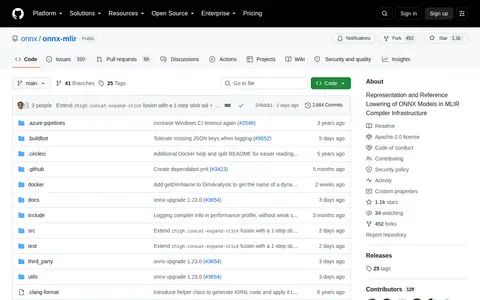
ONNX-MLIR provides compiler technology that transforms a valid Open Neural Network Exchange (ONNX) graph into code implementing the graph with minimum runtime support. It is based on LLVM/MLIR compiler technology and contributes an ONNX Dialect and a driver that lower ONNX graphs into MLIR files or LLVM bytecodes.
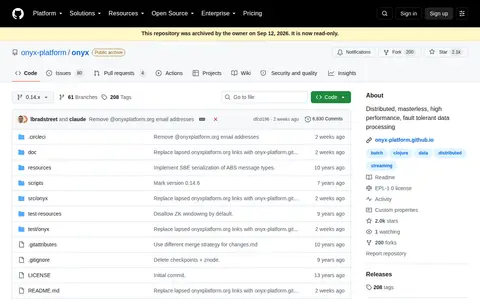
Onyx is a distributed, masterless data processing system written in pure Clojure, with a batch and stream hybrid processing model. The repository is archived and read-only. Listed uses include realtime event stream processing, extract, transform, load, and data cleaning.
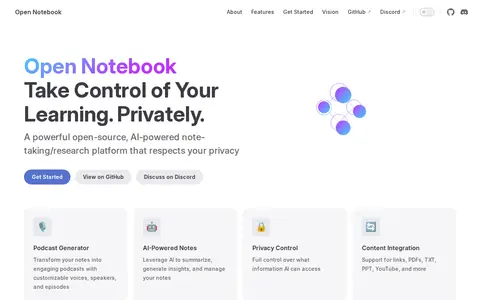
Open Notebook is an open-source, AI-powered note-taking and research platform focused on user privacy. It includes a podcast generator that transforms notes into customizable audio content, AI tools for summarizing notes and generating insights, granular privacy controls for AI data access, and support for integrating links, PDFs, text files, presentations, YouTube videos and other content types. The platform is designed for researchers, students, and learning enthusiasts.

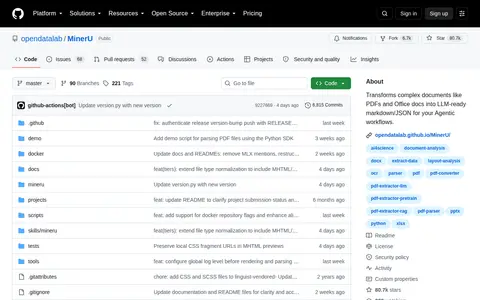
MinerU is a tool that transforms complex documents such as PDFs and Office documents into LLM-ready markdown or JSON for agentic workflows. It supports multiple input formats including PDF, images, DOC/DOCX, PPT/PPTX, XLS/XLSX, RTF, ODT/ODS/ODP, EPUB, OFD, HTML/MHTML and CSV/TSV. Version 4.0 offers four parsing tiers and a document library with search and citation locators, and documents are not automatically uploaded to the official service; remote parsing requires explicit configuration.

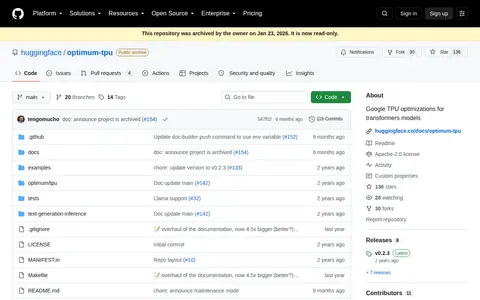
Optimum-TPU is a Hugging Face project providing Google TPU optimizations for transformers models, aiming to ease training and inference on TPUs. It supports text generation models including Gemma, Llama2, Llama3 and Mistral, and includes a text-generation-inference backend. The repository was archived in January 2026 and is read-only, with the project in maintenance mode.
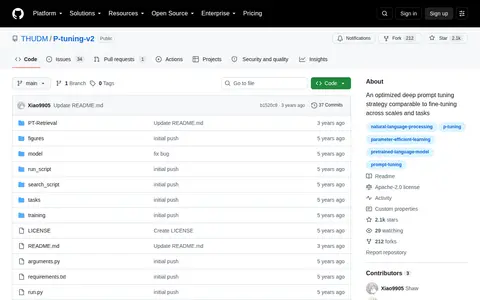
P-tuning v2 is an optimized deep prompt tuning strategy that applies continuous prompts to every layer input of a pretrained transformer. It is described as comparable to fine-tuning across scales and tasks.
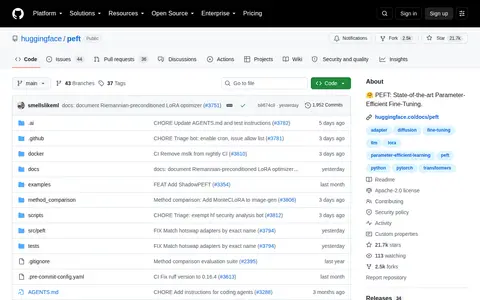
PEFT is a library of parameter-efficient fine-tuning methods from Hugging Face. It adapts large pretrained models by fine-tuning only a small number of extra parameters instead of all model parameters, which decreases computational and storage costs. It is integrated with Transformers, Diffusers and Accelerate.
Phenaki is a Google Research model that synthesizes realistic videos from textual prompt sequences. It uses an encoder-decoder tokenizer for variable-length videos and a transformer that translates text embeddings to video tokens, trained jointly on image-text and video-text data.
Pinokio uses AI to create, edit, transform, or animate video content.
PixVerse uses AI to create, edit, transform, or animate video content.
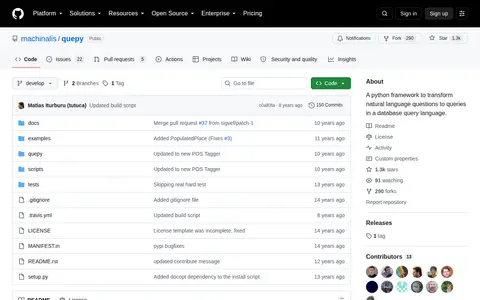
A python framework to transform natural language questions to queries in a database query language.
ray3.run uses AI to create, edit, transform, or animate video content.
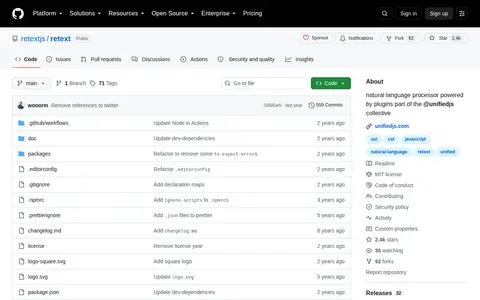
Retext is an ecosystem of plugins that work with natural language as structured data, specifically concrete syntax trees. It is a tool that transforms natural language with plugins, which can inspect and change the natural language. The repository is a monorepo containing packages for parsing English, Dutch and Latin-script prose and serializing syntax trees.
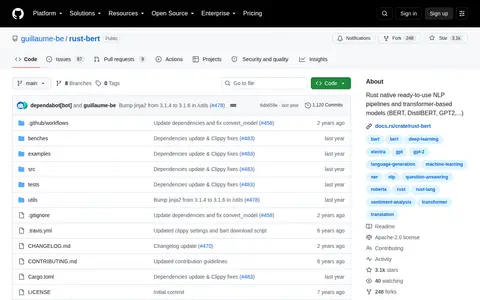
Rust native ready-to-use NLP pipelines and transformer-based models (BERT, DistilBERT, GPT2,...).
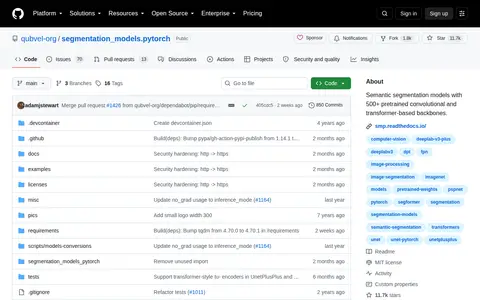
segmentation models.pytorch is a library that offers semantic segmentation models paired with more than 500 pretrained convolutional and transformer-based backbones. It is maintained as an open source project on GitHub.
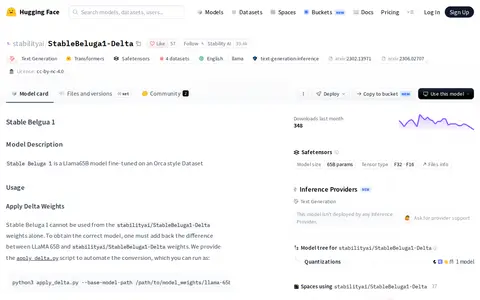
Stable Beluga 1 is a text generation model developed by Stability AI, released under a CC-BY-NC-4.0 license. It can be used with libraries such as Transformers, via inference providers, in notebooks, or in local applications.