
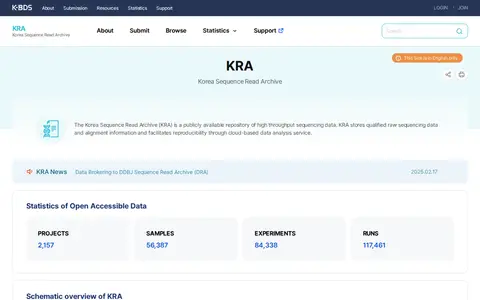
The Korea Sequence Read Archive (KRA) is a publicly available repository of high throughput sequencing data. It stores qualified raw sequencing data and alignment information and facilitates reproducibility through a cloud-based data analysis service. The site states it is in English only, and news notes restrictions on duplicate data submissions and data brokering to the DDBJ Sequence Read Archive.
Järfälla Municipality Open Data portal
Search a government or civic data catalog for reusable public information.
Links
Tags
-
0The Korea Sequence Read Archive (KRA) is a publicly available repository of high throughput sequencing data. It stores qualified raw sequencing data and alignment information and facilitates reproducibility through a cloud-based data analysis service. The site states it is in English only, and news notes restrictions on duplicate data submissions and data brokering to the DDBJ Sequence Read Archive.
-
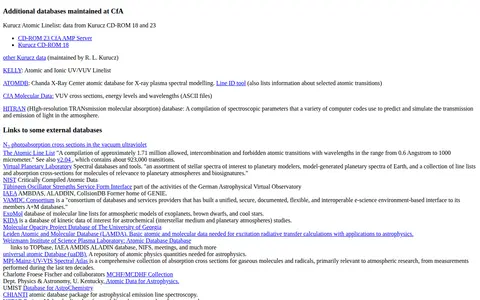
0The R. L. Kurucz atomic linelist is hosted among databases maintained at the CfA. The source describes it as data from Kurucz CD-ROM 18 and 23, with links to CD-ROM 23, the CfA AMP Server and CD-ROM 18. Other Kurucz data are maintained separately by R. L. Kurucz.
-
0The European Genome-phenome Archive is a service for permanent archiving and sharing of personally identifiable genetic, phenotypic, and clinical data generated for biomedical research projects or in research-focused healthcare systems.
-
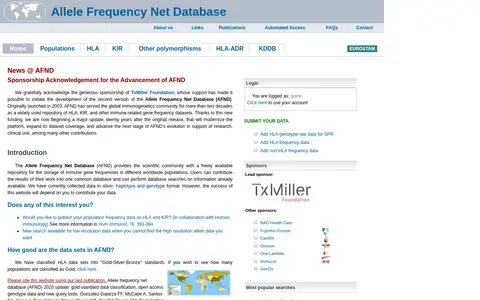
0The Allele Frequency Net Database is a freely available repository for immune gene frequencies in worldwide populations. Users can contribute allele, haplotype and genotype data and search existing records. HLA datasets are classified into Gold-Silver-Bronze standards, and a second version is in development.
-
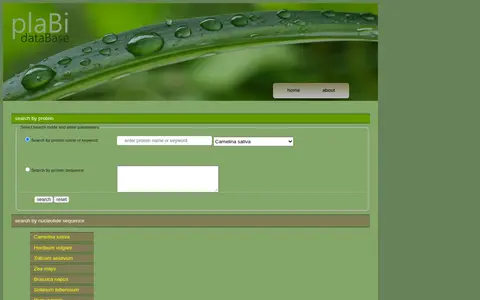
0PlaBi dataBase is a plant genomics portal focused on eight crop plants and Arabidopsis thaliana. It provides protein, cDNA and genomic sequences for protein-coding genes, PFAM conserved domains, a JBrowser genome browser for some plants, and orthologous protein search based on MCL clustering.
-
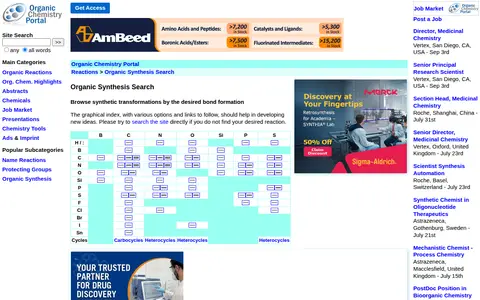
0A page on the Organic Chemistry Portal that lets users browse synthetic transformations by desired bond formation through a graphical index with links. It also explains target-oriented synthesis, which develops a short high-yielding route to a specific molecule via retrosynthesis, and diversity-oriented synthesis, which builds libraries of varied compounds for screening.
Community notes
Reviews and discussion
No reviews yet
Be the first to share how this project worked for you.
Join the discussion
Sign in with a verified account to leave a review or join the discussion.
Sign in to review