


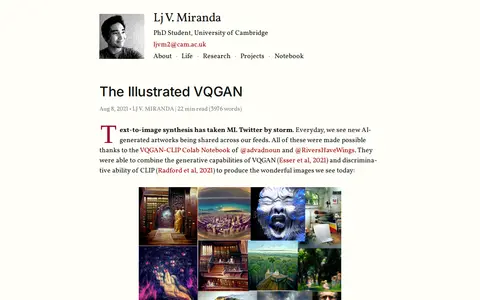
An illustrated explainer article on VQGAN, describing how the model generates images from text at a conceptual level and how VQGAN and CLIP work in tandem. It covers a theory of perception, using transformers to model interactions, expressing images through a codebook, and training the GAN and transformer.
GummySearch
Explore any niche. Discover pain points, content opportunities, and what solutions people are eager to pay for.
Screenshot unavailable. The listing stays available while a preview is prepared.
Links
Tags
-
0An illustrated explainer article on VQGAN, describing how the model generates images from text at a conceptual level and how VQGAN and CLIP work in tandem. It covers a theory of perception, using transformers to model interactions, expressing images through a codebook, and training the GAN and transformer.
-
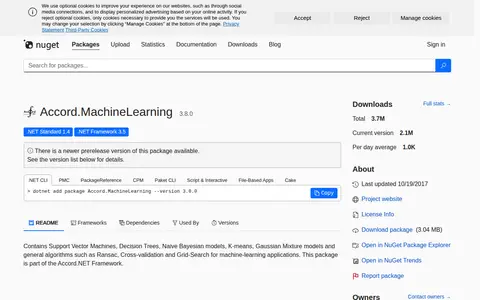
0Accord.MachineLearning is a NuGet package, part of the Accord.NET Framework, that contains Support Vector Machines, Decision Trees, Naive Bayesian models, K-means, Gaussian Mixture models, and general algorithms such as Ransac, Cross-validation and Grid-Search for machine-learning applications. Version 3.8.0 targets .NET Standard 1.4 and .NET Framework 3.5.
-
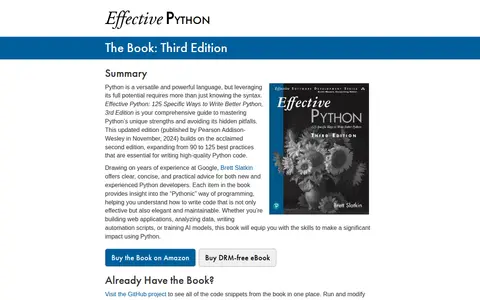
0Effective Python: 125 Specific Ways to Write Better Python, 3rd Edition is a book by Brett Slatkin, published by Pearson Addison-Wesley in November 2024. It expands on the second edition from 90 to 125 best practices for writing Python code, adds new chapters on robustness and performance, and covers the language through Python version 3.13.
-
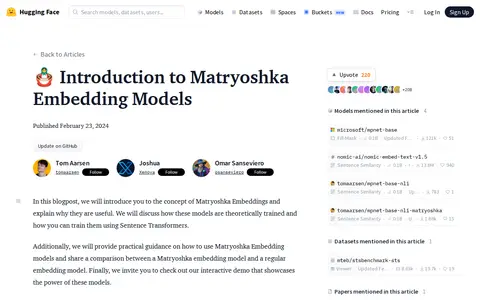
0A Hugging Face blog post introducing Matryoshka Embedding models. It explains embeddings as numerical representations and describes how Matryoshka models store more important information in earlier dimensions, allowing large embeddings to be truncated while remaining useful. It covers theoretical training and training with Sentence Transformers, with a comparison to a regular embedding model.
-
0
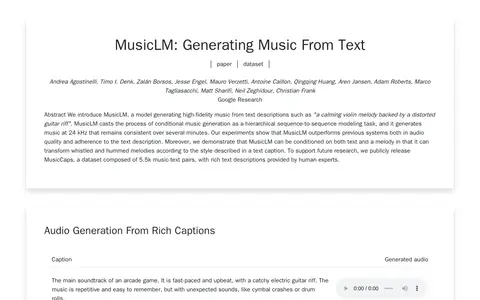
MusicLM is a model that generates high-fidelity music from text descriptions. It frames conditional music generation as hierarchical sequence-to-sequence modeling and produces audio at 24 kHz consistent over several minutes. It can also be conditioned on text and a melody, transforming whistled or hummed melodies according to a text caption. The project released MusicCaps, a dataset of 5.5k music-text pairs with descriptions by human experts.
-
0An article by Andy Baio examining how AI companies use datasets and models from academic and nonprofit research groups. It describes Meta's Make-A-Video using Shutterstock clips and YouTube videos collected by Microsoft, and notes nonprofit datasets used for Stable Diffusion and other models. It argues this outsourcing shifts accountability and legal liability away from corporations.
Community notes
Reviews and discussion
No reviews yet
Be the first to share how this project worked for you.
Join the discussion
Sign in with a verified account to leave a review or join the discussion.
Sign in to review