
huggingface.co
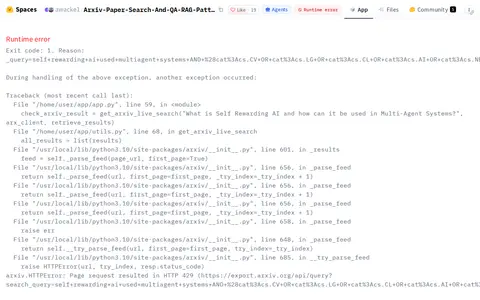
Interactive Hugging Face app that helps find, analyze or synthesize information for research and knowledge discovery.

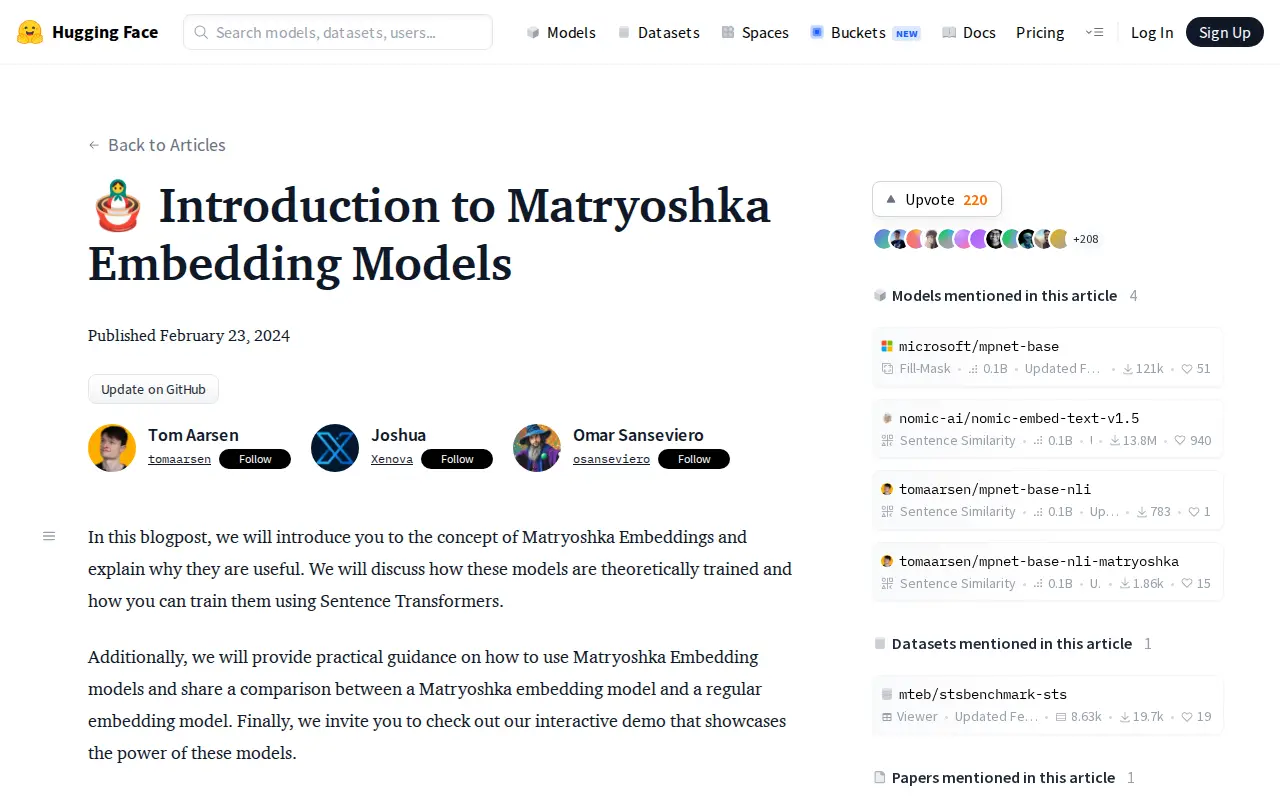
A Hugging Face blog post introducing Matryoshka Embedding models. It explains embeddings as numerical representations and describes how Matryoshka models store more important information in earlier dimensions, allowing large embeddings to be truncated while remaining useful. It covers theoretical training and training with Sentence Transformers, with a comparison to a regular embedding model.
Interactive Hugging Face app that helps find, analyze or synthesize information for research and knowledge discovery.

PromptEden monitors how brands appear in AI answers, compares competitors, and inspects cited sources. It also provides content creation with Eden and connects AI clients through the Model Context Protocol. Paid plans start at $49 per month.

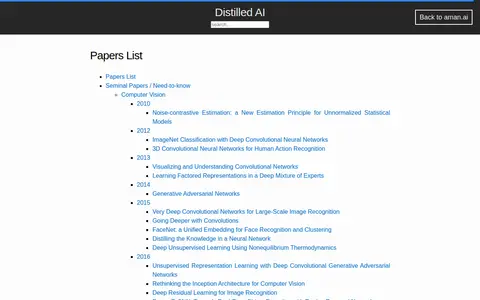
Aman's AI Journal papers list compiles seminal and need-to-know computer vision papers, organized by publication year from 2010 onward. Entries include titles such as ImageNet Classification with Deep Convolutional Neural Networks, Generative Adversarial Networks, and Deep Residual Learning for Image Recognition. The site also offers course notes and learning material for Artificial Intelligence and Deep Learning Stanford classes.

Cosmos generates 30-second video essays from a typed idea, with sourced facts, archive pictures, a voiceover and original music. Films can be made free up to three a day, with a watermark, and a clean 1080p MP4 can be bought for $9. No credit card is required to start and there is no subscription.

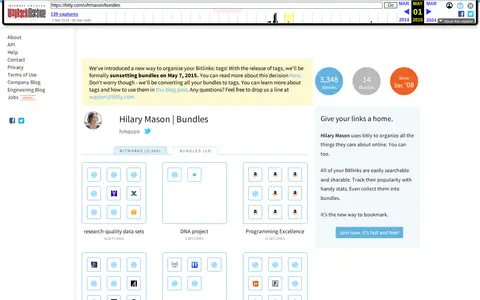
An archived Bitly bundles page belonging to Hilary Mason, listing link collections on topics such as research-quality data sets, programming, data stories and data science blogs. The page notes that Bitly sunset bundles on May 7, 2015 and converted them to tags.

The Journal of Artificial Intelligence Research (JAIR) is a journal dedicated to the rapid dissemination of important research results to the global AI community. Its scope encompasses all areas of AI, including agents and multi-agent systems, automated reasoning, knowledge representation, machine learning, natural language, planning and scheduling, robotics and vision, and uncertainty in AI.
Community notes
Be the first to share how this project worked for you.
Sign in with a verified account to leave a review or join the discussion.
Sign in to reviewKeep exploring
Interactive Hugging Face app that helps find, analyze or synthesize information for research and knowledge discovery.
PromptEden monitors how brands appear in AI answers, compares competitors, and inspects cited sources. It also provides content creation with Eden and connects AI clients through the Model Context Protocol. Paid plans start at $49 per month.
Aman's AI Journal papers list compiles seminal and need-to-know computer vision papers, organized by publication year from 2010 onward. Entries include titles such as ImageNet Classification with Deep Convolutional Neural Networks, Generative Adversarial Networks, and Deep Residual Learning for Image Recognition. The site also offers course notes and learning material for Artificial Intelligence and Deep Learning Stanford classes.
Cosmos generates 30-second video essays from a typed idea, with sourced facts, archive pictures, a voiceover and original music. Films can be made free up to three a day, with a watermark, and a clean 1080p MP4 can be bought for $9. No credit card is required to start and there is no subscription.
An archived Bitly bundles page belonging to Hilary Mason, listing link collections on topics such as research-quality data sets, programming, data stories and data science blogs. The page notes that Bitly sunset bundles on May 7, 2015 and converted them to tags.
The Journal of Artificial Intelligence Research (JAIR) is a journal dedicated to the rapid dissemination of important research results to the global AI community. Its scope encompasses all areas of AI, including agents and multi-agent systems, automated reasoning, knowledge representation, machine learning, natural language, planning and scheduling, robotics and vision, and uncertainty in AI.