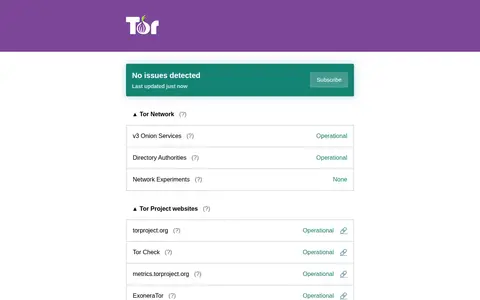

status.torproject.org
Official service-status page for Tor Project websites, bridges, directories and network services.
Recently added
Browse dated community launches and imported or editorial directory additions.
Official service-status page for Tor Project websites, bridges, directories and network services.

Official page that tests whether the current connection appears to be using the Tor network.

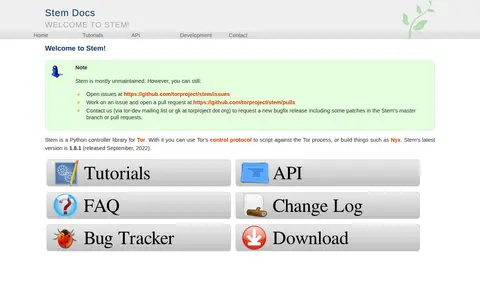
Stem is a Python controller library for Tor. It implements Tor's directory and control specifications, allowing scripts and applications to interact with the Tor process through its control protocol. The latest version is 1.8.1, released September 2022, and the project is noted as mostly unmaintained. It requires only Python.

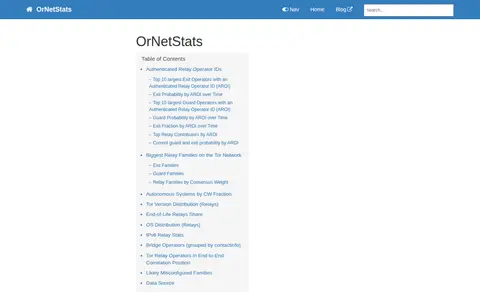
OrNetStats presents statistics and network health data about the Tor network and its relay groups. It reports on relay families, Autonomous System shares, MyFamily misconfigurations, end-of-life tor releases and potential risk to users, and displays Authenticated Relay Operator IDs in place of unverified ContactInfo strings.

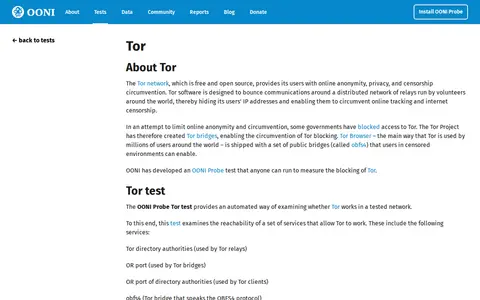
The OONI Probe Tor test provides an automated way of examining whether Tor works in a tested network. It measures the reachability of Tor directory authorities, OR ports and obfs4 bridge addresses. The Tor network is described as free and open source, providing online anonymity, privacy and censorship circumvention.
Tor measurement project collecting performance data for public relays, bridges and onion services.

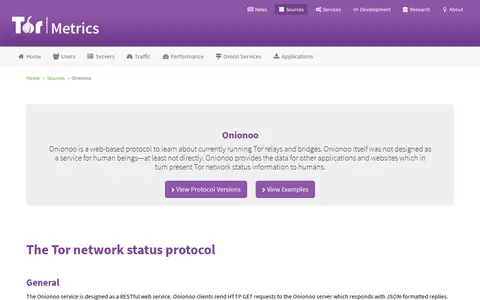
Protocol and API documentation for Tor relay and bridge status data used by network tools.

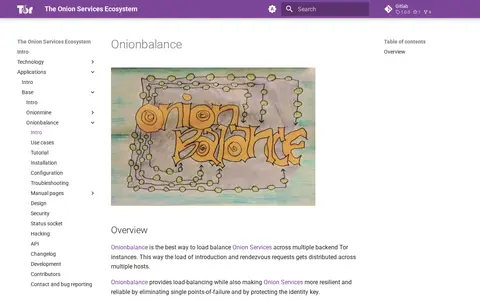
Load-balancing system for resilient Tor onion services, documented by the Tor onion-services team.

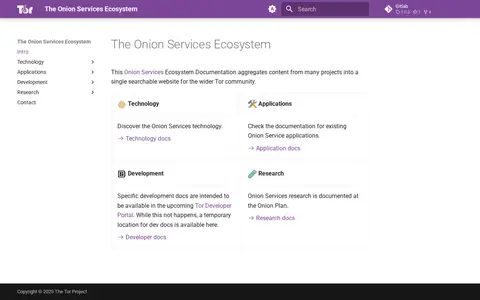
Tor Project documentation portal for onion-service applications, standards and operator tools.

Official guides for understanding, deploying and maintaining Tor onion services.

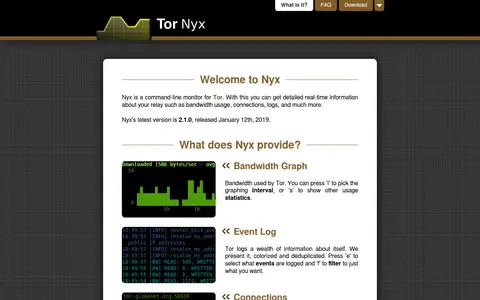
Nyx is a command-line monitor for Tor, providing real-time information about a relay such as bandwidth usage, connections and logs. It is a curses interface suited to ssh connections and tty terminals. It requires Stem 1.5.4 or later and works with Python 2.7 and greater, including Python 3.x.
Official source repository for the Tor network daemon and core protocol implementation.

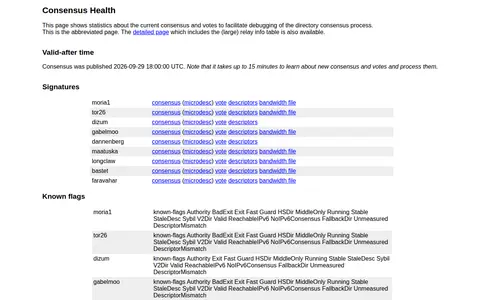
A page publishing statistics about the current Tor directory consensus and authority votes, including valid-after time, signatures, known flags, flag thresholds, the number of relays voted about, IPv6 statistics, consensus methods, recommended versions and consensus parameters. The page states that it is abbreviated and a detailed version with a relay info table is available.

Official Tor service distributing bridge relay addresses to users facing network blocking.
Official Rust implementation of Tor with developer documentation and project tracking.

UNODC report on darknet-enabled cybercrime threats and policy responses in Southeast Asia.
A Tor Project page that summarizes resources the project provides for research on improving Tor design, monitoring the Tor network, and studying attacks and defenses for anonymous communication systems. It points researchers to data collection, analysis guidance and measurement and attack tools.

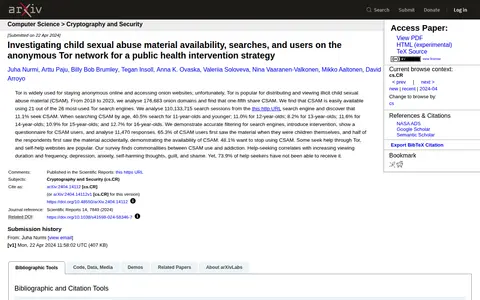
Public-health research measuring harmful-content availability and searches on the Tor network.

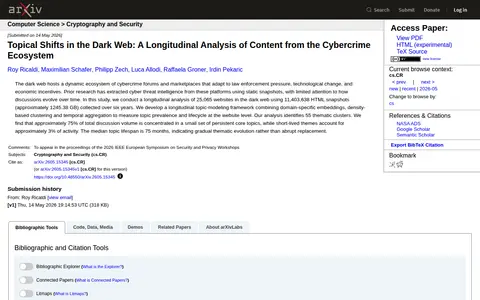
An arXiv paper presenting a longitudinal analysis of the dark web cybercrime ecosystem. The authors analyze 25,065 websites using 11,403,638 HTML snapshots collected over six years, applying a topic-modeling framework with domain-specific embeddings, density-based clustering and temporal aggregation. The analysis identifies 55 thematic clusters and measures topic prevalence and lifecycle at the website level.
RAND study of illicit online markets and the operational lessons they present for public policy.

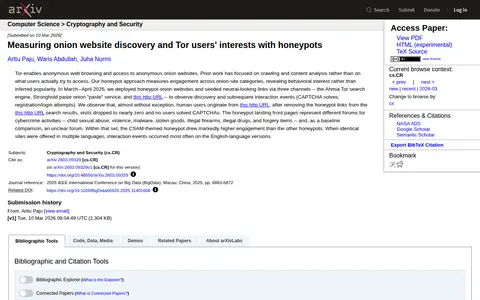
An arXiv paper measuring onion website discovery and Tor users' interests with honeypots. The authors deployed honeypot onion websites in March–April 2025 and seeded links via three channels to observe interaction events. They report that human users almost without exception originated from Ahmia.fi, and that the CSAM-themed honeypot drew markedly higher engagement than the others.

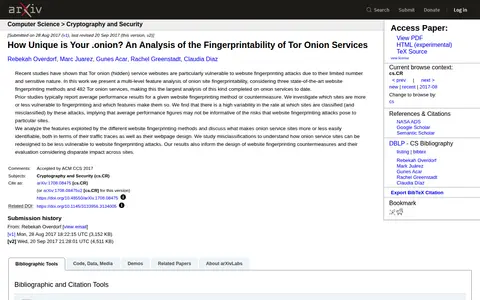
Study of whether website fingerprinting can distinguish and identify Tor onion-service traffic.

A working paper by John Schriner that focuses on how researchers monitor the Dark Web. It defines onion services and Tor and discusses tools for monitoring and securing onion services.

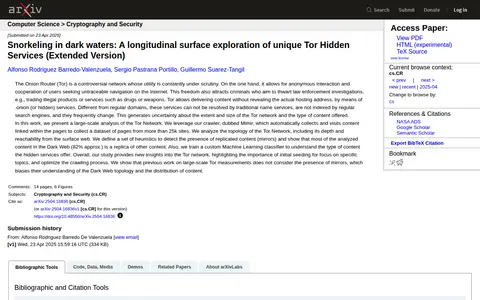
An arXiv paper presenting a large-scale analysis of the Tor network using a crawler called Mimir, which collects and visits linked content. The authors report a dataset of pages from more than 25k sites and examine network topology, replicated content and content types.