



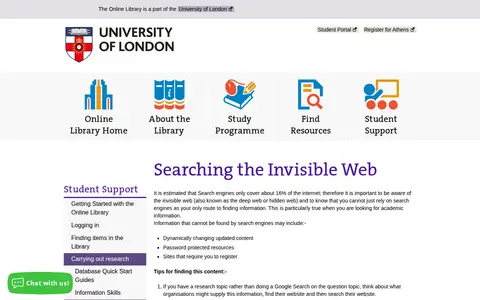
A library support page explaining the invisible web, also called the deep web or hidden web. It states that search engines cover about 16% of the internet and advises against relying on them alone, especially for academic information. It lists content search engines cannot find, such as dynamically changing content, password protected resources and sites requiring registration, and suggests web directories and asking a librarian.
OEDB Invisible Web Guide
Guide to search tools and databases that surface information outside conventional web indexes.
Links
Tags
-
0A library support page explaining the invisible web, also called the deep web or hidden web. It states that search engines cover about 16% of the internet and advises against relying on them alone, especially for academic information. It lists content search engines cannot find, such as dynamically changing content, password protected resources and sites requiring registration, and suggests web directories and asking a librarian.
-
0This arXiv paper by Dirk Lewandowski and Philipp Mayr provides a critical review of Bergman's 2001 study on the Deep Web. It introduces the concept of the Academic Invisible Web, defined as databases and collections relevant to academia but not searchable by general-purpose internet search engines, and reviews approaches for indexing it. The authors question Bergman's size estimate and suggest collaboration.
-
0An arXiv paper on digging deeper into hidden web databases limited by the top-k output constraint. It presents the GetNext meta-algorithm, which retrieves the next ranked tuple through a restrictive interface without prior knowledge of the ranking function, and algorithms that generate and execute multiple reformulated queries. Theoretical analysis and experiments over synthetic and real-world databases are reported.
-
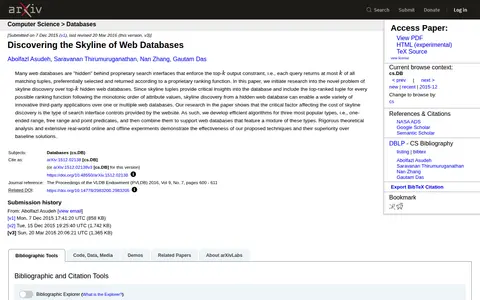
0An arXiv paper on discovering skylines over hidden web databases whose search interfaces enforce a top-k output constraint. It examines how search interface controls affect discovery cost and develops algorithms for one-ended range, free range and point predicates, combined for mixed interfaces. Experiments over real-world online and offline databases are reported.
-
0The Guardian SecureDrop is a tool for securely sending messages and documents to the Guardian. It uses the Tor network to hide where messages came from, and communication is encrypted in transit and on the server. Sources access it through an onion URL using the Tor browser.
-
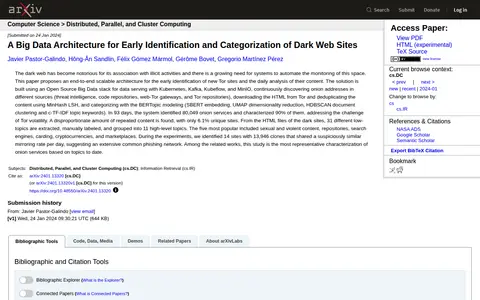
0This arXiv paper proposes an end-to-end scalable architecture for early identification of new Tor sites and daily analysis of their content. It is built on an open source big data stack including Kubernetes, Kafka, Kubeflow and MinIO, discovering onion addresses across several sources, downloading HTML from Tor, deduplicating with MinHash LSH and categorizing with BERTopic modeling. In 93 days it identified 80,049 onion services and characterized 90% of them.
Community notes
Reviews and discussion
No reviews yet
Be the first to share how this project worked for you.
Join the discussion
Sign in with a verified account to leave a review or join the discussion.
Sign in to review